Are you eligible for CMC if you work in telemetry, stepdown or a cath lab?
Sachi, CRNA
CRNA
In This Article (8 sections)
- What requirements do you need to check first?
- How many hours does CMC require?
- How should a telemetry or stepdown nurse audit assignments?
- What should a cath lab nurse check?
- Who should verify your hours?
- Does CMC eligibility mean your experience qualifies for CRNA school?
- Our Final Thoughts
- Take the Next Step
You may qualify for CMC from telemetry, stepdown or a cath lab. Your actual care, qualifying hours, license and base specialty certification decide that, rather than the unit name alone. Once you’ve checked those requirements, we recommend our CMC Review, questions and planner to help you prepare. You can explore them with the seven-day membership trial.
AACN lists settings beyond CVICU on its CMC certification page. So don’t rule yourself out because you work outside CVICU. But don’t count every scheduled shift as qualifying adult cardiac care, either. You need to show which hours involved the qualifying care.
Let’s work through the hours before you choose an exam date. If one type of assignment is unclear, describe it to AACN and ask whether it counts. You’ll get a more useful answer than asking whether an entire unit qualifies.
What requirements do you need to check first?
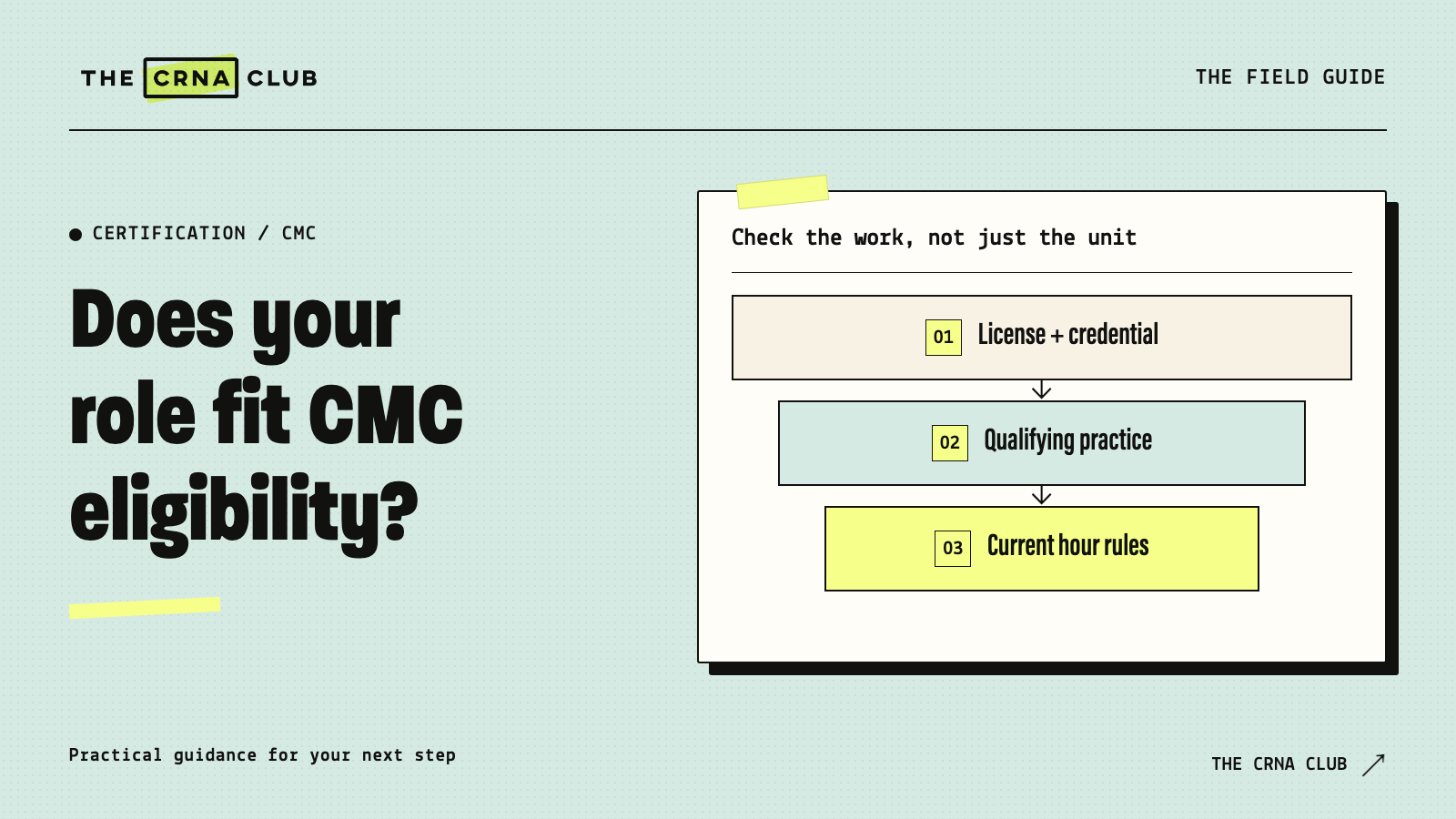
Check your license, base specialty certification and clinical practice separately. AACN requires a current unencumbered U.S. RN or APRN license and an eligible nationally accredited clinical nursing specialty certification. The CMC attaches to that base credential. Passing a preparation course doesn’t satisfy these requirements or replace the clinical-hour requirement.
Start a document with one row for each requirement and a place for the evidence. Record the license you currently hold and the base certification you intend to use. Check the current expiration dates before you build an exam schedule.
Don’t assume only AACN-issued base credentials qualify. The CMC and CSC FAQ explains the criteria for eligible clinical nursing specialty certifications and gives examples. If your credential isn’t straightforward, confirm it with AACN directly.
Keep the confirmation with your planning notes. An email explaining your exact credential and practice is more useful than a screenshot of someone else’s approved application. Their license, base certification, patient population or dates might differ from yours.
This is also a good time to separate certification from CRNA admissions. A base credential accepted for CMC attachment doesn’t automatically meet a nurse anesthesia program’s certification requirement. Each decision needs its own current source.
How many hours does CMC require?
AACN offers two clinical-practice routes with total, recent-year and adult cardiac-care requirements. Read the full wording for the route you intend to use. The adult cardiac hours are included within the qualifying total, rather than added on top. Meeting one number alone doesn’t establish eligibility for the whole route.
As checked November 3, 2026, AACN describes the following requirements:
| Requirement | Two-year route | Five-year route |
|---|---|---|
| Qualifying direct care of acutely or critically ill adult patients | 1,750 hours in the previous two years | At least 2,000 hours in the previous five years, subject to the full route requirements |
| Hours in the most recent year before application | 875 of the total | 144 of the total |
| Adult cardiac-care subset | 875 of the total | 1,000 of the total |
Use the current CMC eligibility wording and handbook when applying. The table is a planning summary. It doesn’t replace the rest of the requirements, including qualifying care, location and verification.
Notice how the columns work. For the two-year route, 875 recent-year hours and 875 adult cardiac hours describe separate checks within the total. Don’t silently replace the published wording with an assumption that every recent-year hour must be cardiac, or that all cardiac hours necessarily occurred in the most recent year.
Write both subsets in your ledger so you can show how you meet each requirement. If your documentation doesn’t distinguish them, improve the record before guessing.
How should a telemetry or stepdown nurse audit assignments?
Look at the patients you cared for and the care you provided. First identify the qualifying adult hours, then the cardiac hours within that total. We suggest keeping uncertain assignments in a separate column until you’ve asked about them. That way, you can explain the total instead of relying on a percentage you applied to every shift.
Build a private work ledger with these fields:
- Date range: Record the period covered.
- Qualifying adult direct-care hours: Enter supported hours that meet the care definition.
- Adult cardiac subset: Identify the qualifying hours involving the specified cardiac care.
- Recent-year subset: Identify qualifying hours within the required recent period.
- Evidence source: Use appropriate employer or assignment records.
- Unresolved question: Name the assignment or time category that needs clarification.
Avoid putting patient names or other unnecessary patient identifiers in a personal study file. Use appropriate employer processes to verify your work. The ledger is about eligibility hours and the nature of care, not a collection of patient charts.
Here’s a made-up two-year audit: 1,900 qualifying adult hours, including 920 adult cardiac hours, with 900 qualifying hours in the most recent year. Those figures clear the three numerical checks in the two-year column. Now change only the recent-year figure to 820. The total and cardiac subset still clear their checks, but the recent-year requirement does not. Keep the checks separate and confirm that the care and records meet AACN’s full criteria.
If the available record only supports a range, don’t present an exact total as verified. Describe the uncertainty and ask how AACN wants the situation documented.
What should a cath lab nurse check?
If you work in the cath lab, separate your patient-care work from your other duties. Which patients were you caring for? What did you do during procedures and recovery? Which hours were administrative? AACN lists cath labs as a possible setting, but you still need to match your actual work with its care requirements.
Write a brief description of your role before calculating the hours. Include the adult patient population and the direct care you provide. Then distinguish the portion of your schedule relevant to the requirement from time devoted to activities outside it.
A useful clarification question is specific: “My role includes these patient-care activities during these periods. Which of these hours meet the CMC direct-care definition, and what documentation should my verifier retain?” You aren’t asking AACN to approve a generic job title. You’re asking about a defined practice pattern.
Keep separate notes for any uncertainty about acuity, supervision or location. AACN’s page also describes eligible bedside supervision for certain roles and eligible practice locations. Review those details if they apply instead of assuming a rule from another certification.
Once the practice question is answered, you can plan the studying. Eligibility and readiness are different checks. A nurse who qualifies still needs to review parts of cardiac medicine outside their usual procedural cases.
Who should verify your hours?
Choose a clinical supervisor or qualifying professional colleague who knows your practice and can support the eligibility information. AACN identifies an RN or physician as a possible professional colleague and requests contact information for verification if an application is audited. Ask before naming someone, and give them the current criteria you used.
Prepare a short verifier packet containing the route, relevant date ranges, calculated totals and the basis for classifying the hours. Include unresolved categories rather than hiding them inside the total. Your verifier should understand what they are being asked to support.
For example, “I worked full time for two years” is too broad. A better packet shows the qualifying total, the recent-year amount and the adult cardiac subset, with the appropriate records behind each calculation. The explanation should remain understandable when someone reads it several weeks later.
Don’t ask a verifier to sign an estimate they can’t support. If records are incomplete, discuss a reasonable documentation method with the employer and AACN. Additional study, excellent practice scores or an approaching school deadline don’t remove the requirement.
Keep the final record secure and follow your employer’s rules for work information. You need enough support for eligibility without retaining unnecessary clinical details outside approved systems.
Once the eligibility question is resolved, our CMC Review offers teaching for the cardiac knowledge you will study. Explore those lessons and the certification planning tools through the seven-day membership trial to connect your next exam date with a workable preparation plan.
Does CMC eligibility mean your experience qualifies for CRNA school?
Earning CMC won’t change a school’s ICU requirement. You can meet AACN’s certification rules and still need different experience for a particular CRNA program. We suggest checking your target schools in our School Database, then asking the program directly about your role when its policy isn’t clear.
Our certifications beyond CCRN guide discusses certification planning in the larger application. Keep it beside a school-specific requirements list rather than using another credential as proof of admission eligibility.
Make two distinct questions in your application notes: “Am I eligible for this certification?” and “Does this program accept my clinical experience?” Attach the AACN answer to the first and the program’s answer to the second. This prevents one encouraging answer from being applied to a different decision.
If your school list requires a different experience background, account for the time needed to obtain it. Studying for CMC might still serve your professional goals, but it won’t change the dates or nature of the work already on your resume.
Our Final Thoughts
Start with the work you actually do. A telemetry, stepdown or cath lab title is neither automatic approval nor automatic disqualification. An honest hour audit and a clear eligibility question give you a much stronger starting point.
Get the uncertain details resolved before paying for an application or building your schedule around an assumed exam date. Then your study plan will rest on something solid.
Take the Next Step
Once you’ve confirmed eligibility, try our seven-day membership trial for CMC Review, questions and planning. Start with the cardiac topics you see least often at work. For your separate CRNA-school search, use the School Database preview to begin a shortlist with up to three saved programs, then confirm each school’s experience requirements.