Are CMC practice questions enough, or do I need more teaching?
Sachi, CRNA
CRNA
In This Article (11 sections)
- How do you know if CMC questions are enough?
- How do you identify where you need teaching?
- What would a simple case exercise show?
- What does a fuller explanation add to a rationale?
- How should you use references after a missed CMC question?
- When should you change your study activity rather than your resource?
- How do you check whether questions are too narrow for your needs?
- How should you judge progress after adding teaching?
- Where does a CMC course fit if you already own questions?
- Our Final Thoughts
- Take the Next Step
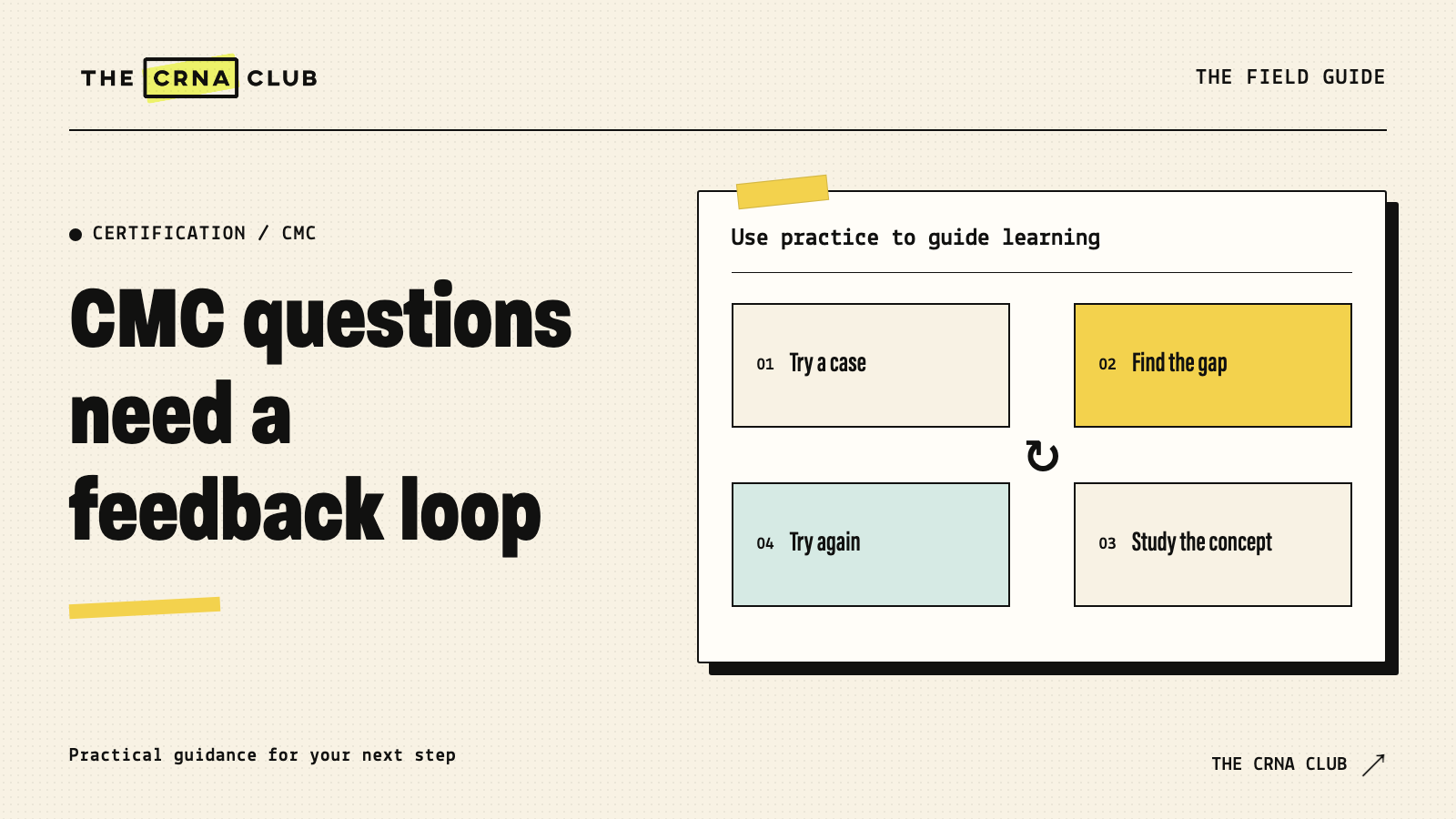
CMC questions are useful practice, but a short rationale won’t always teach a concept you’re missing. If the answer makes sense while you read it and falls apart on a different example, use a fuller explanation before another set.
We suggest our CMC Review in CRNA Club membership for those gaps. You get CMC teaching, questions and a planner together. Use the lesson to understand the relationship, practice it and schedule another check later.
You don’t have to stop using questions you already own. Give the missing explanation its own study time so the next attempt has something new behind it.
How do you know if CMC questions are enough?
They should help you see which explanations are available independently and which ones still depend on prompts or answer recognition. Review what information you used, why the choice fit and what remained uncertain. The result should point toward a defined learning task, not only another set size.
Use the applicable CMC test plan to keep coverage in view. That linked revision applies on and after November 19, 2026; earlier appointments need the applicable earlier official plan.
A question set samples material. It doesn’t guarantee every topic requiring review appeared, and a familiar high result doesn’t establish that an unfamiliar topic is covered.
Our certifications-beyond-CCRN guide gives broader credential context. Use your actual clinical scope and official eligibility separately from the practice result.
How do you identify where you need teaching?
Cover the choices and explain why the answer fits. Where do you get stuck? If you don’t understand the measurement or relationship, use the relevant CMC lesson. If you knew the concept but answered the wrong request, practice identifying what the question asks. Another course isn’t the automatic answer to every mistake.
Use these checks after practice:
-
You don’t understand what a variable represents: Foundational explanation and retrieval.
-
You know each value but cannot connect the profile: Worked interpretation and a changed example.
-
You recognize the correct choice only after seeing it: Explain without options, then check unfamiliar application.
-
You answer a different request from the stem: Restate the actual decision before choosing.
-
The rationale assumes knowledge you don’t have: Targeted teaching of that background concept.
-
You explain the reasoning clearly: Continue broader coverage and later application.
Use the point matching what happened in your session. It helps you choose the next task. You don’t need to turn these checks into another score.
What would a simple case exercise show?
Let’s check one relationship. Cardiac output is 6 liters per minute and body surface area is 2 square meters. Cardiac index is output divided by body surface area. Divide 6 by 2 and you get 3 liters per minute per square meter.
Now use output of 4.8 liters per minute and body surface area of 1.6 square meters. Divide 4.8 by 1.6. The index is still 3 liters per minute per square meter. Explain why the raw output changed while the indexed value stayed the same.
If you only recognize the first answer from a familiar question, the changed example exposes the gap. If you explain the denominator and carry the units, you have demonstrated more than answer memory.
This arithmetic doesn’t establish a diagnosis or treatment. It isolates one relationship so you see whether you understand it. A fuller clinical case needs additional reliable findings and context.
Use our hemodynamic teaching to separate what a number measures from how it fits the patient. If you understand the formula but can’t interpret a profile, choose the lesson for that next step. You don’t need more calculation cards to solve a different kind of gap.
What does a fuller explanation add to a rationale?
A fuller lesson walks through the steps a short rationale assumes you know. What does the information mean? How do the findings fit? Why does that choice follow? Work through the part you’re missing, then try a different example with the explanation closed.
A short rationale might state a conclusion accurately without giving you the background needed to follow it. Reading the same final sentence several times won’t necessarily build the missing relationship.
Find the exact question you need answered. “Why does this measurement belong in the interpretation?” is more useful than “I don’t understand CMC.” A targeted lesson or reference now has a defined job.
After reviewing, close the material and write the explanation in your own words. If you cannot do it yet, identify the smaller missing step rather than copying another polished paragraph.
How should you use references after a missed CMC question?
Use a credible source for the specific gap, then return to active retrieval. The CMC examination bibliography for the revised plan helps locate authoritative follow-up reading. It isn’t a requirement to buy every title or read each one cover to cover.
Find the reference section answering the part you still don’t understand. Read that section, close it and explain the idea. Save the location so you find it again after practice. A focused reading task helps more than adding the whole textbook to tomorrow’s unfinished list.
If a clinical explanation conflicts with another current authoritative source, compare the context and investigate. Don’t decide by whichever resource offers the most confident answer key.
Keep commercial question text within permitted use. A paraphrased learning question and source location usually support your notes without recreating a protected bank or collecting recalled examination items.
When should you change your study activity rather than your resource?
Change the activity when your materials already explain the topic but your sessions don’t check independent understanding. Passive review, immediate repetitions and rushed rationales sometimes leave the same gap despite adequate access. Try a clear learning task before replacing the whole stack.
Say you watch a lesson and repeat familiar questions until the score rises. Before moving on, explain the idea without either one open. Then try a changed example later. Those checks show whether you learned something you use beyond the first wording.
Another nurse uses active retrieval but the explanation remains unclear. A different teaching source or focused discussion now makes sense. The decision follows the actual problem, not a universal rule everyone needs more or less content.
How do you check whether questions are too narrow for your needs?
Compare the material you attempted with the full applicable outline and your own exposure gaps. A bank or personal topic selection sometimes emphasizes familiar acute cardiac content while leaving other areas insufficiently examined. Don’t infer broad readiness from a narrow set you enjoy answering.
For appointments on and after November 19, the revised plan includes noncardiovascular conditions as well as cardiovascular topics, interventions and monitoring. Read the detail instead of treating CMC as only a longer version of a familiar cardiac section.
AACN’s revision announcement explains the effective date and says existing materials remain useful. Audit the coverage of any product you use rather than assuming all current settings already implement the revision.
When a broad gap appears, assign teaching before expecting a large question set to supply everything through answer explanations.
How should you judge progress after adding teaching?
Look for a clearer independent explanation and better application to a different example. Record what changed in your reasoning. A larger familiar percentage alone doesn’t show whether the added teaching resolved the gap you identified.
A hypothetical weekly cycle includes a focused lesson, retrieval without notes and later unfamiliar practice. At the final check, the learner identifies which connection now makes sense and what still needs clarification.
If the explanation remains uncertain, revise the repair task. Perhaps the foundational definition is missing, or a comparison between two plausible choices needs a clearer source.
Our CCRN overview provides broader foundation context if you are building from that preparation. Keep the CMC scope as the source for the goal you are now pursuing.
Where does a CMC course fit if you already own questions?
Use it for identified explanations rather than treating every lesson as an automatic restart. Sample a difficult topic, retrieve it independently and judge whether the teaching changed your understanding. Check current coverage against the plan applying to your date.
Try CMC Review, practice and planning through the seven-day membership trial. Bring one concept a rationale hasn’t cleared up. Work through the lesson and answer a different example. You’ll be testing the teaching on the gap you need help with.
No preparation resource guarantees a passing outcome. Your useful check is whether you understand and apply the concepts more clearly while keeping the applicable scope covered.
Keep one sentence describing what the teaching changed in your reasoning. That makes the next progress check more informative than a question count alone.
Our Final Thoughts
Let practice identify the missing connection and give teaching a specific job. Work through the explanation, close the source and change the example. You should leave the session able to say what you learned, not only how many questions you completed.
Take the Next Step
Use the seven-day membership trial for CMC teaching beside questions and planning. Already have useful lessons? The free certification planner gives you one lifetime free plan to make room for explanation review and later practice.