Are CSC practice questions enough, or should you also use a cardiac-surgery reference?
Sachi, CRNA
CRNA
In This Article (9 sections)
- When is a question explanation enough?
- What signals you need a deeper reference?
- How do you choose a surgical reference?
- What should you do while reading the reference?
- How do you avoid reading far beyond the gap?
- How should you compare conflicting explanations?
- How do you know the extra reading helped?
- Our Final Thoughts
- Take the Next Step
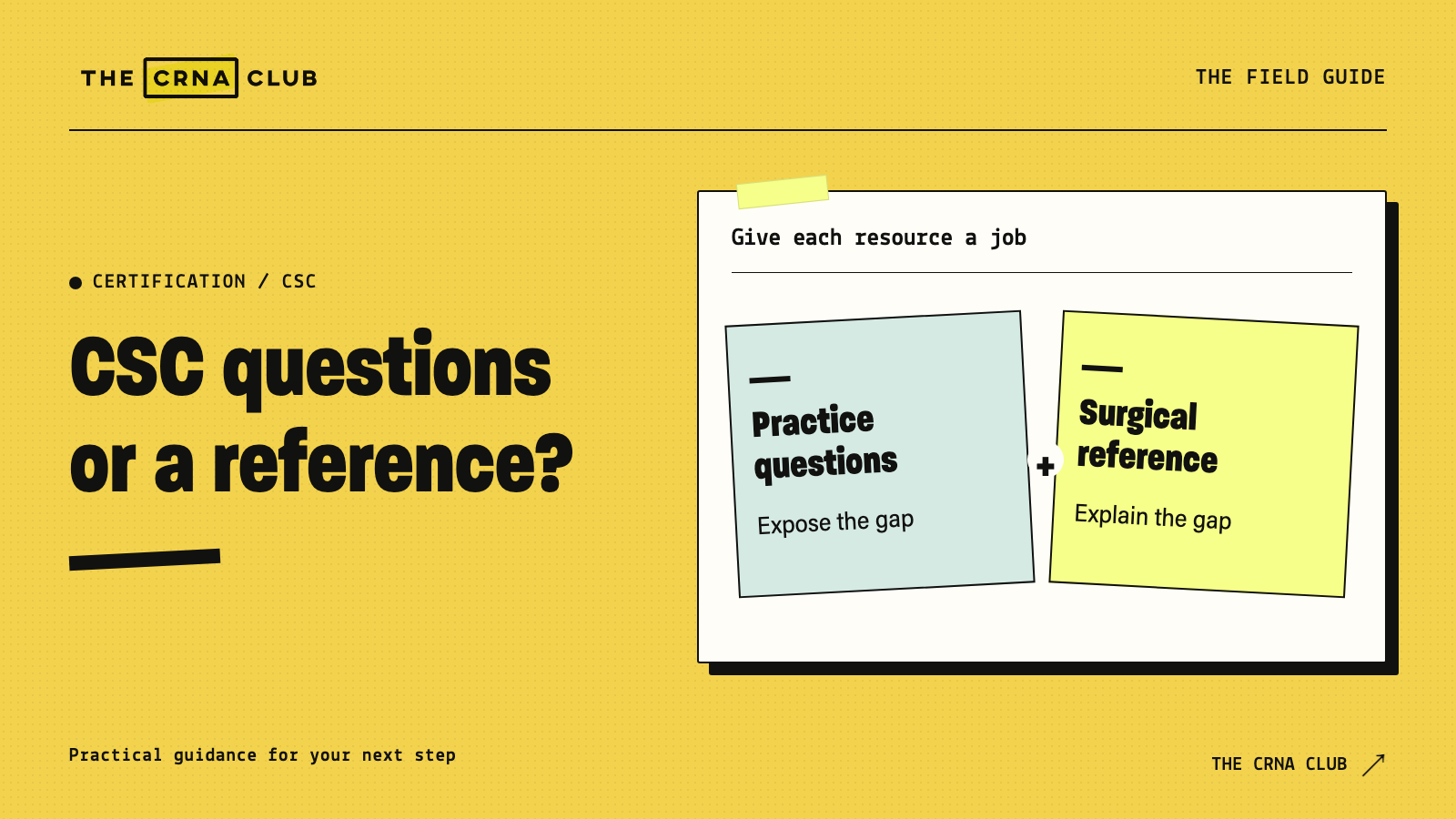
We suggest using our CSC questions to find what you still need to learn, then adding a cardiac-surgery reference when the rationale doesn’t explain enough. The seven-day membership trial includes CSC questions, a planner and shared cardiac lessons. Use the lessons for physiology or medication gaps, and surgical reading for the procedure-specific detail. You don’t have to choose questions or a book for every topic.
A good question explanation might be enough for a concept you already understand. For something you’ve never seen or learned properly, two sentences may leave too much missing. Recognize the difference before spending another evening repeating items you remember.
Start with the applicable AACN CSC test plan. It tells you what needs coverage. Your error log tells you where a short explanation needs more support.
When is a question explanation enough?
After reading the rationale, can you explain why the answer fits? Can you explain why another option doesn’t? If yes, try a different case later. If you only remember the right letter, keep working on the explanation. That is the difference between a useful correction and recognizing an answer you’ve just read.
Imagine you miss a question because you overlooked an explicit time detail in the stem. You understand the physiology and the rationale makes the error clear. Your next task may be careful interpretation of a new question rather than reading an entire surgical chapter.
Write the missed detail and explain how it changes the answer. Then choose an unfamiliar item with a similar type of decision. If your reasoning holds, you have useful evidence the correction carried over.
Keep the explanation short enough to say without looking. If you need to repeat the rationale word for word because you don’t understand the terminology, the review is unfinished. Look up the term and connect it with the patient situation.
A resource doesn’t need to be long to be useful. The useful question is whether it resolves your particular gap accurately. Sometimes one clear paragraph does. Sometimes you need a diagram and a fuller explanation before the short answer makes sense.
What signals you need a deeper reference?
Use deeper reading when the mechanism is unfamiliar, the surgical context is unclear or you can’t explain why plausible alternatives differ. Repeated misses on related cases are another reason to investigate. Choose the reference section that addresses the gap rather than rereading a whole book without a defined question.
Try this self-check:
- You recognize the answer but can’t explain the mechanism: Read the relevant physiology or treatment section.
- You don’t understand the procedure in the stem: Learn its purpose and postoperative implications.
- Two complications still seem identical: Compare their mechanisms and distinguishing information.
- The explanation conflicts with another source: Check current primary guidance and source dates.
- You misread the task despite understanding the content: Practice interpreting a fresh stem.
Choose the item that matches your miss. Now you’ve got a specific next step instead of another long question set on the same confusing topic.
For example, “I keep missing postoperative low-output questions” remains broad. “I don’t understand why the same pressure reading fits different mechanisms” gives you a reference question. Read with that question beside you, and note which measurements and clinical findings separate the possibilities.
If the problem persists, try another explanation or seek focused teaching. More repetition of a confusing rationale often preserves the confusion along with the answer.
How do you choose a surgical reference?
Choose a reference relevant to the named gap and appropriate for the current exam scope. Check its edition, clinical context and how it handles explanations. Use the official bibliography to identify suitable sources, while checking current clinical guidance for date-sensitive management facts. A bibliography is a resource map, not a requirement to buy every title.
AACN’s CSC bibliography includes cardiac-surgery, critical-care and related references. If you already have library access to a suitable source, begin there before purchasing another book.
For a nursing-focused explanation, we suggest Cardiac Surgery Essentials for Critical Care Nursing, 4th edition. For a perioperative reference lookup, Bojar’s Manual of Perioperative Care in Adult Cardiac Surgery, 6th edition is another named option in the revised bibliography. Begin with one you already have access to. If you understand the mechanism after reading the first source, you don’t need to buy the other for the same question.
Keep the source details in your notes. A page number and edition help you return later and recognize when two explanations come from different contexts or periods. Don’t copy an old numerical recommendation into a current study card without checking it.
Some physiology remains useful across editions while management recommendations evolve. Evaluate those separately. An older source isn’t automatically useless, and a familiar source isn’t automatically current enough for every treatment detail.
What should you do while reading the reference?
Write the question before you open the book. Read that section, close it, and explain what changed in your understanding. Then try a different CSC case. We suggest doing that before moving into another chapter, so you can tell whether the reading actually helped.
Use a focused reading note:
- The question I need answered.
- The explanation from the source, paraphrased briefly.
- The patient finding it helps explain.
- What would make me reconsider the explanation.
- A later practice task.
Consider a hypothetical learner studying postoperative hemodynamic compromise. The source describes several possible contributors rather than one fixed pattern. Her note should preserve that reasoning. She might write, “Low output requires comparing ventricular function, rhythm, filling and other case information.”
Now change the hypothetical case. Add a different rhythm or another finding. Does the explanation still fit? If not, describe why. The purpose of deeper reading is understanding the relationships well enough to respond to changed information.
Our hemodynamics and perfusion article supports one foundation for this work. Use a surgical reference for the postoperative details it doesn’t address. Keep the distinction clear in your study notes.
How do you avoid reading far beyond the gap?
Set a stopping question before you open the chapter. Stop the targeted reading when you can explain the named concept accurately, identify its limits and apply it to unfamiliar practice. Save adjacent questions for later if they aren’t necessary to understand the current one. This keeps reference work manageable alongside the full outline.
Suppose you’re reviewing a particular postoperative complication. Reading its mechanism and assessment is useful. Following every unfamiliar citation into a second chapter and then another can consume the session before you’ve checked the original explanation.
Write those additional questions in a parking list without giving them an urgent place in today’s plan. At the end of the week, compare the list with the applicable outline and your recurring errors. Give time to questions that serve a real learning need.
Avoid measuring success by pages read. A short section that changes your interpretation of a case is useful progress. Fifty highlighted pages without a clear explanation leave the review task unfinished.
If the chapter keeps using physiology you don’t understand, go back to the foundation first. Our cardiac lessons can help you work through pressure, flow or drug effects. Once those pieces make sense, return to the surgical explanation. It will be much easier to follow.
How should you compare conflicting explanations?
Identify the exact disagreement, check source dates and clinical contexts, and use current primary guidance or prescribing information where relevant. Don’t average two incompatible statements or choose the shorter one simply because it’s easier to memorize. Keep the unresolved point visible until you have a sound explanation.
Sometimes the disagreement comes from an oversimplified study sentence. A statement written as “always” may omit the patient conditions described in the fuller source. Restore the relevant conditions rather than preserving a shortcut that changes the fact.
Sometimes the sources concern different patient populations or time periods. Write those differences before deciding they truly conflict. A postoperative study case and a general medical scenario might require different context even when the medication or monitor has the same name.
The AACN CSC handbook and preparation page remain the starting point for exam-related questions. Current clinical authorities answer clinical management questions. A practice-bank rationale shouldn’t become the authority for an administrative eligibility rule.
If the discrepancy remains important and unresolved, seek clarification from a qualified educator or the relevant organization. Don’t hide uncertainty beneath a confident flashcard.
How do you know the extra reading helped?
Come back to the topic later with a question you haven’t seen. Can you use the patient findings to explain the answer? What would make you change it? That’s what we want the extra reading to help you do, beyond remembering the wording of the original rationale.
Keep a before-and-after note. Before: “I chose the answer because I recognized a word.” After: “I identified the patient problem, used the relevant findings and explained why another option fit less well.” The second note describes the learning you wanted.
Keep coverage in view too. Deeper reading is valuable, but one interesting topic shouldn’t consume the whole schedule while other domains remain untouched. Return to the outline and choose the next task from both unresolved errors and unfinished content.
Our Final Thoughts
Use questions for feedback and references for the explanations the feedback shows you need. You don’t have to choose one method for every topic.
A clear question, a targeted section and a fresh case make deeper reading useful. Keep the resource set manageable and let your understanding determine the next step.
Take the Next Step
Try our seven-day membership trial and start with a few CSC questions. Use the cardiac lessons when a foundation needs work, add surgical reading for the remaining detail, and schedule a later check in the CSC planner. Give each resource a clear use: learn the explanation, practice it, and come back to anything still unclear.