Are older CCRN books still useful after the 2025 exam update?
Sachi, CRNA
CRNA
In This Article (10 sections)
- What changed in November 2025?
- Which parts of an older book need separate checks?
- How do you compare your book with the current outline?
- How do you check coverage without delaying studying?
- When should you supplement instead of replace?
- How should you handle an old passing-score statement?
- Are older practice questions still worth using?
- What should your next purchase decision look like?
- Our Final Thoughts
- Take the Next Step
Keep an older CCRN book if its explanations help you. AACN says existing study materials remain useful after the November 12, 2025 revision. Compare your edition with the current outline, update old exam facts and add teaching where coverage is missing.
If your book leaves you needing clearer explanations or practice, we suggest our CCRN Toolkit. You get video lessons, CCRN questions and a planner. Use it beside the book for the topics you need, rather than replacing useful material because the cover has an earlier year.
The important question is specific: what does your book still explain well, and what do you need help learning now?
What changed in November 2025?
AACN introduced revised CCRN examinations for appointments on and after November 12, 2025. Use the applicable plan for your population and pathway. The revision changes what you should check for preparation alignment, while the underlying value of an older explanation depends on its accuracy and relevance.
The official revision announcement links current plans and bibliographies. It also states existing study materials remain useful. Read both points together before assuming every older reference needs replacement.
This article focuses on auditing materials. Our CCRN overview covers the broader certification context. Keep the official outline as the source for exact current examination scope.
A new edition sometimes includes useful updates. The decision to buy it should still answer a specific need, especially when much of your existing material explains concepts clearly.
Which parts of an older book need separate checks?
Check examination facts, clinical content and topic coverage separately. A resource sometimes teaches a mechanism accurately while listing an old passing score or historical domain weights. One outdated table doesn’t automatically invalidate every chapter, but it does give you a reason to audit carefully.
-
Examination structure and scoring: Compare the book with current AACN documents. Use the current official fact when they differ.
-
Domain weights: Check the applicable current test plan. Update your study allocation rather than following the old printed table.
-
Topic list: Compare the current outline with the contents. Look for missing teaching or a chapter using a different label.
-
Clinical explanations: Check a credible current clinical reference and investigate the exact disagreement.
-
Application and scheduling instructions: Read the current handbook and appointment information. Follow the current process rather than historical instructions.
-
Practice questions: Check relevant scope and explanations. Use them for learning while labeling familiar or outdated material honestly.
You don’t need a verdict on whether the whole book is good or bad. Keep the chapter helping you understand a topic. Correct the old exam table. Find another explanation for the section leaving you confused. Those are manageable actions you take while studying.
How do you compare your book with the current outline?
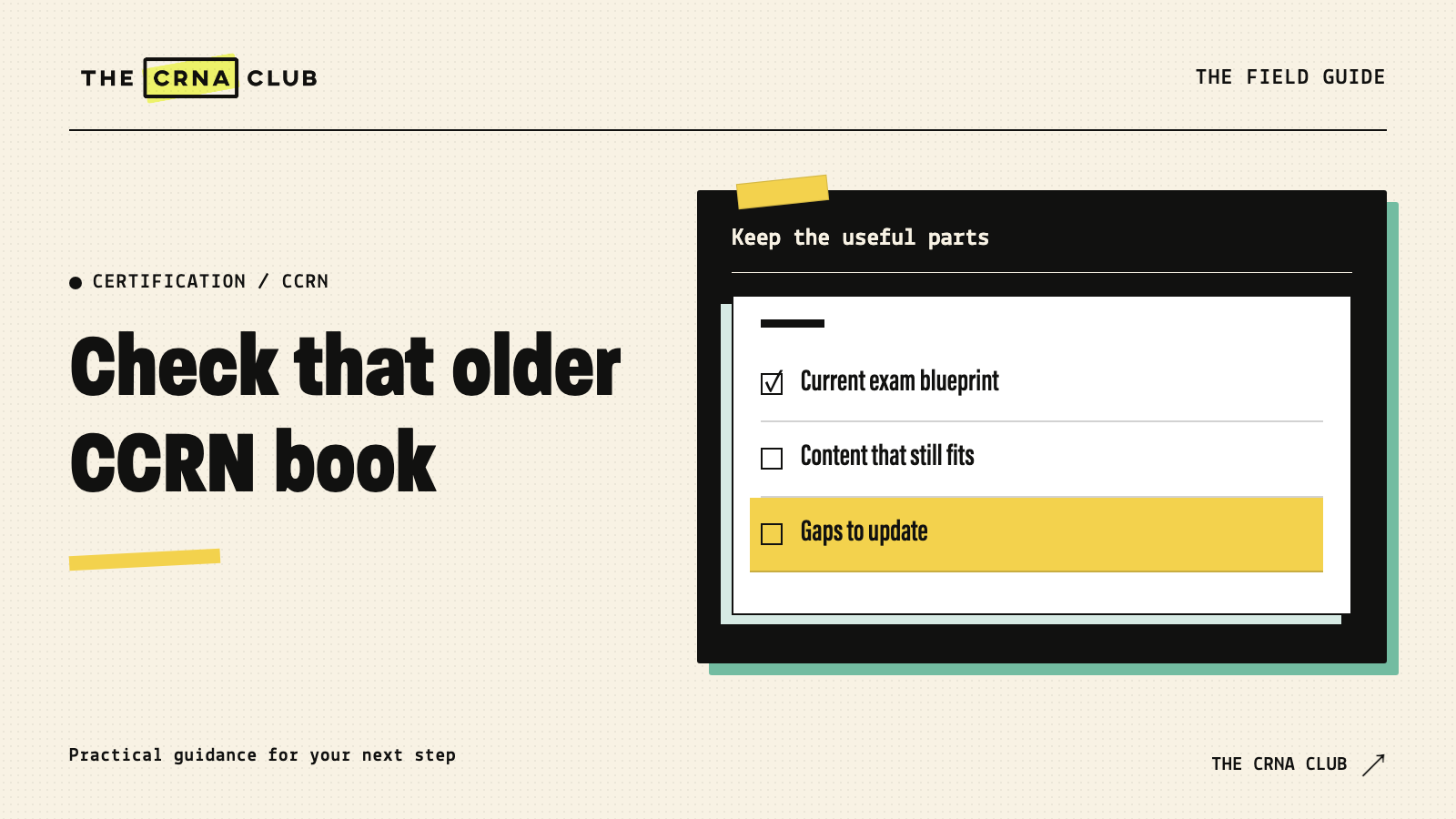
Put the official topic in one column and its location in your material in another. Add what you still need to learn. Search for related terminology before marking a topic absent, because an older book might explain it under a different heading. Keep the audit focused on finding teaching you will use.
Start with the current adult CCRN test plan if that is the examination relevant to your experience. Don’t use an adult crosswalk as a substitute for checking a pediatric or neonatal plan.
Here’s a worked example using the published contents of Elsevier’s Pass CCRN (Adult), sixth edition. The learning notes are hypothetical; chapter titles locate the teaching, not proof you have learned it:
| Study area | Location in my book | Learning status | Next action |
|---|---|---|---|
| Cardiovascular review | Chapter 3, The Cardiovascular System | Definitions clear; filling pressure versus flow still confusing | Use the matching explanation and a changed hemodynamic example |
| Renal review | Chapter 8, The Renal System | Recognize the topic; cannot explain the process | Read the relevant subsection, then use a focused lesson if still stuck |
| Neurological review | Chapter 5, The Neurologic System | Not checked yet | Compare its subtopics with the current outline before marking coverage complete |
| Professional Caring and Ethical Practice | Chapter 2 with that title | Need applied scenarios | Explain the patient need and why an action fits |
Use your own edition’s contents and index for exact pages. If you can locate the topic but still can’t explain it, record a teaching need rather than marking the row complete.
How do you check coverage without delaying studying?
Audit a manageable section, then study it. You don’t need a perfect spreadsheet covering every possible detail before opening a chapter. Work through coverage as you proceed, with a brief whole-outline check so large unfamiliar areas don’t remain invisible.
In your first session, check the edition and contents, then choose one unfamiliar topic from the current outline. Find the explanation in your book and try explaining it without looking. If a step is missing, write it down and use a focused CCRN lesson or reference for that part.
Next session, work on the missing explanation before adding more rows to your comparison sheet. The sheet should help you get to the teaching, rather than becoming another project to finish before you’re allowed to study.
Set a time limit for searching within a resource. If you cannot locate useful teaching after checking contents, index and related headings, record the gap and move to a credible supplement. Repeatedly searching the same book won’t add a missing explanation.
Suppose the book’s chapter explains a concept clearly, but its introduction gives historical domain weights. Keep the explanation in your crosswalk and use the official plan for allocation. In a different chapter, you locate only a definition where you need an applied explanation. Record that teaching gap separately. The first discrepancy changes a planning fact. The second changes the material you need for learning. Treating both as a single verdict on the entire book would make the next step less clear.
When should you supplement instead of replace?
Add teaching when your book is still helpful but leaves particular gaps. Our CCRN videos give you another way to work through those explanations. A full replacement makes more sense if broad areas are missing or you keep finding conflicts with current sources. Base that decision on what you find in the book.
A book with a few old examination facts might remain a useful teaching reference after you correct those facts in your plan. A resource leaving several broad areas unexplained creates a larger problem.
Also consider access you already have. Your institution sometimes provides clinical references or educator support. Check those options before buying several new products to fix one concept.
The AACN examination bibliography identifies references used in examination development. It helps you locate credible sources for a specific question. It isn’t a command to purchase every listed title.
How should you handle an old passing-score statement?
Use the current official examination source and label historical numbers as historical in private notes. Don’t let an old raw cut score or rounded percentage become your practice target. Examination scoring facts and commercial practice results answer different questions, even when both appear as percentages.
This matters because older lessons and study discussions sometimes repeat scores long after a revision. A confident explanation doesn’t make the number current.
Check the date and applicability before using any number to decide what remains in your plan. If you don’t need the historical comparison, leave the old value out entirely. Your preparation doesn’t benefit from remembering several obsolete thresholds.
The same approach applies to fees, identification instructions and appointment changes. Follow current official materials for actions you will take, rather than relying on a book’s original publication date as a guarantee.
Are older practice questions still worth using?
Older questions sometimes help review concepts, but check their explanations and scope. Familiar questions are useful for retrieval after learning, while fresh practice gives you a different check of application. An old bank’s percentage doesn’t establish current examination readiness or validate outdated content.
If a question seems inconsistent with a current authoritative explanation, identify the specific conflict. It might involve context, terminology or a changed recommendation. Investigate before committing the answer to memory.
Keep a short note when you exclude or revise a learning point. That prevents you from repeatedly encountering the same discrepancy and wondering whether you already checked it.
Avoid looking for recalled examination items to compensate for an older resource. Current scope and credible explanations are the appropriate starting points for updating your plan.
What should your next purchase decision look like?
Finish the sentence: “I need this resource because my current material doesn’t help me do this specific learning task.” Then test a sample against that task. If the new explanation resolves the gap and fits your calendar, you have a reason to consider it.
Try our CCRN review through the seven-day membership trial with a topic your book hasn’t explained clearly. Work through the video and practice the concept. You’ll be checking the help you need before deciding how to combine your resources.
Don’t buy another resource because an older date makes you nervous. Choose it because you tried the explanation and understood something you couldn’t explain before. That gives the purchase a purpose and your next session a starting point.
And if urgency comes from admissions timing, review CCRN application requirements versus strategy. Verify the policy driving your calendar before making expensive changes to the plan.
Our Final Thoughts
Keep useful teaching and correct the parts requiring an update. A version audit should leave you with a current official outline, reliable explanations and a short list of specific gaps. You don’t need an entirely new shelf to make that happen.
Take the Next Step
Use the CCRN Toolkit for video teaching, CCRN practice and planning alongside your useful references. If you want to start with the calendar, the free certification planner includes one lifetime free plan. Put the gaps you found into actual study blocks.