Can a high CCRN score make up for a low GPA when applying to CRNA school?
Sachi, CRNA
CRNA
In This Article (11 sections)
- Does a CCRN result change a GPA calculation?
- What do published program requirements tell you?
- What does the high score contribute?
- How do you distinguish a minimum requirement from an academic weakness?
- What if your recent grades are much better than your older grades?
- Should you retake CCRN for a higher score or take a course?
- How should you describe the result in an application?
- What should you ask a program when the policy is unclear?
- How do you turn this into a practical next step?
- Our Final Thoughts
- Take the Next Step
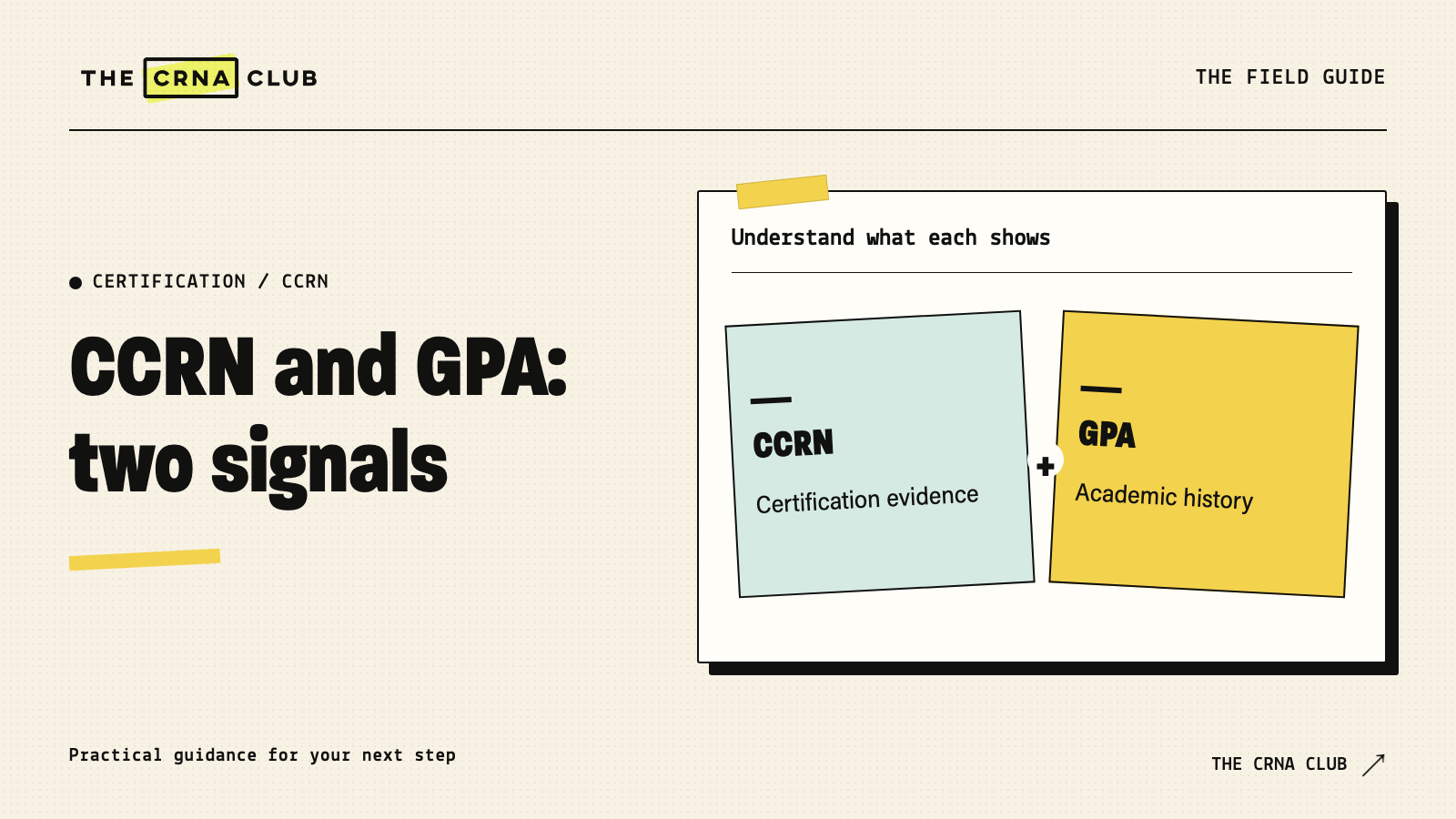
A high CCRN score doesn’t change your GPA or automatically waive an academic requirement. Be proud of the result, then look at what your transcript still needs to show. The next useful step might be a particular course, rather than another certification exam.
Start with our free Transcript Analyzer to review your academic record. It includes one lifetime free analysis. Then use our School Database to compare target programs and confirm which GPA calculations and prerequisites each one uses.
We suggest making that comparison before spending more time chasing a higher CCRN score. You want the next task to address the part of the application needing work.
Does a CCRN result change a GPA calculation?
No. A certification examination result doesn’t add academic grade points or remove prior coursework from a GPA. Program-specific policies determine which courses and attempts enter a particular calculation. Find those rules and calculate the relevant GPAs before deciding what your transcript needs.
Look at more than one GPA when the program uses more than one. Your cumulative GPA might include an older degree while your recent nursing or science work is much stronger. Our Transcript Analyzer helps you review those patterns. The school’s rules still decide which courses belong in its calculation.
Think about two nurses with the same cumulative GPA. You have weak grades in an older degree and stronger recent nursing work. Another nurse has recent weak science grades. The overall number matches, but the transcripts show different work to address. A CCRN score won’t explain that difference for you.
For a simple GPA example, 30 graded credits at 3.0 represent 90 quality points. A new three-credit A adds 12 points: 102 divided by 33 gives about 3.09, if all those credits belong in the calculation. A CCRN score adds no graded credits or quality points. That is why a course changes the arithmetic and a certification result doesn’t. Use your school’s actual inclusion and repeat rules before planning from that example.
What do published program requirements tell you?
Read current academic requirements and certification instructions separately. A program requesting CCRN still has its own transcript expectations. A published GPA minimum doesn’t disappear because another part of the application is strong, unless the program explicitly describes an applicable exception or process.
For example, Ohio University’s current admissions page lists an undergraduate GPA requirement alongside its CCRN requirement. Those are separate stated criteria. Don’t interpret the credential as permission to ignore the academic condition.
Wake Forest’s current application guidance describes a multifactor selection process and discusses academic performance. That supports checking the whole record, but it doesn’t publish a universal formula trading a CCRN point for a GPA fraction.
These examples were checked November 3, 2026. Use the current requirements for your own application cycle. One program’s wording doesn’t establish another’s policy.
What does the high score contribute?
Report it accurately when requested and use the preparation to build clearer clinical explanations. A strong examination performance is one piece of evidence in your record. Without a published program rule, don’t assign it a specific admissions weight or assume it cancels an identified academic weakness.
You don’t need to minimize the work involved. Studying while working and learning unfamiliar material are real efforts. Keep the explanation factual rather than claiming the score proves you will earn particular grades in a different graduate curriculum.
If a program requests the numerical report, provide the actual document. If it asks for certification proof, follow that instruction. A score-report requirement tells you what must be submitted, not exactly how the committee weighs it.
Our CCRN application strategy guide covers the credential’s broader place in preparation. Use this article to decide what academic work still deserves attention after passing.
How do you distinguish a minimum requirement from an academic weakness?
First determine whether you meet the published academic conditions using the program’s calculation. Then examine the pattern and recency of the coursework relevant to its stated expectations. Meeting a minimum and presenting stronger recent academic evidence are different planning questions.
Use this planning worksheet:
-
Do I meet the stated calculation? Gather all required transcripts and program rules, then check whether the published condition is satisfied.
-
Which subjects remain weak? Review grades, credits and course level to identify what academic learning needs attention.
-
Is there recent improvement? Use relevant later coursework and dates to describe the actual trend.
-
What does the program request? Read current criteria and ask for direct clarification when needed, so you know which additional evidence is relevant.
-
What does CCRN add? Keep accurate certification evidence and any requested report separate from your academic record.
The worksheet isn’t an admissions predictor. It helps you stop combining several different concerns into “my GPA is low.”
What if your recent grades are much better than your older grades?
Calculate and describe the actual trend using the relevant records and program rules. Stronger recent work deserves an accurate explanation. It doesn’t remove earlier grades automatically, and it doesn’t guarantee a program gives the trend the weight you hope for.
Say your older undergraduate grades are weaker than your later science courses. Name the actual subjects, levels and results showing improvement. Your transcript supports that explanation. The CCRN score stays a separate achievement rather than standing in for the coursework.
Another nurse has a high CCRN result but hasn’t completed recent academic work addressing weak science grades. Her next planning question concerns the relevant course and whether it fits target-program requirements.
The two plans differ because the missing evidence differs. A certification score alone doesn’t tell you which applicant needs which course.
Should you retake CCRN for a higher score or take a course?
We don’t suggest chasing a higher score on a passed exam as a general way to fix GPA. First check what the school requests and what is missing. If you lack an acceptable prerequisite, work on the course. If you need stronger academic evidence, confirm which relevant coursework the program will consider.
A hypothetical applicant has met a credential requirement but lacks a prerequisite meeting the school’s stated criteria. Raising the certification score doesn’t complete that prerequisite. The course policy decides the next task.
Another applicant meets stated coursework conditions and is unsure whether additional academic evidence would help. That person needs program-specific information and a broader application review, not an invented universal score target.
If you consider a new course, confirm its acceptability before enrolling. A more advanced title doesn’t automatically satisfy an exact prerequisite, credit requirement or subject definition.
How should you describe the result in an application?
Use the requested format and make factual statements you support. List the credential accurately and provide the score report if asked. In narrative sections, answer the actual prompt rather than using a high result as a long argument that the program should disregard grades.
If you discuss preparation, explain what you learned or changed. Perhaps you identified a specialty gap and built a focused review process. Only describe your actual experience. Don’t invent a story about exceptional study discipline because it sounds like the right lesson.
Keep academic context specific too. Explain a relevant improvement without making excuses for every old grade. The transcript and requested documents should support what you say.
Our CCRN overview provides general certification context. For a program’s numerical-report instructions, use that program’s official application materials.
What should you ask a program when the policy is unclear?
Ask how the stated academic condition is calculated or whether an explicit review process applies. Keep certification documentation as a separate question. A precise request gives the program something answerable instead of asking it to predict admission from two isolated numbers.
A hypothetical question might be: “Does your stated GPA calculation include all prior undergraduate coursework, and how are repeated courses treated for this application cycle?” Another might ask which later coursework the program considers within its published academic review.
Avoid asking whether a certain CCRN score “makes up for” a GPA unless the program has described that relationship. You need the actual policy and relevant evidence, not a promise no one is in a position to give.
Save the answer with your program notes and use it before paying for another course or exam.
How do you turn this into a practical next step?
Use the Transcript Analyzer to review your record, then compare it with your target programs. If the weak area is chemistry, find out which course addresses that subject and whether it also meets a prerequisite. Don’t add an unrelated credential before answering the academic question.
Try transcript review and school research together through the seven-day membership trial. Use the tools to find the part needing attention, then confirm course decisions with the program. You’re choosing the next useful piece of work rather than asking one strong exam result to solve every old grade.
Write the next task beside the evidence gap before leaving the review. That keeps a strong new achievement from distracting you from a separate requirement still needing attention.
Our Final Thoughts
Keep the high CCRN result as a factual strength and review the transcript on its own terms. Find the academic requirement, identify the missing evidence and choose work that addresses it. You don’t need a made-up exchange rate between two different parts of your application.
Take the Next Step
Start with the free Transcript Analyzer to review your academic record. It includes one lifetime free analysis. Then compare the relevant calculations and course patterns with each target program’s current requirements before deciding what to work on next.