Can CVICU experience alone prepare you for the CSC?
Sachi, CRNA
CRNA
In This Article (9 sections)
- What does your CVICU background actually tell you?
- How should you compare experience with the CSC outline?
- How do routine cases leave study gaps?
- What should you do when familiar work is hard to explain?
- How do you study topics with no hands-on exposure?
- How do you use practice questions to test the audit?
- What should remain separate from your experience audit?
- Our Final Thoughts
- Take the Next Step
CVICU experience gives you a useful starting point for CSC, but your usual cases won’t cover every topic. We suggest using our CSC questions to check what you can explain, then the planner to make time for what you can’t. The seven-day membership trial also includes cardiac physiology and medication lessons to help with foundations behind the surgical questions.
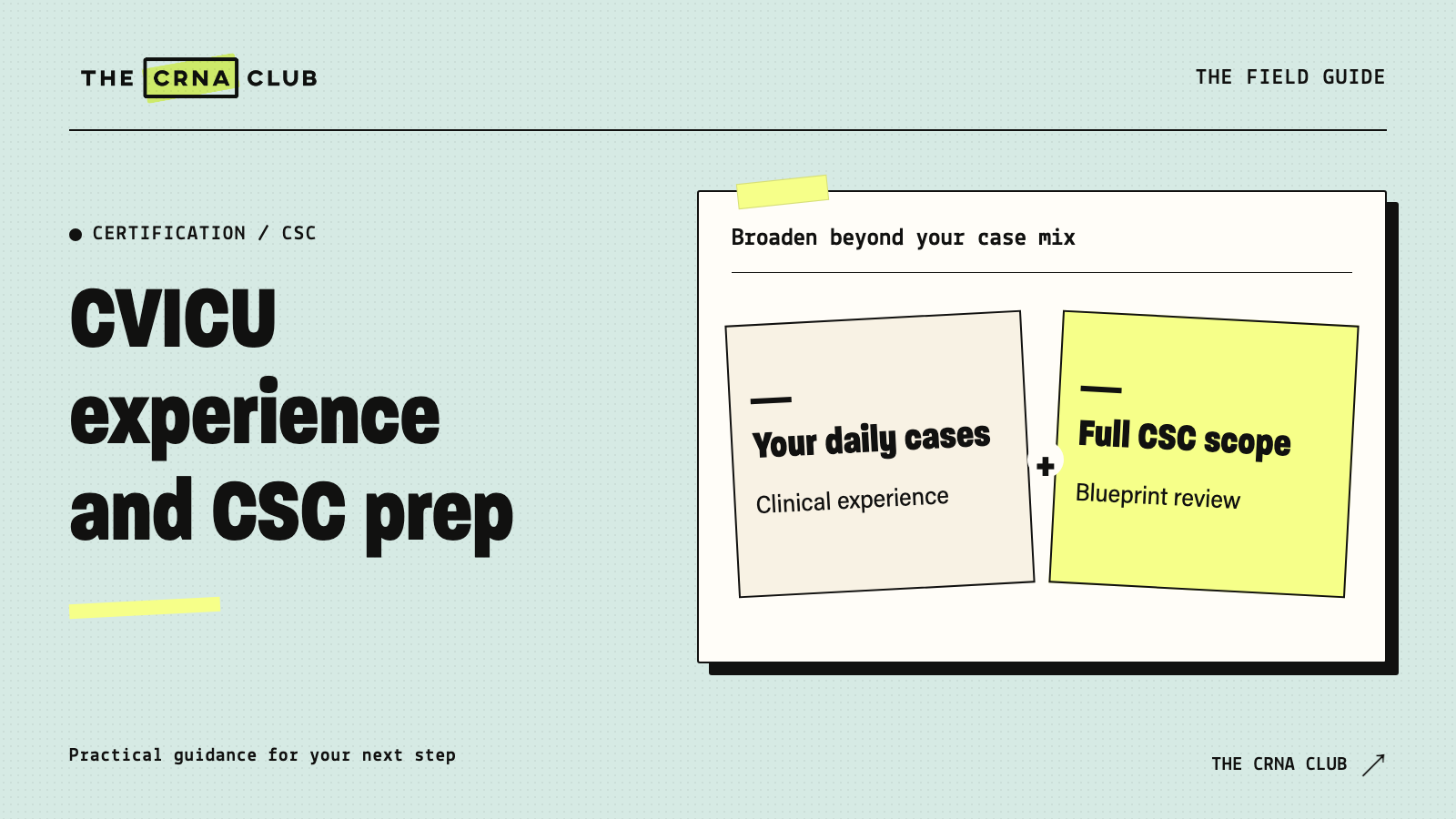
You might be comfortable recovering a routine postoperative patient and still need a careful review of another procedure, complication or intervention. That doesn’t diminish your experience. It tells you where the next study block belongs.
Once you’ve checked the AACN CSC eligibility requirements, compare your experience with the outline. Let’s separate what you’ve done from what you understand well enough to explain in a new case.
What does your CVICU background actually tell you?
Start with the patients you actually care for. Which procedures do you see often? Which devices do you use yourself? Then ask whether you can explain why the care changes after each procedure. You may know the routine well and still need to review the physiology behind it.
Make one row for a routine CABG recovery and another for an outline procedure you rarely see. For each, separate “I cared for this,” “I observed this,” and “I studied this.” Then add the explanation you still need. That turns a job title into your own study list without borrowing a colleague’s experience.
Then choose one routine case and explain it from the beginning. What was the procedure intended to address? What observations were relevant afterward? Which changes would require you to reconsider the initial explanation? You don’t need to include private patient details to make the study task useful.
If you recognize the sequence of tasks but can’t explain the physiology, mark that gap. Repetition builds familiarity with work, while exam questions may ask you to reason through changed information. You need both the experience and the explanation.
Our hemodynamics and perfusion article helps check a foundation often used in postoperative reasoning. Follow it with a new case rather than assuming reading equals mastery.
How should you compare experience with the CSC outline?
Take each topic in the outline and ask: have you cared for it, and can you explain it without notes? We suggest keeping those answers in different columns. Then use CSC questions to check familiar topics too, because a changed case can expose a gap that routine work hasn’t.
The revised CSC test plan applies on or after November 19, 2026. Use the earlier applicable version for an earlier appointment. Read the procedures, complications, interventions and monitoring items before assigning checkmarks.
Your audit might reveal gaps like these:
- A familiar procedure: You encounter it frequently and understand its purpose, but still have postoperative questions. Review those missing implications.
- An uncommon complication: Exposure is limited and you recognize the name without understanding the mechanism. Read a targeted reference and work a case.
- A device absent from the unit: You have no hands-on experience and know only its basic purpose. Learn its function, monitoring and limits.
- A familiar medication: You administer it frequently and can explain its mechanism and response. Check that understanding with unfamiliar mixed questions.
Don’t give every topic the same time estimate. A brief refresher and a new topic require different work. The audit becomes useful when the next task is concrete enough to finish in a session.
How do routine cases leave study gaps?
Routine assignments give repeated exposure to some situations and little exposure to others. The same years of practice can therefore produce different study needs in different nurses. Identify the topics your unit rarely manages and the aspects of familiar cases you haven’t explained deeply, then give both a place in your plan.
Consider two hypothetical nurses. One unit mostly manages a predictable postoperative case mix. Another sees a wider range of procedures but assigns particular devices to a smaller group. Neither nurse should assume the unit’s full capabilities describe their personal experience.
Each nurse needs to distinguish “our unit uses it” from “I have cared for it” and “I understand it.” Those are different statements. Keeping them separate helps the study plan and keeps descriptions of experience accurate.
A rare complication also raises a learning challenge. You may remember one dramatic example vividly, but one example doesn’t explain every presentation or every competing cause. Use a reference and varied cases to broaden the explanation.
Avoid turning a memorable pattern into an absolute rule. Our postoperative drainage article covers a specific assessment concern. Connect it with the larger exam and hemodynamic findings instead of using drainage alone to name every postoperative problem.
What should you do when familiar work is hard to explain?
Use the gap as a reason to revisit the mechanism rather than repeating the task sequence from memory. Start with the patient problem, explain why an intervention addresses it, then describe the response and relevant risks. A clear explanation should still work when the question changes a meaningful detail.
Choose one intervention you encounter frequently. Explain its purpose in ordinary language while preserving the correct clinical terms. If you reach a word you can’t define, pause there. That’s the next learning task.
For a medication, connect mechanism with the expected physiologic effect and monitoring. For a device, explain what it measures or supports and its limitations. For a procedure, describe the postoperative context you need to understand. Keep each explanation connected to an actual clinical question.
Then change the hypothetical patient. Add an altered rhythm, a different pressure trend or another relevant finding. Does your explanation still fit? If it doesn’t, explain what changed. If it always stays the same, check whether you’re using the new information.
The CRNA Club’s Learning Library and CMC Review include teaching for relevant cardiac physiology and pharmacology foundations. The seven-day membership trial gives you a way to explore those lessons alongside CSC questions and planning. Use that teaching to make the mechanism clearer before applying it to a new postoperative case.
How do you study topics with no hands-on exposure?
Learn the topic’s purpose, physiology and monitoring through appropriate teaching and references, then apply the explanation in hypothetical cases. Seek a suitable teaching opportunity when available, while keeping knowledge and hands-on competence distinct. Studying a device or procedure should never become a claim you have personally managed it.
Use the AACN CSC bibliography to identify relevant surgical references. Start with a focused section that answers your question rather than collecting several books before reading any of them.
For an unfamiliar procedure, begin with what it is intended to accomplish. Then learn the postoperative assessment and the complications listed in your outline. For an unfamiliar device, understand what information it supplies and what uncertainty remains despite that information.
After reading, write a short case explanation without notes. Use an authorized practice question or your own clearly hypothetical scenario. The check should require reasoning rather than repeating a definition you just copied.
If the reference assumes too much prior knowledge, review the foundation first. A basic diagram or mechanism lesson may make the surgical section easier to understand. You don’t need to pretend an advanced paragraph made sense simply because you finished reading it.
How do you use practice questions to test the audit?
Try mixed CSC questions you haven’t seen. Do you miss the topics you expected, or does a familiar area turn out to need work too? Mark guesses along with wrong answers. We suggest using that list to choose the next lesson or surgical section, then checking the explanation again later.
A question may show your experience audit was too optimistic. You marked a topic familiar, but you couldn’t interpret the changed patient context. Update the row and give it a specific task. That is the audit doing its job.
Another question may reveal an unfamiliar topic you hadn’t noticed. Return to the outline and identify the appropriate section. Don’t add the question as an isolated fact without seeing how it fits the larger content.
Keep your review proportional. A missed detail doesn’t automatically mean relearning the entire exam. A recurring mechanism gap deserves more than rereading one sentence. Let the pattern of errors guide the depth of the next session.
Use practice scores as feedback with context. Avoid universal bank targets, predictions of passing or claims about exam frequency based on remembered questions.
What should remain separate from your experience audit?
Keep eligibility, knowledge coverage and CRNA admissions requirements as separate checks. Each uses different evidence and answers a different question. Use the evidence each decision needs: your qualifying hours, explanations across the outline and each school’s experience policy.
Use the current AACN documents for certification eligibility. Use the outline and your learning checks for study planning. Use each program’s current instructions for admissions. Our certifications beyond CCRN guide helps connect the tasks without treating them as interchangeable.
Write the next action beside each question. Your hours might be confirmed, a procedure might need review, and a school might need an email about your ICU background. Now you know what to do next instead of trying to answer whether your experience is “enough” for everything at once.
Our Final Thoughts
Your CVICU experience is useful material for learning. Use it honestly, then let the outline show what your usual assignments haven’t covered.
A familiar task that needs a clearer explanation and an unfamiliar topic needing a first review both belong on the calendar. Naming the gap is progress you can use.
Take the Next Step
Try our seven-day membership trial and use the CSC questions to check one familiar topic and one you rarely see at work. Review the cardiac foundation in our lessons where needed, add surgical reading for the procedure details, and put the remaining work in the CSC planner. Let your actual explanations guide the study time.