Can Easy Electives Raise Your GPA for CRNA School?
Sachi, CRNA
CRNA
In This Article (9 sections)
- When does an elective change the GPA mathematically?
- Why might an elective leave science GPA unchanged?
- Does the elective solve your actual academic problem?
- What about technical, vocational or continuing-education credits?
- Does pass/fail credit help the same way as an A?
- What should you consider instead of random electives?
- What should your final enrollment decision say?
- Our Final Thoughts
- Take the Next Step
Yes, a graded elective can raise a GPA if it counts in that group and the grade is higher than your current average. But we suggest doing the math before enrolling. Our Transcript Analyzer helps you organize the record, and the manual GPA Calculator in our seven-day trial lets you try a course scenario. Then check whether it changes the number your schools actually use.
If you’ve already completed many credits, the numerical effect may be small. That doesn’t make an elective pointless. It means you need to know what you’re buying with the time and tuition.
If your concern is a science GPA or a required course, an unrelated elective may leave that problem exactly where it was. Our low-GPA application guide covers the broader plan. Let’s compare what an elective would actually change.
When does an elective change the GPA mathematically?
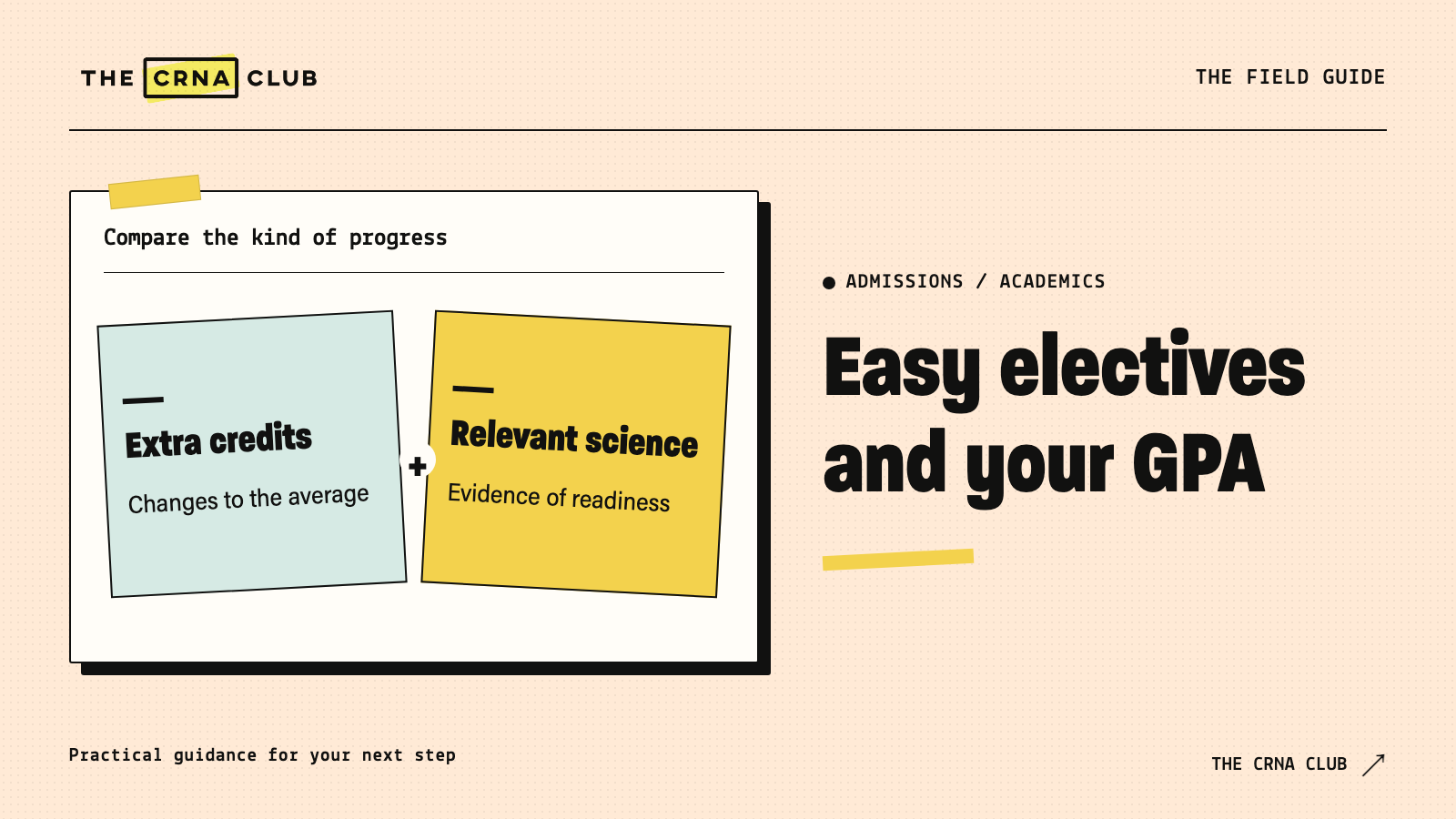
First check that the elective belongs in the GPA you’re trying to raise. Then add its credits and grade points. We suggest trying that in the manual GPA Calculator, with the grade clearly marked as a scenario. An expected A isn’t a completed grade, and a long transcript can move much less than you expect.
NursingCAS’s official calculation guidance explains quality points and attempted-credit weighting. Use the relevant category rather than placing the course into whichever number you want to raise.
Consider a hypothetical applicant with 120 included credits at 3.00. The existing total is 360 quality points. A new three-credit A adds twelve quality points and three credits. The result is 372 divided by 123, or about 3.02.
Now add twelve A-grade credits instead. The result is 408 divided by 132, or about 3.09. That takes more work and still doesn’t produce a dramatic change in a long transcript.
The calculation doesn’t tell you whether the elective is accepted academic coursework or belongs in the target school’s review. Those policy questions come first. The example simply shows why the credit denominator matters.
Why might an elective leave science GPA unchanged?
A course outside the program’s science group doesn’t change that group’s GPA even if it raises an overall average. Define the science group using the school’s actual rule and keep the standardized application category separate. Don’t assume every college course enters every number because it carries a grade.
For a hypothetical applicant, the science group contains 30 credits and 90 quality points, a 3.00 GPA. A three-credit non-science elective earns an A. If it isn’t included in that science group, the science result remains 90 divided by 30, or 3.00.
If the applicant instead takes a three-credit course accepted in that science group and earns an A, the group becomes 102 quality points over 33 credits, or about 3.09. The arithmetic differs because the course group differs.
NursingCAS’s subject list helps with standardized classification. A program may define its own science review, so keep that policy beside the estimate.
Our science GPA calculation article works through choosing the group. Use it before deciding an elective will address a science minimum or a weak prerequisite grade.
Does the elective solve your actual academic problem?
Ask three questions. Does it change the GPA you need? Does it meet a requirement? What will you learn? An elective might raise cumulative GPA while leaving a science minimum unmet. We suggest putting those answers beside the projected change so a small numerical increase doesn’t distract you from an unfinished prerequisite.
Use this decision worksheet:
- What changes mathematically? Calculate the included credits, projected grade and weighted result.
- Does the course satisfy a rule? Confirm subject, level, lab, grade, recency and program acceptance.
- What learning does it add? Read the actual syllabus and relevant content.
- What remains unresolved? Name any missing requirement or academic concern after completion.
- What does it cost? Check current tuition, fees and realistic study time.
Imagine an applicant below a stated science minimum. A non-science elective might change an overall average while leaving the eligibility problem open. Another applicant already meets academic requirements and takes an elective for a personal interest. That is a different goal and doesn’t need to be sold as a CRNA admissions strategy.
Keep the explanation honest. You don’t need to describe every course as impressive or challenging. You need to know why the course is part of your plan.
What about technical, vocational or continuing-education credits?
Verify how the specific institution, credit and grade are treated before assigning them a GPA effect. Technical or vocational labels don’t establish a universal rule, and continuing-education completion isn’t automatically the same as graded college coursework. Check the actual transcript and the application and program instructions rather than counting every certificate as academic credit.
Ask the provider what record it issues. Is there an official academic transcript? What credits and grade appear? Which institution awards them? Is the work undergraduate, graduate, noncredit or another category? Those questions describe the actual record before anyone evaluates it.
Then ask the relevant application service or target program about the specific uncertain coursework. Avoid a broad question such as “Do vocational classes count?” if your situation involves a particular institution and credit type.
NursingCAS’s Colleges Attended instructions require reporting institutions under its stated rules. Reporting history and assigning a GPA role are related but separate tasks. Don’t omit required history because you assume it won’t help.
If the treatment remains unresolved, don’t build a tuition plan around an assumed increase. Get the answer while you still have the option not to enroll.
Does pass/fail credit help the same way as an A?
Non-graded pass or satisfactory credit does not supply the same GPA quality points as a letter-graded A under NursingCAS’s stated calculations. Follow the actual grade rules, including the treatment of failing grades. Don’t assign a pass a 4.0 value yourself to make a planning number rise.
A course might still satisfy a requirement if the program accepts the grading format. That acceptance needs checking separately. A useful class can add knowledge or a credential without changing the GPA you hoped to improve.
Consider a hypothetical three-credit course with a pass grade. If it is excluded from the relevant GPA under the rules, neither the quality-point numerator nor the graded-credit denominator changes. Treating it as twelve new quality points would produce an unsupported result.
This matters when comparing short certificates, prior-learning credit or employer education. Keep the type of record clear. The phrase “three credits” alone doesn’t tell you whether the work contributes a letter grade to the intended calculation.
If your academic history contains many non-graded courses, review the actual program instructions before deciding what additional graded work would be useful. Avoid universal claims about how every committee evaluates that background.
What should you consider instead of random electives?
Consider the course or task that addresses the actual remaining requirement or learning need. That may be an accepted science retake, a required lab, relevant recent coursework or unfinished nonacademic application work. Once the academic requirements are met, more courses should still have a clear purpose rather than serving as reassurance alone.
Before registering, check what the course would accomplish at each target school. Does it meet a requirement, repair a specific gap, or provide relevant new learning? Choose the class for that purpose rather than assuming everyone needs the same retake or advanced course.
TCU’s current FAQ provides one program’s guidance on relevant additional science and retakes. Use its scope accurately and check your own target schools. A recommendation from one program isn’t a requirement everywhere.
The GPA + Prerequisites lessons help connect course choices with transcript questions. Explore the seven-day membership trial if you want structured teaching while deciding whether a class actually belongs in the plan.
Don’t enroll in a difficult science course without enough time merely because it sounds more relevant. Protect the workload and understand the content prerequisites. A course with a clear purpose still needs a realistic schedule.
What should your final enrollment decision say?
Before paying, say what the class will do for you. Which GPA changes, by how much, and what requirement does it meet? If the only answer is “it’s an easy A,” compare the time and tuition with the actual increase. You may have a better use for that study block.
Write: “This course enters ___, changes my planning estimate from ___ to ___ under these assumptions, and addresses ___.” If it doesn’t satisfy a requirement or add relevant learning, be clear about the personal reason you’re choosing it.
You might still choose the elective. The point is making the choice with accurate expectations rather than a vague promise that every A improves the application in the same way.
Our Final Thoughts
An A in an included course changes the arithmetic. The application value still depends on which number matters and what academic work remains unfinished.
Do the calculation, verify the course treatment and name the purpose. Then spend your time where it helps you complete a stronger, accurate application plan.
Take the Next Step
Start with the free Transcript Analyzer, which includes one lifetime free analysis, to review your current record. Then try our seven-day membership trial for the manual GPA Calculator and GPA lessons. Compare the elective with a relevant course or another unfinished task before deciding where the tuition and study time belong.