Can you study for the CMC and CSC together?
Sachi, CRNA
CRNA
In This Article (9 sections)
- What should you verify before combining study plans?
- Which topics can you study together?
- How should you track medicine-specific and surgery-specific gaps?
- What would a realistic combined week look like?
- How do you use question banks without blending the results?
- How does the November 19, 2026 transition change the plan?
- When should you stop studying for both at once?
- Our Final Thoughts
- Take the Next Step
Yes, you can study shared CMC and CSC topics together. We suggest using our CMC Review for cardiac foundations, then keeping CMC and CSC question practice and planning separate. Membership gives you those lessons, both question banks and planners through the seven-day trial. Add targeted surgical reading for CSC topics, so shared physiology doesn’t hide the postoperative material you still need.
Learn the shared physiology once, then check it in both medicine and surgical cases. Keep unfinished work under the right exam so a completed CMC lesson doesn’t accidentally erase a CSC gap.
If you haven’t decided which exam belongs first, use our certifications beyond CCRN guide to place the decision in your wider application plan. This article assumes you’re considering both and want a practical way to organize the overlap.
What should you verify before combining study plans?
Check that you’re eligible for each exam, then put the right outline beside each planned date. Do the hour check once before comparing topics. Studying a shared chapter helps with knowledge, but you still need the qualifying practice for both credentials.
AACN’s CMC page and CSC page describe their respective requirements. CMC concerns qualifying adult cardiac care. CSC concerns qualifying adult cardiac-surgery care in the first 48 hours postoperatively. Check the full hour and credential rules using your own record.
Write each intended exam date at the top of the plan. If one date remains undecided, label it tentative. You don’t need two paid appointments to begin comparing the material.
Then account for your other obligations. Two exams alongside shifts, a lab science and an application deadline may leave less study time than the calendar appears to offer. A combined plan still needs realistic hours.
If you aren’t sure you want both credentials, prepare for one first and reconsider the second later. Combining is a study option, not an obligation or evidence of being a more committed applicant.
Which topics can you study together?
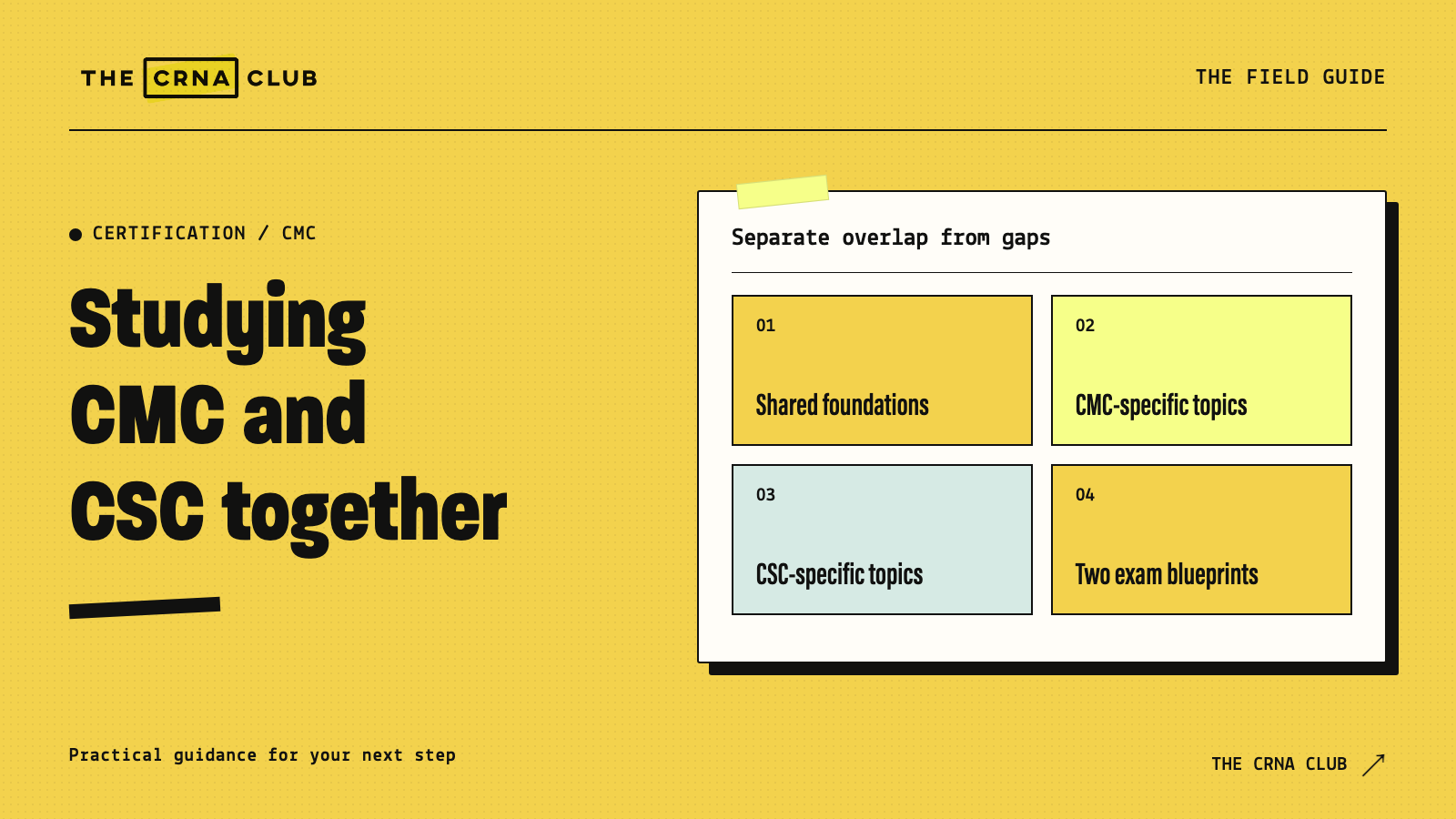
Compare individual outline items rather than treating whole domains as equivalent. Some physiology, monitoring and medication concepts appear across cardiac medicine and cardiac surgery, while the clinical settings change their application. Mark shared foundations separately from exam-specific examples so understanding the mechanism doesn’t hide a missing postoperative or medical context.
Open the CMC test plan beside the CSC test plan. Use the versions matching your exam dates. Copy the actual items into a personal worksheet and connect only the items you can explain as related.
Your worksheet might begin this way:
- Pressure and flow: Explain filling pressure, output and resistance once. Then work medicine and postoperative cases separately.
- Rhythm assessment: Use a consistent interpretation method. Review the relevant context and interventions in each outline.
- Vasoactive medications: Connect the mechanism with its expected effects. Compare how the patient problem changes after surgery.
- Respiratory support: Review physiology and monitoring. Check the distinct listed situations and complications.
- Procedures: Learn the purpose of each named procedure. Keep exam-specific procedures on their own lists.
Use this list to start your worksheet, then add the actual outline details. Keep an item that appears in only one exam on that exam’s list.
How should you track medicine-specific and surgery-specific gaps?
Keep one list for CMC and another for CSC. Say you review an inotrope in CMC Review. That helps with the drug mechanism in both, but you still need to apply it in a postoperative case for CSC. Check off what you learned and leave the unfinished case review on the list.
For CMC, use the actual medicine outline to identify areas outside your normal practice. For CSC, compare your experience with the full surgical scope rather than only the procedures your unit performs frequently. Familiarity with routine recovery doesn’t cover every listed complication or intervention.
Make each gap actionable. “Study cardiac surgery” is too large for a single session. “Explain how a specific procedure changes the postoperative assessment” gives you a defined learning task. Record the source and a later check beside it.
If you review an inotrope’s mechanism in a shared session, mark the foundation reviewed in both lists. Then leave the relevant exam-specific case task open until you’ve completed it. This avoids the tempting shortcut of marking an entire section finished because the medication name is familiar.
Our dobutamine explanation is an example of a focused mechanism reference. Use it to answer a specific gap, then return to your respective clinical cases and outline items.
What would a realistic combined week look like?
A combined week should include shared foundation work, exam-specific sessions and mixed review with separate error logs. Choose the number and length of sessions around your actual availability. Use the example below to place shared and exam-specific work into the blocks you have.
Imagine an eligible nurse with three planned study blocks on days off and one shorter review block. One longer session addresses a shared mechanism. Another works through unfamiliar CMC cases. The third addresses a CSC-specific procedure or complication. The short session revisits errors from both.
| Session | Task | Record afterward |
|---|---|---|
| Shared foundation | Explain one mechanism without notes | Which steps remain unclear? |
| CMC | Practice unfamiliar medicine questions | Which patient clues changed the answer? |
| CSC | Review a surgical gap and work a case | What postoperative context did you miss? |
| Delayed review | Revisit explanations after time has passed | Did understanding carry over? |
If the schedule feels unrealistic after a work week, reduce the simultaneous load or move the second exam. Don’t turn protected sleep into the missing study block.
Keep a little flexibility. Some shared foundations will take longer than expected. A useful calendar responds to the learning, rather than forcing every outline item into the same amount of time.
How do you use question banks without blending the results?
Use the CMC questions for CMC and the CSC questions for CSC, and keep the results separate. If you miss a question in each, ask why. Do both misses come from the same drug mechanism? Review it once. Did you miss a postoperative detail? That needs its own surgical review.
For each set, record whether the questions were new and whether you used notes. Add uncertain correct answers to the error log. Repeated-bank recognition is useful for checking recent learning, but it doesn’t substitute for unfamiliar material.
If you miss a hemodynamic question in each bank, inspect the reasoning. Perhaps both errors come from confusing filling pressure and volume. One foundational review might help both. Or perhaps the mechanism is clear and the difficulty lies in a postoperative detail. That second problem needs a different task.
Don’t average the two bank percentages into a combined readiness score. You would erase information about which outline still needs work. Keep the numbers separate and use the explanations to decide what the next session should do.
The seven-day membership trial includes CMC Review, certification planning and CMC/CSC quiz questions. Use the lessons to strengthen shared cardiac foundations, practice applying them with the quiz questions, and schedule targeted surgical reading for the remaining gaps.
How does the November 19, 2026 transition change the plan?
The revision means each exam needs a date-specific outline check. AACN’s revised CMC and CSC exams apply on or after November 19, 2026. If your appointments fall on different sides of the transition, label the versions separately. An old shared checklist shouldn’t silently carry over to both new exams.
AACN says current study materials remain useful. Keep accurate explanations and compare their coverage with the applicable outlines. The date alone doesn’t mean every physiology chapter or reference needs replacing.
Review the revised outlines item by item. Note additions or changes relevant to your materials and review the remaining gaps. Don’t infer a future passing score from an older version or a practice-bank percentage.
If you reschedule, update the version label before doing more question sets. That keeps you from studying from the wrong version. Once the version is clear, return to the actual learning tasks rather than repeatedly checking revision announcements for reassurance.
When should you stop studying for both at once?
Separate the plans when simultaneous preparation prevents useful review, leaves large gaps unresolved or interferes with required application work. Choosing one exam first is a reasonable response to limited time. The purpose of combining study is to reduce redundant effort, not to commit you to an exhausting schedule regardless of the result.
Review the past two weeks of actual work. Did you complete the shared sessions while repeatedly skipping the exam-specific ones? Are you guessing through unfamiliar surgical topics because there wasn’t time to read? Those patterns suggest the plan needs more space.
Choose which exam has the clearer purpose and more manageable remaining work. Keep the other gap list, mark a date to revisit it and stop pretending both calendars remain active. You’ll preserve what you’ve learned without carrying two urgent deadlines.
Our Final Thoughts
Shared foundations make combined preparation possible. Separate outlines and error logs keep it honest. You want less duplicated reading and better explanations, with enough time for the topics your usual patients don’t teach you.
If studying for both stops helping, choose one first. A plan you can follow and learn from is worth more than an ambitious calendar you keep rewriting.
Take the Next Step
Start a seven-day membership trial and choose one cardiac foundation to review in CMC Review. Then use CMC and CSC questions separately to see how the context changes. Build each calendar with its own remaining topics, and give surgical reading a place in the CSC plan instead of assuming the same lesson finishes both.