Can I use my CCRN materials to study for the CMC, and what do I need to add?
Sachi, CRNA
CRNA
In This Article (11 sections)
- What should you keep from CCRN preparation?
- Which CMC plan should you use for the comparison?
- What should the CCRN-to-CMC crosswalk contain?
- How do you check whether you need more depth?
- What if your broad materials already explain the topic well?
- Should you reuse your old question bank?
- How do two different clinical backgrounds change the transition?
- How should you turn the crosswalk into a calendar?
- What should you confirm before committing to CMC?
- Our Final Thoughts
- Take the Next Step
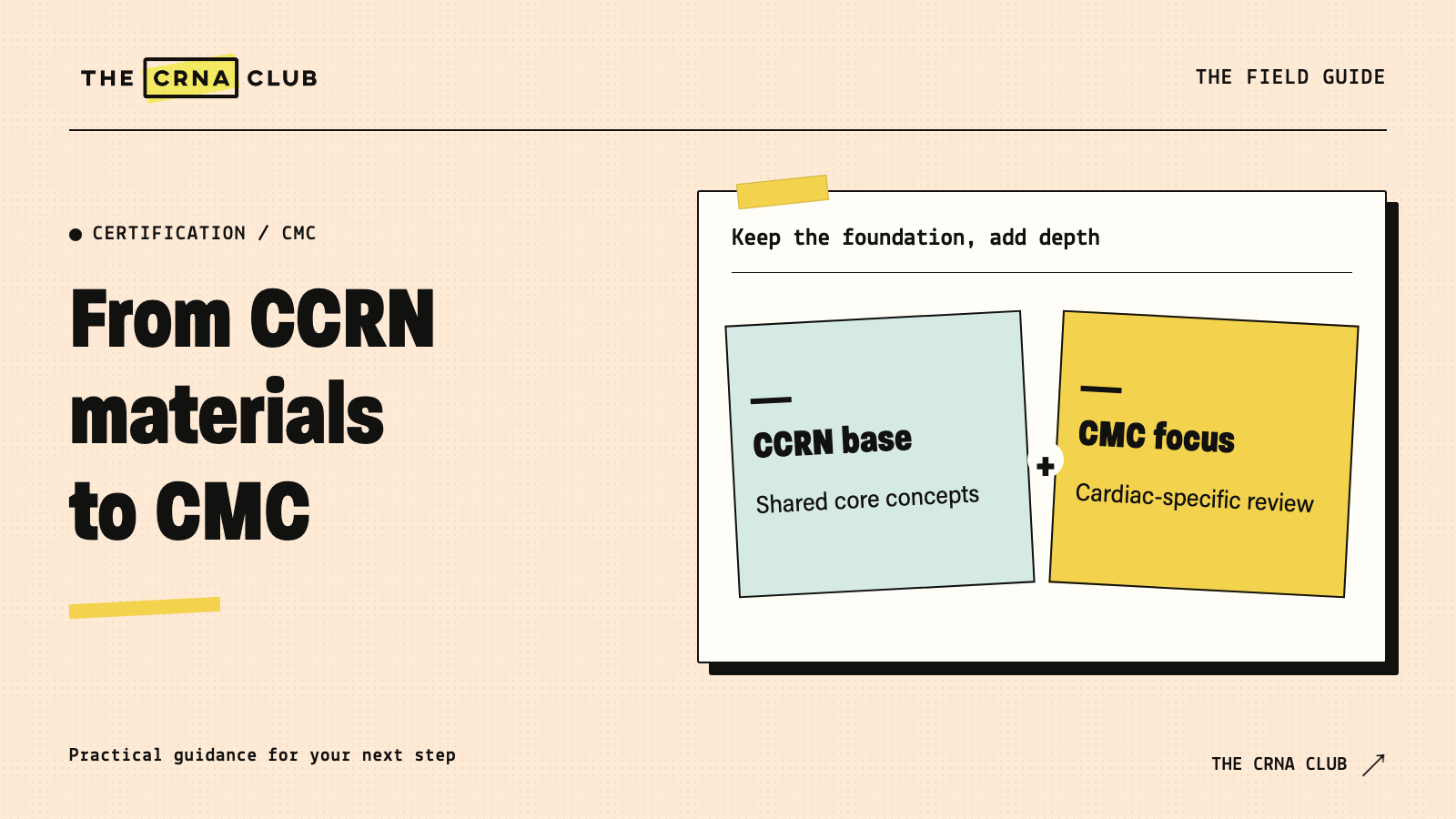
Keep the CCRN explanations that still help you, then add CMC teaching for the depth or topics they’re missing. We suggest our CMC Review in CRNA Club membership, with CMC questions and a planner to help you use that foundation for the next exam.
Compare your materials with the CMC outline applying to your date. If your old notes explain a concept clearly, use them. If they give you a definition but leave you unable to work through a cardiac-medicine case, choose the relevant CMC lesson.
You don’t need to buy the same basic explanation again or assume a broad cardiac chapter completes the whole plan. Let’s map what you have to what you need.
What should you keep from CCRN preparation?
Keep accurate explanations you still understand, useful references and a study process you actually followed. Recheck the concepts independently instead of assuming a previous pass means everything remains easy to retrieve. Your earlier notes also reveal which topics never became clear enough to explain.
A useful retained resource might explain a basic measurement, physiology relationship or medication concept well. Use it as a foundation, then ask what the CMC plan requires around the related conditions, decisions and monitoring.
Our CCRN overview gives the broad credential context. For the next examination, use the official CMC scope rather than expanding your old notes according to whichever topics feel familiar.
Also keep the active habits. Closing a source and explaining the concept independently remains useful. Repeating a completed checklist without checking present understanding does less to identify the work now needed.
Which CMC plan should you use for the comparison?
Use the version applying to your examination appointment. AACN’s revised CMC examination starts November 19, 2026. A before-and-after comparison without the appointment date sometimes mixes two versions into one plan and creates unnecessary confusion about resource coverage.
AACN’s revision notice links the updated materials and says existing study resources remain useful. The revised CMC test plan applies on and after the launch date.
Write the version at the top of your crosswalk. If you are testing earlier, obtain the currently applicable earlier plan through official materials instead of using future weights automatically.
Don’t judge a resource only by publication year. Compare what it teaches with what you need, and check clinical explanations separately when an apparent conflict appears.
What should the CCRN-to-CMC crosswalk contain?
Put a CMC topic beside the explanation you already have. Close the source and ask whether you understand it in a different case. If a connection is missing, write it down and use the relevant CMC lesson. That gives the new teaching a specific purpose instead of turning your old notes into another full rewrite.
A personal worksheet might look like this:
| CMC study job | What existing CCRN material might supply | What to check next |
|---|---|---|
| Heart failure | Basic pump physiology and familiar findings | Which relationship or patient finding still needs a fuller explanation? |
| Acute kidney injury in a cardiac patient | Renal physiology foundations | Can you explain the relevant renal problem instead of labeling every change cardiac? |
| Pharmacology | A drug class and basic mechanism | Can you connect the mechanism with the effect and monitoring described? |
| Hemodynamic monitoring | Definition and units of the measurement | Can you interpret it with other findings and measurement limitations? |
Use the actual official topics in your working copy. The table describes the comparison process, not a substitute syllabus.
Don’t mark a row complete because you found the heading. Read the explanation, close it and test whether it answers your actual learning question. A familiar title sometimes hides a partial explanation.
How do you check whether you need more depth?
Explain the concept in a changed example, including why the findings support your interpretation and what information would change it. If the explanation depends on recalling one familiar answer, return to targeted teaching. More depth should solve a specific missing connection rather than make the notes longer by default.
Say your CCRN notes give the definition and reference range for a hemodynamic variable. You remember both. Now ask what it represents, what affects the interpretation and which other findings you need. Does the explanation still hold without the familiar question in front of you?
If it gets vague, use our CMC monitoring teaching to work through the missing relationship. Keep the useful definition. Add the connection you couldn’t explain, then check a different example later. You don’t need a second set of notes repeating what you already know.
We suggest interpreting the whole profile before drawing a conclusion from one measurement. The point is connected reasoning rather than collecting a larger number of isolated facts.
What if your broad materials already explain the topic well?
Keep an accurate explanation helping you understand the topic. Check it against the CMC scope and current evidence, then use practice. You don’t need another purchase for the heading alone. Focus CMC teaching on the areas your broad material hasn’t explained well enough.
The CMC examination bibliography helps locate targeted reference reading for the revised plan. It doesn’t require buying every listed title.
A hypothetical learner finds a clear explanation in an institutional reference already available through work. She uses it to repair a gap and records the section. That resource has done the job.
Another learner’s existing summary leaves the same relationship unclear. She tries a more focused lesson and judges it by whether she explains a different case afterward. The decision follows the gap rather than a rule everyone needs the same new stack.
Should you reuse your old question bank?
Use relevant old questions for review, but don’t treat repeated familiar results as a complete CMC readiness check. You still need practice addressing the applicable CMC scope and opportunities to examine unfamiliar examples after learning. Keep the purpose of each set clear.
An old broad bank sometimes helps retrieve foundations. It doesn’t automatically supply the scope or depth of a different examination just because the same organ system appears.
For the crosswalk, record which practice function remains missing. Is it application of a new topic, interpretation across several related findings or fresh examples after exhausting familiar material? Then choose practice serving that role.
Review uncertain correct answers too. A prior pass sometimes makes it tempting to assume a correct choice means the explanation is still solid. Ask why the answer fits before checking the rationale.
How do two different clinical backgrounds change the transition?
Use the same outline but different gap maps. A nurse with frequent qualifying cardiac experience and a nurse whose exposure differs sometimes need different teaching emphasis. Their shared CCRN credential doesn’t establish the same baseline for every CMC topic.
Say you explain cardiac conditions well but have neglected the noncardiac topics. Another nurse needs more monitoring teaching. Both of you passed CCRN, but the next lessons should differ. Use the same official scope and choose the review from your actual gaps.
Neither should assume the more comfortable area deserves most of the available time. Familiarity makes material easier to open, which sometimes leaves the actual gaps waiting.
Our certifications-beyond-CCRN guide places the options in broader context. Keep study needs and qualifying clinical practice as separate checks.
How should you turn the crosswalk into a calendar?
Build the calendar from the gaps you found:
- Group the unresolved connections into manageable tasks.
- Assign them to realistic blocks around work.
- Include teaching, independent retrieval and later application where needed.
- Leave space to review questions instead of filling every block with answering them.
Don’t schedule a whole domain as one vague appointment.
A hypothetical first week addresses one clear gap, checks it later and performs a small broader review to identify what comes next. The next week changes according to what remains unresolved.
You don’t need a universal transition duration. Estimate from your actual baseline and observe how long the learning takes. A nurse’s online story about a quick second certification doesn’t establish your timeline.
Also compare the calendar with the applicable official weights and scope. A tool helps organize time. It shouldn’t replace that version check or imply every automated setting already matches an upcoming revision.
What should you confirm before committing to CMC?
Verify the current base credential, clinical-practice and other eligibility conditions with AACN. Passing CCRN doesn’t automatically establish the rest of the requirements. Use the actual patient care, dates and verification rules rather than assuming a title or resource purchase qualifies you.
AACN’s current CMC page provides the complete conditions. Ask about an unclear role before building the plan around an assumption.
Try our CMC Review, questions and planner through the seven-day membership trial. Choose a topic your old notes left unclear, work through the lesson and practice, then schedule another check. That’s how we suggest adding to the foundation you already built.
Keep the source location beside each retained explanation. That saves the next practice review from becoming another search through the whole old course.
Our Final Thoughts
Keep the foundation that still works and add teaching for what it doesn’t explain. A good crosswalk gives each resource a clear role and each gap a specific task. You are building on prior learning while checking the requirements of the next goal honestly.
Take the Next Step
Start the seven-day membership trial to use CMC review beside questions and planning. If you only need a schedule first, the free certification planner includes one lifetime free plan. Check your calendar against the AACN outline for your date.