Can You Get Into CRNA School With a WGU or Pass/Fail BSN?
Some CRNA programs will consider a Western Governors University (WGU) or other pass/fail BSN. Others exclude pass/fail degrees. Before you pay an application fee or enroll in another class, ask whether your degree meets the program’s requirement and how it will evaluate a BSN without a traditional GPA.
Sachi, CRNA
CRNA
In This Article (7 sections)
We suggest starting with the Transcript Analyzer to organize your courses and earlier grades. Compare the results with the application service and school rules. The seven-day CRNA Club trial adds the broader academic-planning lessons and school tools as you build your list.
Does WGU give you a 3.0 GPA?
WGU says it doesn’t calculate a GPA or class rank. Its Academic Transcript and Record of Achievement also present different information. The latter describes completed courses as work within a 3.0–4.0 range, but this isn’t a conventional calculated GPA. Use the WGU transcript explanation to identify the document your receiving school needs.
So don’t type 3.0 into every application because someone told you all WGU graduates have one. Follow the application’s instructions for a nonnumeric record, and ask the school about any required conversion.
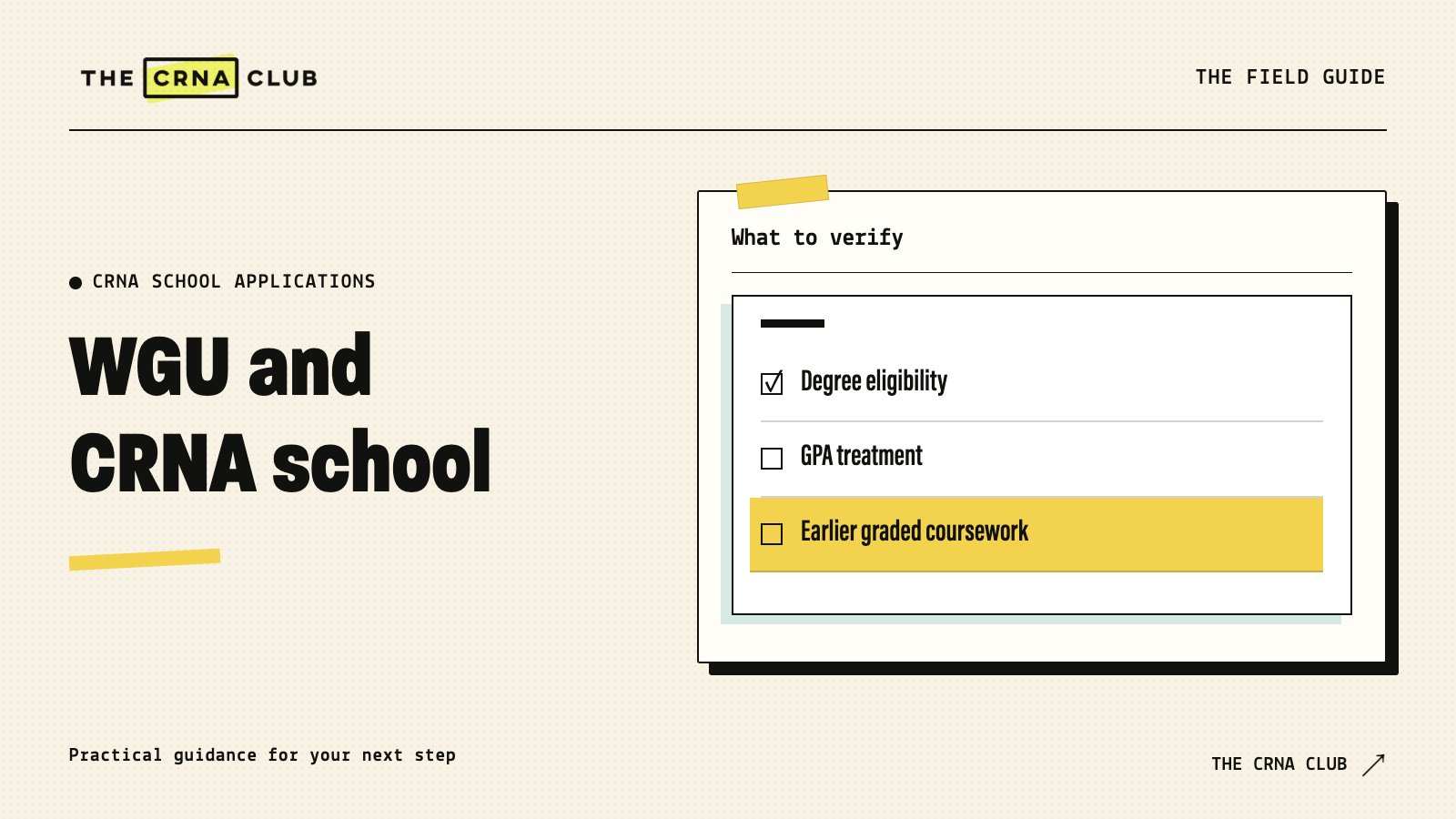
Gather these before contacting programs:
- Your BSN Academic Transcript and its grading key.
- The earlier graded nursing and science coursework.
- Each program’s degree and GPA requirements.
- Any written clarification about a numeric conversion.
Your ADN sciences and an earlier bachelor’s degree still deserve an accurate review. Don’t let the pass/fail label erase the rest of your academic history in your own planning.
How does NursingCAS handle pass/fail classes?
When NursingCAS calculates a GPA, it excludes non-graded pass credits. You still report the required coursework. Its official calculation guide explains the treatment of non-graded credits.
Here’s a fictional example using 90 graded credits at a 3.50 GPA, followed by 30 non-graded pass credits. For a calculation excluding those pass credits, the graded record remains 315 quality points divided by 90 credits: 3.50. You don’t add 90 invented quality points for the pass credits and divide by 120.
The receiving program might also run its own academic review. Keep the NursingCAS calculation and that separate school review labeled correctly. Our NursingCAS GPA guide covers the broader arithmetic.
The podcast “GPA and what you need to know” explains why each school’s included coursework matters. Listen on Spotify or Apple Podcasts.
Use the Transcript Analyzer to assemble your course list. Its current calculator assigns P, PASS and PR a 3.0 planning value, while NursingCAS leaves non-graded pass credits out of its GPA calculations. Check the imported grades and compare the official calculation separately. A planning result doesn’t replace the official application calculation.
Which CRNA schools consider a pass/fail BSN?
Check the program’s policy for your entry year. Here are three ways schools handle a nonnumeric record:
- Union University reviews prior degrees from pass/fail programs individually. Its policy separately says pass/fail course credits aren’t accepted for admission.
- National University says it does not accept BSNs from pass/fail or competency-based programs for its DNAP.
- Marquette University asks for a numeric conversion from the institution when the GPA is nonnumeric. Its admissions FAQ directs applicants to the Graduate School for help. That’s a conversion requirement; ask Marquette how it applies to your specific degree.
What should you ask a CRNA program before applying?
Ask about your actual combination of degrees and grades. A useful message looks like this:
I hold a [degree] from [institution], completed in [year]. My BSN uses [exact grading description]. I also have graded coursework from [institutions]. Does this degree meet your requirement for the [entry cohort]? How do you evaluate the nursing, science and recent-course GPAs for this record? Please let me know whether you need a numeric conversion or additional graded coursework.
Attach the grading key when the program permits attachments. Don’t send an unexplained GPA screenshot and expect admissions to reconstruct every institution you attended.
Save each answer with the school, cohort and date. One program’s response doesn’t settle the next application.
Should you take graded science classes after a pass/fail BSN?
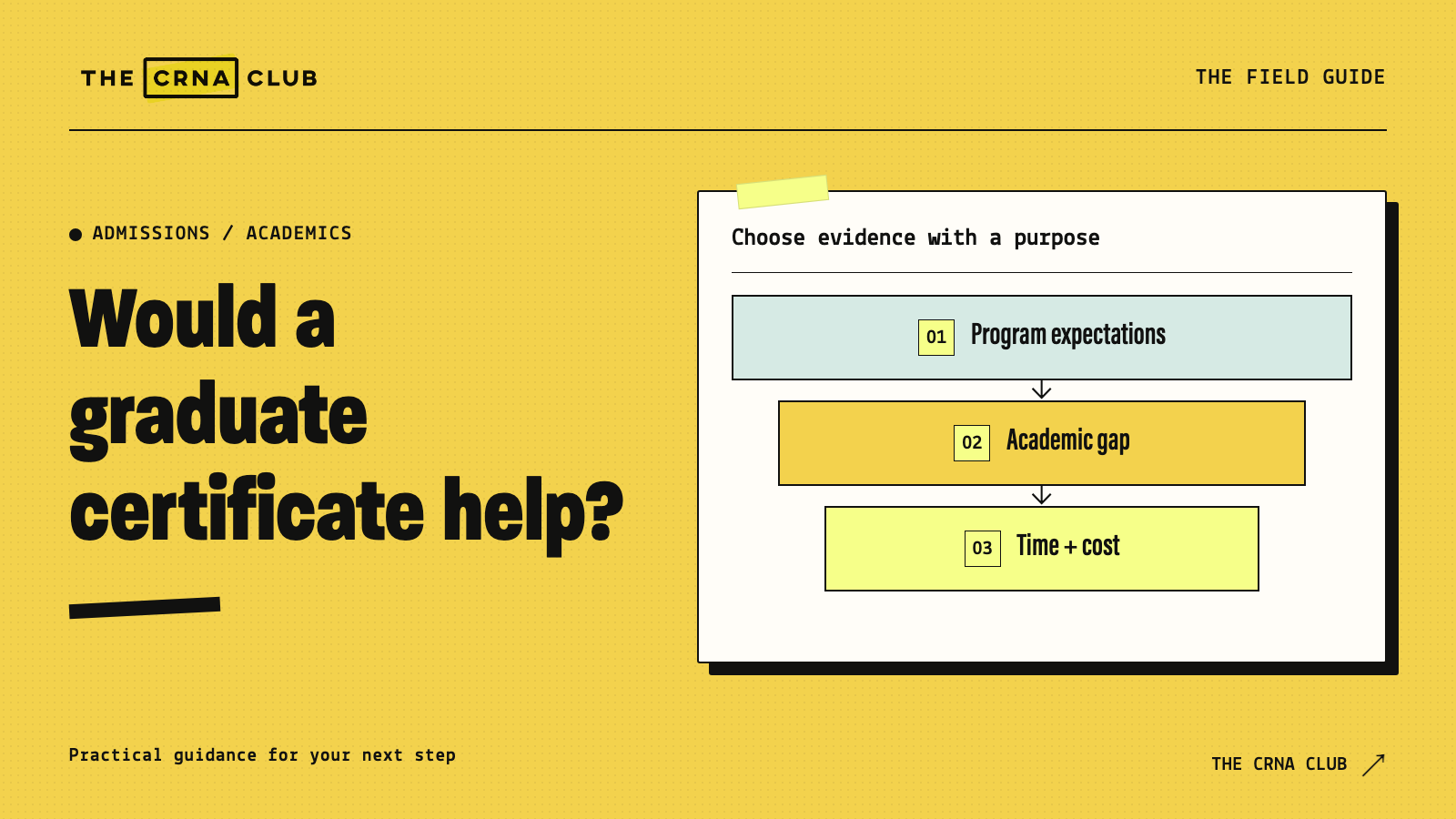
Take a class when it has a clear job. It might satisfy a missing prerequisite, update an expired course or provide recent graded evidence in a weak subject. Don’t enroll in a whole new degree because you’re worried the word “pass” looks bad.
Compare these fictional applicants:
| Academic record | Question to resolve first |
|---|---|
| Strong recent graded sciences before a pass/fail RN-to-BSN | Does the school accept the degree and how does it review those earlier grades? |
| Older sciences with mixed grades and no recent graded work | Which course would address the school’s requirement or the weakest academic area? |
| A missing prerequisite despite a completed BSN | Which exact course will satisfy it? |
We suggest choosing the smallest useful academic step after the program answers. If physiology needs attention, a carefully chosen physiology course makes more sense than an unrelated easy elective. If your record already meets the requirement and shows strong recent work, another class deserves a specific reason.
Our Final Thoughts
You don’t have to solve every possible school’s GPA policy today. Start with three programs you’d attend. Send them the same accurate description of your record, then make your next course decision from their answers.
Plan your academic next step
Review your courses with the Transcript Analyzer, which includes one lifetime free analysis. Then use the seven-day trial for the academic-planning lessons and program-research tools while you decide where your time and tuition belong.