Do CRNA schools see my CCRN score or just that I passed?
Sachi, CRNA
CRNA
In This Article (11 sections)
- Which programs ask for a numerical report?
- What is the difference between a certificate and a score report?
- Does requesting the report mean a higher score guarantees an advantage?
- Should you avoid a program because your passing score is lower than you hoped?
- What if you can’t find your score report?
- How do you check the file before uploading?
- What should you ask when the instructions are unclear?
- Should you retake a passed exam to raise your score?
- How can you keep documents and school requirements organized?
- Our Final Thoughts
- Take the Next Step
Some CRNA programs ask for your numerical CCRN score report. Others ask for proof of certification. Check the actual document request for your application cycle. Asking for a report doesn’t by itself tell you how heavily the school weighs the number.
We suggest using our free School Database to organize your first targets, then confirm their current application instructions. The free tier supports three saved programs. Keep the required report and its deadline with each school’s notes so a certificate doesn’t accidentally stand in for a score report.
You passed. Now you’re seeing “numerical report” and wondering whether to remove the school from your list. Start with the requirement you know, rather than adding a hidden cutoff the program hasn’t published.
Which programs ask for a numerical report?
Current official examples include Wake Forest’s application instructions and the University of Akron’s nurse anesthesia bulletin. Use those as examples of document requirements, then check every target program separately. They don’t establish that all programs request the same evidence or use the score in the same way.
Wake Forest’s current application page requests an unofficial CCRN numerical score report. Akron’s 2026–2027 bulletin lists CCRN certification with a score report. These instructions were checked November 3, 2026.
Read the actual upload instructions too. A public overview and the application form sometimes provide different levels of detail. Don’t assume the shortest sentence you find is the entire submission process.
Our CCRN application strategy article covers the broader credential decision. This article focuses on documenting a result you already earned.
What is the difference between a certificate and a score report?
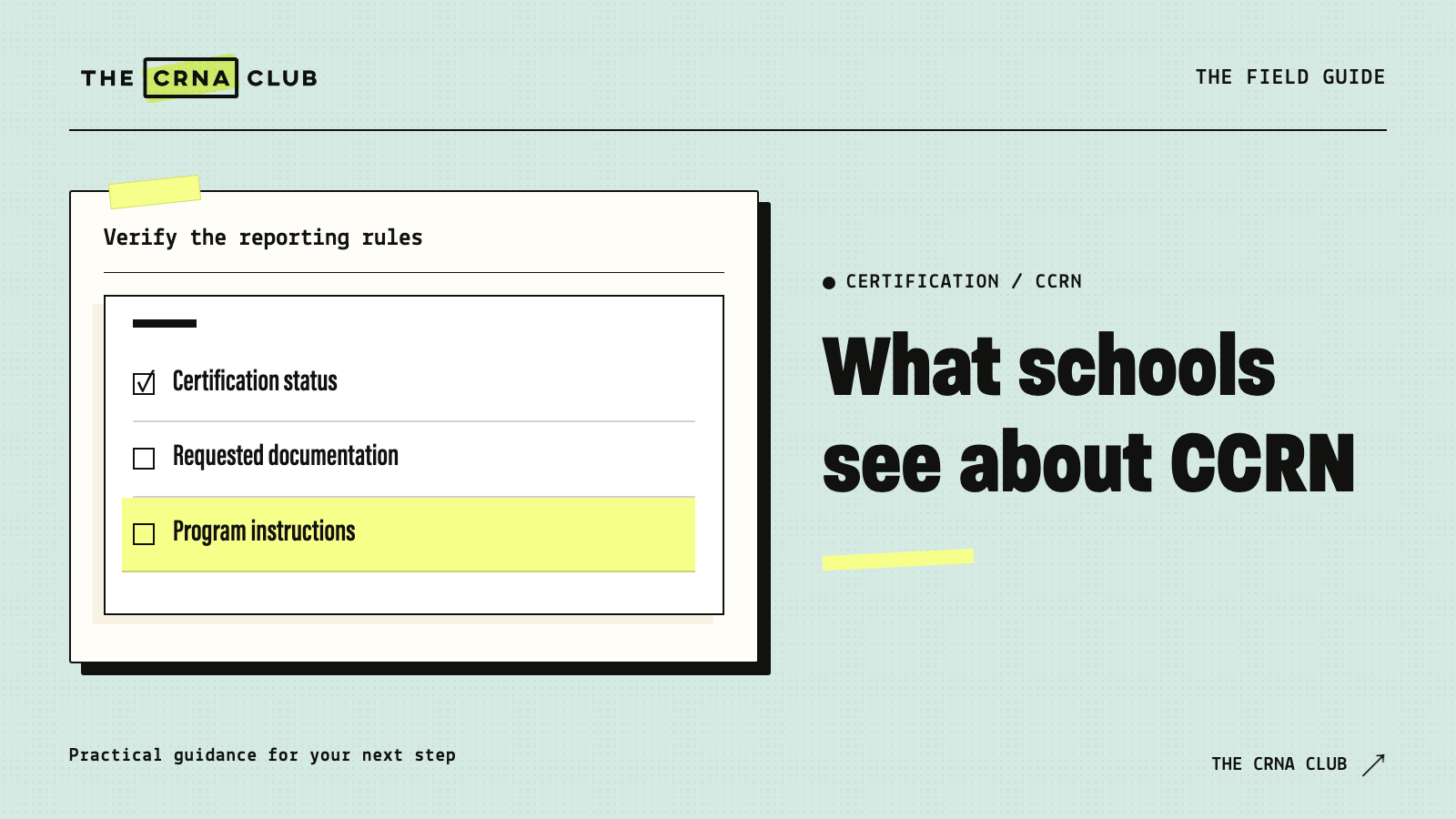
A certificate provides credential evidence, while a score report records examination performance. Use the document the program asks for rather than treating the two as interchangeable. Check whether the instructions name one, both or an official verification method, and record that requirement before uploading.
A personal checklist might look like this:
-
Credential proof: What certificate or verification is requested?
-
Numerical result: Is the actual examination score report required?
-
Official status: Is an unofficial upload allowed, or is another process specified?
-
Deadline: When must that particular evidence be present?
-
Upload location: Which section or permitted submission route applies?
-
Completion check: How do I know the required task is complete?
Use the actual wording in your version. Don’t create an official-versus-unofficial rule for a program that hasn’t stated one. Ask when the instructions leave the process unclear.
Does requesting the report mean a higher score guarantees an advantage?
The request alone doesn’t publish the program’s weighting or create a guaranteed advantage. Use any explicit criteria the program provides, but don’t invent a universal cutoff from an anonymous comment. A document requirement and a selection formula are different pieces of information.
Wake Forest’s page describes a multifactor selection process. That supports reading the broader application instructions, not assigning an exact hidden weight to one report.
Say you see “score report required” and assume every passing result below a certain number gets rejected. Unless the school publishes that threshold, you’ve added a rule. Submit the requested report and review the actual criteria before deciding whether to remove the school from your list.
You also shouldn’t assume the school ignores the number because you passed. Read any explanation it publishes about selection. If it doesn’t state a weight, leave that unanswered and make the application decision from the criteria you do have.
Should you avoid a program because your passing score is lower than you hoped?
Don’t cross a program off because you assume an unpublished cutoff. Look at its current criteria and your whole record. If it states a numerical expectation, use it. If it doesn’t, repeated comments online still don’t become a school policy.
You don’t need to pretend the result is higher or write a long defense of it. Provide accurate evidence and answer the application prompts.
Consider two hypothetical applicants with the same passing result. One meets the program’s stated academic and experience requirements and has a complete application. Another still lacks a required course. The shared CCRN number doesn’t settle either person’s next task.
Review the actual missing evidence. The first needs a broader fit and application review. The second needs to address the course requirement. Crossing both off a list because of an assumed score cutoff avoids the real question.
What if you can’t find your score report?
Check your saved examination records and the current official route for obtaining results or requesting assistance. Use AACN’s instructions rather than relying on an old discussion about how someone recovered a report years ago. Start early enough to resolve the document issue before the program’s deadline.
AACN’s CCRN FAQ explains result reporting and links relevant certification materials. If the current self-service process doesn’t answer your situation, contact the official support channel with the information it requests.
Don’t substitute a practice-bank screenshot or a self-typed number for the required certification report. Those aren’t the document the program named.
Once you obtain the file, save a clear original and a personal backup in a secure location. Keep your application copies organized by document type so a later upload doesn’t require another search.
How do you check the file before uploading?
Open the file before uploading. Check your name, the exam information and the actual result. Compare it with the request for an unofficial numerical report, then use the named upload section. Finally, check completion through the application’s process. Saving the right file and submitting it are two separate tasks.
If the portal asks for a different format or official verification, follow those instructions. Don’t modify factual content to make an unrequested substitute look acceptable.
Keep sensitive documents in the legitimate application process. You don’t need to post the report publicly to ask a general question about score policies. A de-identified description of the requirement is usually enough for a planning discussion.
What should you ask when the instructions are unclear?
Ask which document is required, whether an unofficial copy is accepted and when it must be submitted. Keep the question tied to your actual cycle. A short precise message gives the program something answerable without asking it to predict admission from one score.
A hypothetical draft is:
I am preparing the certification documents for this application cycle. Does the CCRN upload require the numerical examination score report, the current certificate, or both? Is an unofficial copy accepted, and at which milestone must it be received?
Adapt it to the ambiguity. If the page already requests an unofficial numerical report clearly, ask only the unresolved part.
Save the reply with your program notes and record the next action. Don’t treat a past applicant’s recollection as equivalent to a current answer about your own submission.
Should you retake a passed exam to raise your score?
Don’t assume repeating a passed examination is permitted or useful for that purpose. Check current AACN policy and any explicit program expectation before planning another attempt. Then compare the time and cost with other actual application needs rather than inventing a score target.
You might have an academic gap, an interview explanation to practice or a missing application document. Those tasks need their own response. Another examination result won’t complete an unrelated requirement.
Our CCRN overview gives broader credential context. Keep official certification process questions with AACN and admissions weighting questions with the program.
How can you keep documents and school requirements organized?
Keep the requirement, file location and submission status separate. Our school-planning tools help you organize targets and tasks so you see what is still missing. A checkmark should mean you completed what the school asked, rather than found a related document on your laptop.
For each school, write “certificate,” “numerical report” or the exact verification it requests. Add the relevant deadline and next action. That short note is much easier to use than trying to remember which school’s wording you saw last week.
Try school research and application-planning tools through the seven-day membership trial if you’re managing a longer target list. Organize the schools, verify their instructions and record what each document still needs. The tools help you follow the process rather than guess what a score means for admission.
For each program, write the file name beside the requirement and the submission status. That small detail prevents a certificate and numerical report from looking like the same completed task.
Our Final Thoughts
Check the document request and submit it accurately. Keep unpublished weighting separate from what the program actually says. You passed the examination, and the next task is to document the result correctly while reviewing the rest of the application with the same care.
Take the Next Step
Start with the free School Database to build a focused program list, then verify document requirements on each official page. The free tier supports three saved programs. Record the exact report, deadline and next action for each school you keep.