Do I need to memorize normal lab values and hemodynamic numbers for the CCRN?
Sachi, CRNA
CRNA
In This Article (10 sections)
- What should you learn alongside each reference value?
- Why do units deserve their own review?
- How do you move from remembering a range to interpreting a pattern?
- What would a useful hemodynamics study card look like?
- How should you study laboratory values without collecting endless lists?
- What if two references give slightly different ranges?
- How do you check whether your number review is helping?
- Where should you go when the relationships remain unclear?
- Our Final Thoughts
- Take the Next Step
Learn the common CCRN values with their units and meaning. Then practice using them in a case. Knowing a number is high or low gets you started, but you still need to explain what it measures and how it fits the other findings.
If you recognize the ranges but struggle with the relationships, we suggest the hemodynamics and ABG teaching in our CCRN Toolkit. Use the video explanations, try the practice questions and put the concepts needing another pass into your planner.
Keep your normal-values sheet. Let’s make it more useful than a list you recognize when the answer is in front of you.
What should you learn alongside each reference value?
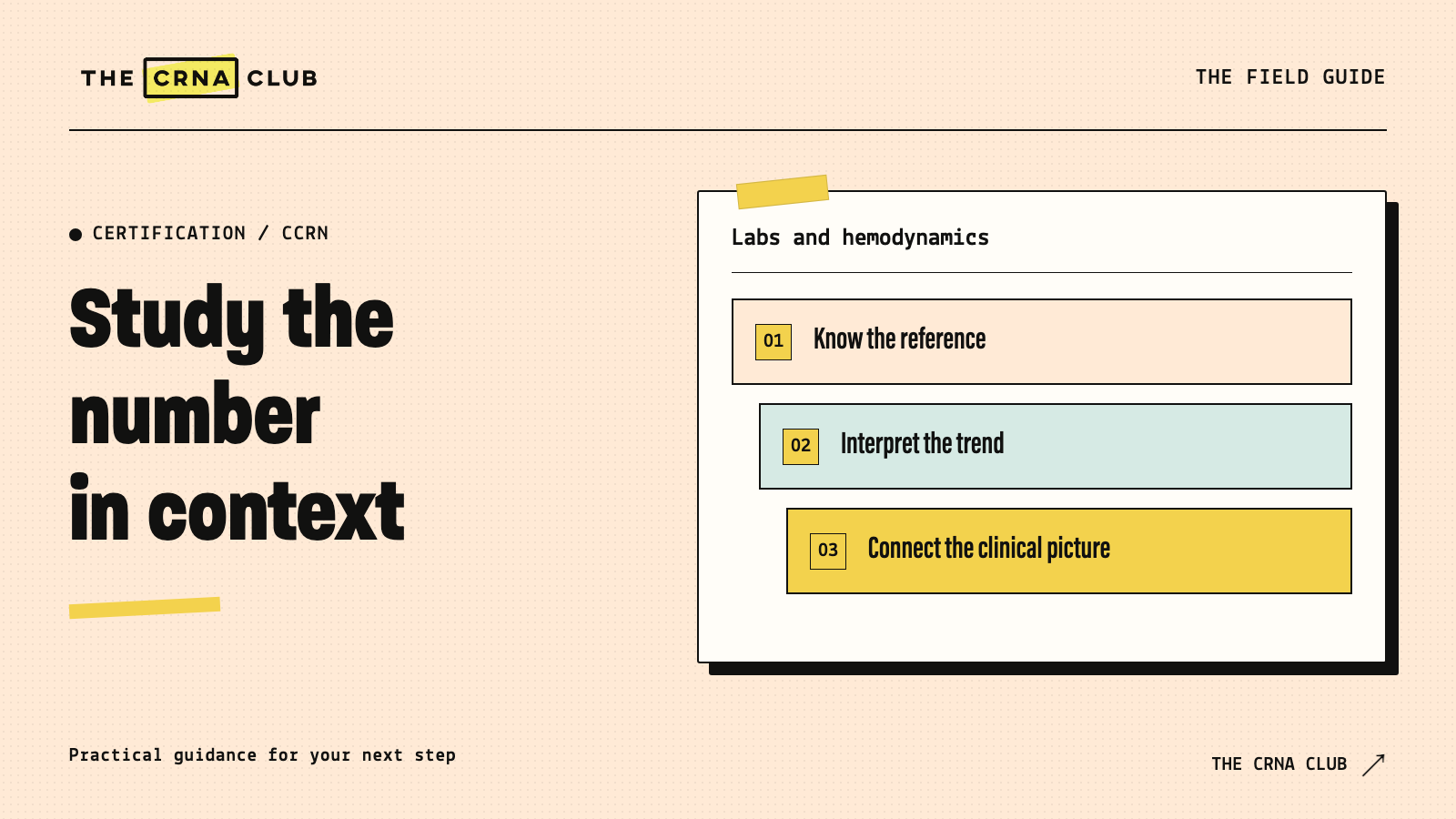
Learn the variable’s name, unit, meaning and relevant context. Add a simple relationship or trend when it helps explain the result. Check the range in a credible current reference, including differences in measurement method or population, rather than assuming every number on an online list applies universally.
AACN’s preparation guidance includes laboratory values and blood gases within review of patient problems. Use that connection when building your notes. The number belongs to a clinical concept you are trying to understand.
A personal worksheet might contain:
-
Variable: The actual measurement or calculated value.
-
Unit: Include it every time you practice.
-
Meaning: What information the value represents.
-
Context: Relevant patient or measurement details.
-
Relationship: What changes the value or how it connects with another variable.
-
Retrieval check: A question requiring an explanation, not only a range.
You don’t need every field for every value. Start with one real entry: arterial pH has a usual reference range of 7.35–7.45 and no unit. Below that is acidemia; above it is alkalemia. A pH within the range doesn’t exclude an acid-base disorder, so review PaCO2, bicarbonate and the clinical context too. The American Thoracic Society’s ABG guide works through that interpretation.
Why do units deserve their own review?
Units tell you what the number represents and help you detect calculation mistakes. Similar-looking values sometimes describe different quantities. Read the unit before comparing a number with your reference, and carry units through calculations instead of adding them after the arithmetic is finished.
For example, cardiac output describes volume per unit time. Cardiac index adjusts output for body surface area. You are looking at related information, but the units and interpretation aren’t identical.
Let’s use a study example. Cardiac output is 4 liters per minute and body surface area is 2 square meters. Divide 4 by 2. Your cardiac index is 2 liters per minute per square meter. The units show what you did: you related the flow to body size.
The arithmetic teaches the relationship. It doesn’t independently establish a diagnosis or treatment. You would still need the rest of the clinical information and a reliable measurement to interpret the result.
Now cover the calculation. Why did you divide by body surface area? Explain that before looking again. If you remember the answer but don’t understand the denominator, use the relevant hemodynamics lesson to work through indexing.
How do you move from remembering a range to interpreting a pattern?
After identifying an abnormal result, explain what information it provides and what it doesn’t establish by itself. Look at related findings, the trend and the measurement conditions. For study, create a second case where the same isolated number appears with different context and explain why more information is needed.
Separate pressure, flow, filling and resistance when you review hemodynamics. That gives you a practical way to organize review rather than treating every hemodynamic value as another version of blood pressure.
A pressure value and a flow value answer different questions. In a study exercise, name which one you are discussing before explaining what it suggests. This prevents a correct range from becoming an unsupported shortcut.
The adult CCRN test plan includes monitoring and interpretation within its scope. Use its actual outline to decide which concepts need review, rather than making a much larger number list simply because a download contains one.
What would a useful hemodynamics study card look like?
Use the front of a card to ask about the variable and a relationship, then answer with an explanation. Include a worked calculation or changed example when relevant. A card asking only for a range checks recall, while a second prompt helps you practice what the value means.
For an original study example:
| Prompt | Answer you should explain independently |
|---|---|
| What does cardiac output describe? | Blood flow per unit time |
| Why calculate cardiac index? | To relate output to body surface area |
| How do I calculate it? | Divide output by body surface area and retain the units |
| What if two people have the same output but different body sizes? | Their calculated indices differ because the denominator differs |
| Does that calculation alone determine the clinical problem? | No, interpretation still requires the patient’s wider findings and context |
Keep output at 4 liters per minute and change body surface area to 1.6 square meters. Divide 4 by 1.6 and you get 2.5 liters per minute per square meter. Same output, different body size. Explain why the calculated index changed before moving to another card.
You have practiced a relationship and arithmetic without memorizing another isolated case.
How should you study laboratory values without collecting endless lists?
Start with the values relevant to the patient problems in the applicable outline and the topics you struggle to explain. Learn them with the associated physiology and common interpretation questions. Expand your list when a specific gap appears rather than trying to memorize every measurement found in a reference book.
Say you keep missing questions involving an unfamiliar metabolic problem. Choose the values and relationships needed to explain that problem. Work through the matching lesson, then try a case. Your study sheet grows from something you need to understand, rather than from every number you find online.
If you’ve spent several sessions making the numbers sheet neater but still avoid the conditions behind it, change the next task. Choose one value and explain what it tells you. Then explain what other information you need. That checks the part another copied range won’t teach.
Use retrieval to connect the two. Ask what the result tells you, what other information you need and which explanation you would investigate next. Check the clinical teaching source whenever your answer becomes uncertain.
What if two references give slightly different ranges?
Check whether the sources use different units, populations, measurement methods or definitions. Use a credible current reference and preserve the context. Don’t force every range into one universal number merely to make a flashcard easier to memorize.
For clinical laboratory results, the reporting laboratory’s reference information helps interpret the value. For examination preparation, use the applicable official scope and current teaching sources to understand the expected concepts.
If a discrepancy affects the underlying interpretation, investigate it before adding the value to your study sheet. Ask an educator to review the exact difference if needed. A short explanation of why ranges differ is often more useful than choosing whichever one you saw first.
Also label a treatment goal separately from a reference range. Those describe different ideas. Don’t assume a number presented as a goal for a particular condition is the normal range for every patient.
How do you check whether your number review is helping?
Attempt an unfamiliar case, explain the measurements and perform any relevant calculation before opening the answer. Review whether the error came from recall, units, arithmetic or interpretation. Give each kind of error an appropriate repair rather than repeating the whole list automatically.
-
Forgot a basic reference: Brief retrieval with a credible range and unit.
-
Mixed up units: Rewrite the quantity and compare like with like.
-
Arithmetic error: Rework the relationship step by step.
-
Correct calculation, unclear meaning: Explain what the variable represents and add context.
-
Remembered the case answer: Change the numbers or scenario and reason again.
These are personal study categories. They help you choose work, not predict an examination score.
Our CCRN overview gives the broader preparation context. Keep numbers inside that plan so one difficult calculation doesn’t consume time intended for several other unresolved topics.
Where should you go when the relationships remain unclear?
Use a fuller explanation when a reference sheet or brief rationale isn’t enough. Identify which connection you don’t understand before searching. “I don’t understand why these variables belong together” gives you a better starting point than opening another large collection of normal values.
Try our hemodynamics and ABG lessons through the seven-day membership trial. Bring one relationship you can’t yet explain. Work through the video, write it from memory and use practice to check it. You don’t have to restart every subject to clear up one missing connection.
Also keep admissions timing separate. CCRN requirements for CRNA school need a program-policy check, regardless of how one numbers session went.
After the next set, name which kind of mistake appeared most often. That observation gives you a focused assignment for tomorrow and keeps another reference sheet from becoming the automatic answer to every problem.
Our Final Thoughts
Know what the number measures, keep its unit attached and practice explaining a changed example. Reference values become much more useful when you connect them with physiology and context. Your next review session should include at least one explanation beyond high, low or normal.
Take the Next Step
Use the CCRN Toolkit for video teaching and practice behind the numbers on your sheet. The free certification planner also gives you one lifetime free plan if you want to schedule focused review with resources you already have.