Do your cardiac-surgery hours meet CSC’s first-48-hours eligibility requirement?
Sachi, CRNA
CRNA
In This Article (9 sections)
- What does the first-48-hours requirement describe?
- How do partial shifts affect the calculation?
- What other hour requirements must you meet?
- What should your private hour ledger include?
- What should you ask your verifier to review?
- What if your unit or procedure mix doesn’t fit neatly?
- Does CSC eligibility establish CRNA-school ICU eligibility?
- Our Final Thoughts
- Take the Next Step
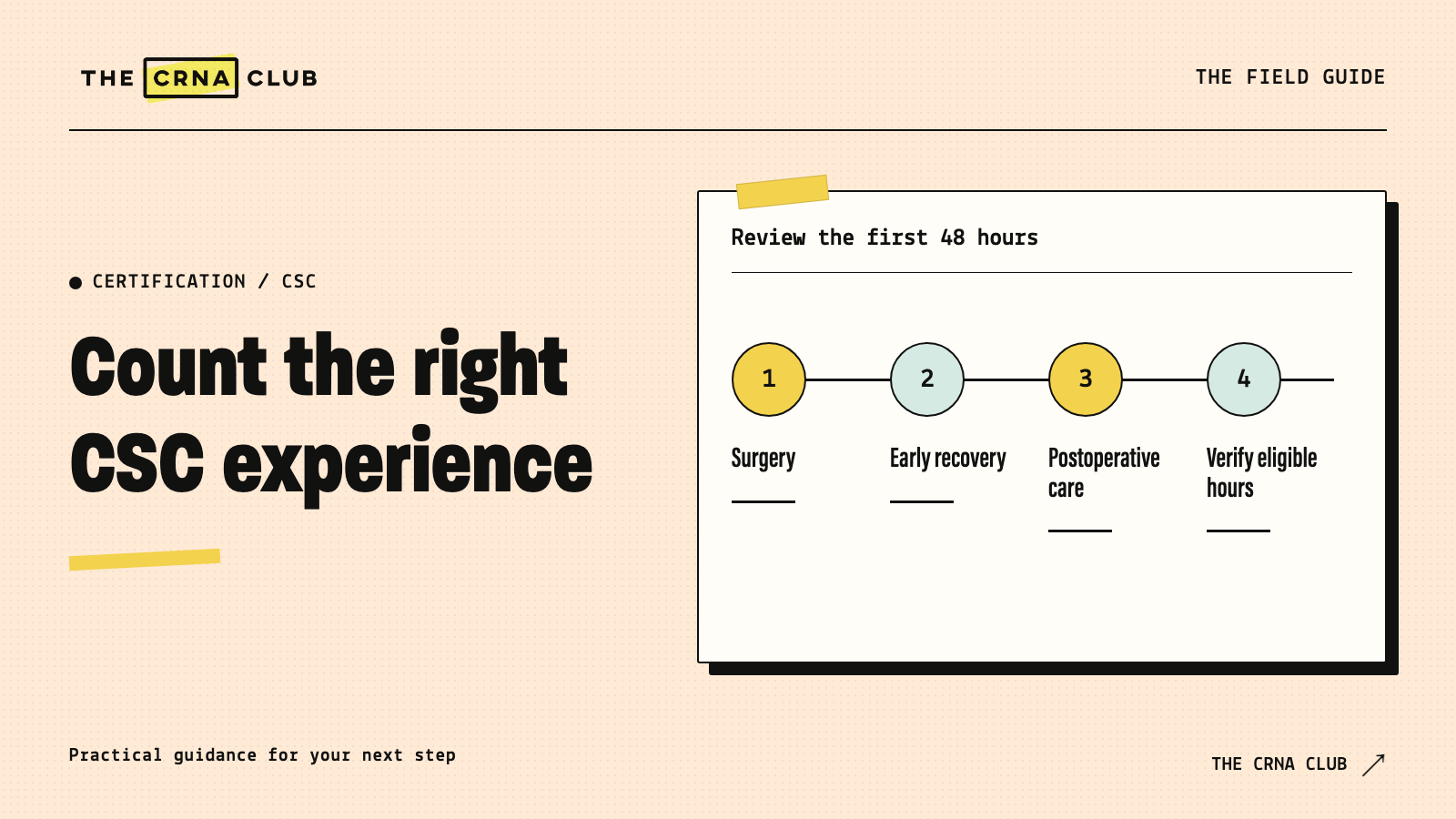
For CSC, your specialty hours need to involve qualifying care of adult cardiac-surgery patients within the first 48 hours after surgery. Count the actual time inside that window, then check the other hour requirements below. Once you know when you’ll qualify, we suggest our CSC planner and questions to help you prepare. You can explore them with shared cardiac lessons through the seven-day membership trial.
A twelve-hour shift may contain fewer than twelve qualifying CSC hours. Your assignment might begin near the end of the patient’s first 48 hours, include nonqualifying patients or contain activities outside eligible direct care. The calculation needs the actual work behind it.
Keep AACN’s CSC eligibility requirements beside your hours. We’ll work through a partial shift first, then the total and recent-year checks. If you’re unsure whether a particular assignment counts, ask AACN about that care before including it.
What does the first-48-hours requirement describe?
The clock follows the patient’s surgery, not your first shift with the patient. If you receive the patient at postoperative hour 44, there are four hours left in that first-48-hour window. You don’t get a new 48 hours because the patient moved to your unit.
Start with the published wording rather than an informal unit habit. A patient described as “a fresh heart” during handoff doesn’t by itself provide the exact time needed for your eligibility record. Use appropriate work documentation and clarify uncertain timing through approved employer processes.
Keep the record focused on what supports the hours. Avoid creating a personal collection of patient identifiers or chart extracts. Your employer may have a process for documenting patient populations and qualifying assignments without transferring unnecessary clinical information into your own files.
If a particular procedure or postoperative situation is unclear, ask AACN about it directly. Describe the procedure and actual care rather than relying on the unit name. A general cardiac-surgery lesson helps you study the physiology, but it doesn’t decide which hours an application accepts.
Write unresolved situations in a separate column. Don’t hide uncertainty by rounding every questionable shift into the total.
How do partial shifts affect the calculation?
Count only the portion of a shift supported as qualifying care within the relevant postoperative window, using AACN’s requirements and appropriate verification. A shift crossing the 48-hour boundary needs more detail than a full-shift payroll record. Avoid double counting hours when you care for more than one patient during the same period.
The following examples illustrate time arithmetic only. They assume the care, patient and documentation otherwise qualify:
| Hypothetical assignment | Time inside first 48 hours | Planning implication |
|---|---|---|
| Care from postoperative hour 24 through 36 | 12 hours | The full period falls inside the window |
| Care from postoperative hour 44 through 56 | 4 hours | Only the first four hours are inside the window |
| Care beginning at postoperative hour 60 | None | Later care doesn’t enter this specialty subset |
| Two qualifying patients during one 12-hour shift | At most the actual qualifying time worked | Two patients don’t create 24 work hours |
For the second row, the calculation is 48 minus 44, or four hours. The remaining eight hours might be important clinical work, but they don’t fall inside the stated first-48-hours specialty window.
Actual records may be more complicated. Assignment changes, breaks, handoffs and the nature of the care require a consistent documentation method. Ask AACN and your verifier how to handle uncertainty rather than presenting the simple example as a universal accounting policy.
What other hour requirements must you meet?
The specialty subset sits within a larger qualifying direct-care total, and the route also includes a recent-year requirement. Meeting the first-48-hours subset alone doesn’t establish complete CSC eligibility. Check all parts of the chosen route alongside the license, base certification and other current conditions.
As checked November 3, 2026, AACN lists these planning figures:
| Check | Two-year route | Five-year route |
|---|---|---|
| Qualifying adult acute or critical direct-care total | 1,750 hours in the previous two years | At least 2,000 hours in the previous five years, subject to full route criteria |
| Most recent year before application | 875 hours within the total | 144 hours within the total |
| Qualifying cardiac-surgery first-48-hours subset | 875 hours within the total | 1,000 hours within the total |
Read the full route in the current CSC page and handbook. The specialty hours aren’t added on top of the total. They’re a subset you need to identify within it.
Also keep recent-year and specialty checks distinct. Don’t invent a rule combining the two numbers differently from AACN’s wording. A clear ledger shows the total, the time period, the recent portion and the specialty subset separately.
If you are near a threshold, don’t use optimistic rounding to make the application fit. Confirm the record or wait until you have adequately supported qualifying hours.
What should your private hour ledger include?
We suggest keeping a simple hours sheet: when you worked, qualifying adult hours, the CSC hours within that time, and which hours fall in the most recent year. Add where the figures came from and anything you still need to ask. Use your employer’s approved records rather than saving patient details in a personal file.
A useful format is:
- Work date or approved reporting period: Place the hours inside the chosen route.
- Qualifying adult direct-care hours: Record the total-hour calculation.
- Qualifying CSC specialty hours: Identify first-48-hours cardiac-surgery care.
- Recent-year flag or subtotal: Show the recency check separately.
- Record source: Note how you derived the figure.
- Question needing clarification: Keep unsupported hours out of a confirmed total.
Start with a small period and test whether the method is workable. If your employer’s records don’t contain enough detail, discuss the problem before reconstructing several years from memory.
Keep a separate summary page so your verifier doesn’t need to repeat your entire calculation. The summary should point to appropriate supporting records and explain exclusions. For example, later postoperative care may appear in your broader clinical background while remaining outside the specific CSC specialty subtotal.
Your goal is a record someone else can follow. A spreadsheet full of exact decimals isn’t automatically stronger evidence if the underlying hours are estimates.
What should you ask your verifier to review?
Ask a knowledgeable clinical supervisor or eligible professional colleague to review the current criteria and the method used to support your hours. AACN requests verification contact information for audits. Give the person enough information to understand the route and the specialty subset before listing them on an application.
The AACN CMC and CSC FAQ provides additional eligibility context. Use the CSC-specific wording whenever the two credentials differ. Adult cardiac medicine hours and qualifying early postoperative cardiac-surgery hours are not interchangeable labels.
A short verifier packet should include your intended route, relevant dates, qualifying totals and the method for handling partial shifts. Add the unresolved situations and any clarification already received from AACN.
Ask your verifier: “Does this match the care and hours you can confirm?” If they can’t confirm part of it, work through that part together before applying. It’s much easier to resolve now than after you’ve planned an exam date around an uncertain total.
If they identify a problem, correct the ledger before applying. Another study resource or a high practice score won’t solve an eligibility documentation gap. Get the hours question settled so the rest of your preparation rests on accurate information.
Once your hour questions are answered, our learning library offers cardiac physiology and pharmacology teaching to support preparation. Explore the lessons, CSC quiz questions, and certification planning tools with the seven-day membership trial as you turn the confirmed eligibility into a study plan.
What if your unit or procedure mix doesn’t fit neatly?
Describe the actual practice to AACN and request clarification for the specific uncertain situation. Job titles and unit labels simplify conversations, but they don’t resolve the patient, timing and direct-care criteria. Keep the answer with your application planning notes so you aren’t relying on an informal interpretation later.
A mixed unit might include cardiac surgery, other surgeries and medical patients. A postoperative patient might move between units during the relevant period. A role might include bedside supervision and administrative time. Each example needs the applicable published criteria and an explanation of the actual work.
As you prepare, our cardiac-surgery chest-drainage article helps with one postoperative assessment topic. Use it for the clinical explanation, while keeping your hours sheet focused on the actual timing and qualifying care.
If you don’t yet meet the specialty hours, keep building the qualifying experience and plan a later check. Studying now may still be useful, but don’t label yourself eligible before the record supports it. A CRNA application deadline doesn’t change the certification rules.
Does CSC eligibility establish CRNA-school ICU eligibility?
CSC eligibility does not decide whether a nurse anesthesia program accepts your clinical experience. The program evaluates its own admissions requirements. Use the certification hour record for AACN and a separate role description for school-specific questions. The same work can be evaluated differently for these separate purposes.
Our certifications beyond CCRN guide helps place the credential within your application plan. Keep the actual school requirements beside it. A new certification doesn’t change the dates, acuity or responsibilities of prior employment.
If a program’s wording leaves your role unclear, ask about the exact role and patient population. Preserve the written answer and date. Don’t replace it with another applicant’s interpretation of how a different school handled their background.
Our Final Thoughts
Count the actual qualifying care, including the time boundary. A careful partial-shift calculation is more useful than assuming every CVICU hour belongs in the specialty subtotal.
Resolve uncertainty while you still have time to improve the record. Then choose an exam date and study schedule supported by your real practice.
Take the Next Step
After confirming your hours, try our seven-day membership trial for the CSC planner, questions and shared cardiac lessons. Choose a realistic date and make time for the topics you see less often. You can also begin with the free certification planner, which includes one lifetime free plan, while keeping the hour check beside your study calendar.