Do Nursing Pharmacology and Pathophysiology Count Toward Science GPA?
Sachi, CRNA
CRNA
In This Article (9 sections)
- What does NursingCAS classify by subject?
- How can a CRNA program’s science GPA differ?
- What should your course-classification worksheet contain?
- How would two similar course titles produce different questions?
- How does classification change the GPA arithmetic?
- What if you disagree with a verified NursingCAS subject?
- What should you ask before enrolling in another course?
- Our Final Thoughts
- Take the Next Step
It depends on whose science GPA you’re calculating. NursingCAS uses its own subjects, including a Nursing category for courses with Nurse or Nursing in the title or prefix. A CRNA school may use a different list. We suggest starting with our Transcript Analyzer, then comparing those courses with your schools. Our seven-day trial includes GPA lessons and school research tools to help you work through the differences.
The material feels like science because you’re learning physiology and drugs. But course content, application classification and program prerequisite acceptance answer different questions. Keeping those questions separate prevents a lot of confusing GPA comparisons.
Before doing the math, get the course list right. Our science GPA calculation guide covers the calculation. Let’s look at why the same pharmacology or pathophysiology grade can sit in different groups.
What does NursingCAS classify by subject?
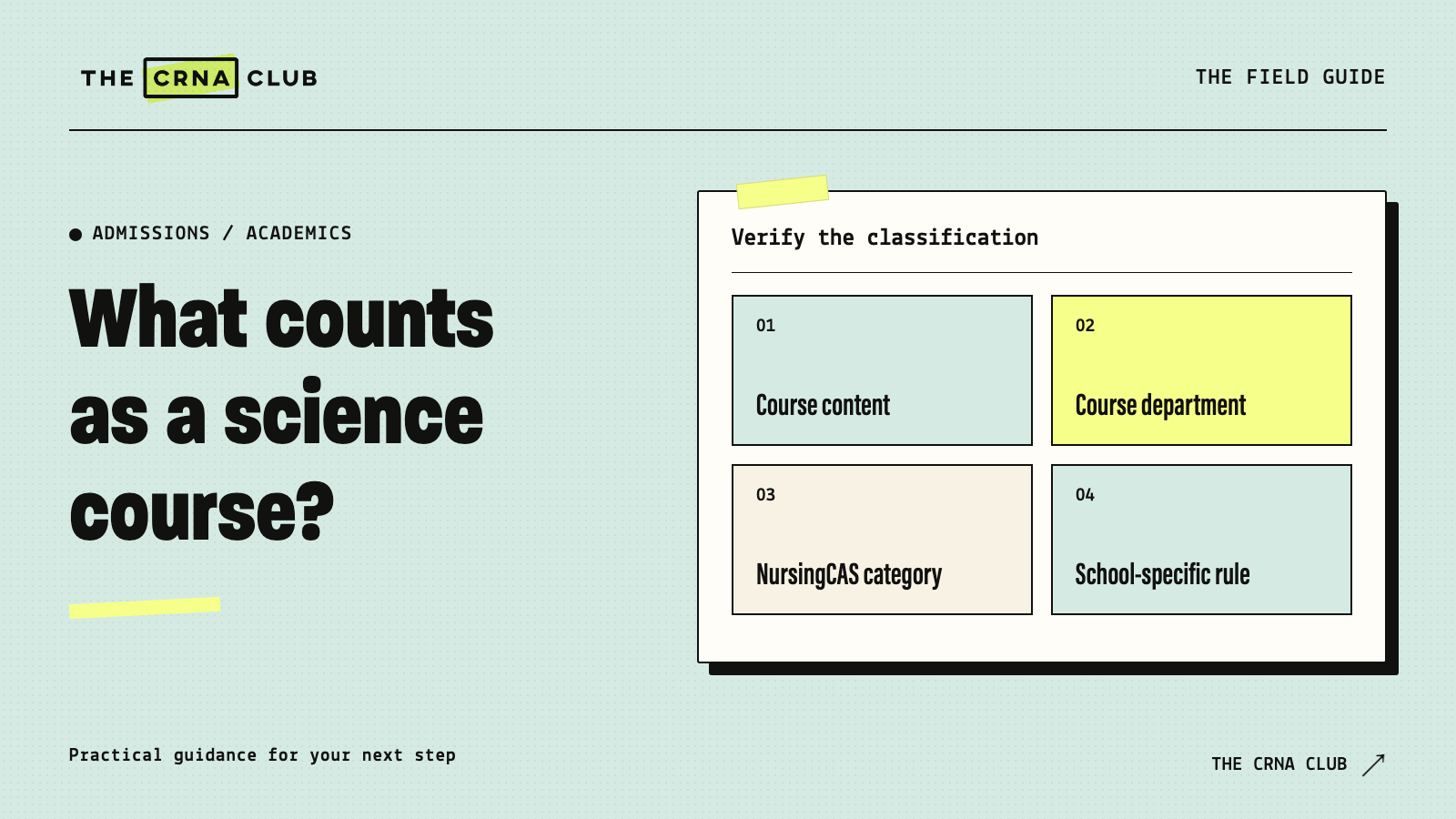
NursingCAS sorts courses using its subject rules. It isn’t asking whether the class felt like science. Check the exact transcript title and prefix. If it includes Nurse or Nursing, that Nursing rule matters even when the material was full of physiology or drug mechanisms.
The official NursingCAS course-subject page lists Pathophysiology within Natural Science, Pharmacology within Other Courses and Statistics within Mathematics. The Nursing-title or prefix rule still needs attention for your actual course.
This is why “I took pathophysiology” isn’t enough information. What does the official transcript call it? Which prefix appears? Is it a nursing course or a course under a different department? Keep the exact record instead of shortening the title in your worksheet.
Don’t choose a subject because the resulting GPA looks better. Reporting and verification need to follow the instructions. The appropriate question is whether the assigned subject matches the documented course under the standardized rules.
Keep this category distinct from prerequisite acceptance. A program might accept a nursing pharmacology course for a requirement even though the application service places it in a different broad subject group.
How can a CRNA program’s science GPA differ?
A program may define its science group using particular subjects or prerequisites instead of copying a standardized category directly. Read its published list and ask about unclear courses. The standardized subject remains useful information, but it doesn’t automatically decide every program-specific science calculation or prerequisite review.
For example, Marian University’s DNP-CRNA FAQ describes science coursework including subjects such as pathophysiology and statistics. That program-specific description differs from treating the NursingCAS Natural Science category as the only possible science group.
Don’t turn the example into a universal rule about pharmacology or every nursing course. Check the actual school and specific class. If the policy says “science GPA” without a course list, ask which courses belong before reporting your own estimate.
A useful response to “my science GPA is 3.5” is “Which course group produced it?” The number is incomplete without that answer. Two applicants might calculate accurate numbers from different groups and still be talking about different measures.
Keep a separate column for each target program when the rules differ. You shouldn’t have to overwrite the original standardized classification whenever a school uses another review definition.
What should your course-classification worksheet contain?
Keep the original course information, then add a separate column for each school’s decision. We suggest reviewing the title, prefix, credits and grade the Transcript Analyzer extracted before using them. Then note whether that school includes the course in science GPA or accepts it as a prerequisite. Those are separate questions.
Use this worksheet for every uncertain class:
- Official course identity: Exact title, prefix, number and institution.
- Academic record: Credits, grade, term and actual level.
- Standardized subject: NursingCAS classification under current rules.
- School-specific question: Science GPA inclusion, prerequisite acceptance or both.
- Evidence: Published policy or dated clarification.
- Status: Confirmed, excluded or unresolved.
If you’re still waiting for an answer, mark it unresolved. You can calculate both scenarios in your notes while you wait, but don’t report the higher one as confirmed just because you prefer it.
Keep the course description available for the program’s review. A syllabus may help the school decide prerequisite equivalence. The application service’s standardized subject dispute process has its own rules, so don’t assume the same document changes both decisions automatically.
Our GPA types and NursingCAS guide helps you keep the broader calculations organized while this worksheet handles the individual course questions.
How would two similar course titles produce different questions?
Similar titles require checking the actual transcript and applicable rule. A nursing-prefixed pathophysiology course and a differently prefixed pathophysiology course may receive different standardized treatment. The program may then review each for its own requirement. Don’t infer either result solely from the shared word in the title.
Consider a hypothetical NURS course titled Nursing Pathophysiology and a hypothetical biology-department course titled Pathophysiology. The NursingCAS instructions give you a specific reason to inspect the Nursing prefix and title in the first case.
Now suppose a target program lists pathophysiology as a prerequisite. You still need its acceptance decision for the actual course. The title may be relevant, but credits, level, content or recency might also matter under the school’s policy.
For pharmacology, keep the standardized category and the school decision separate in the same way. A course doesn’t become more or less scientifically demanding because of the broad application category assigned to it. The classification serves a reporting system, while your learning and program acceptance are separate questions.
The practical result is a clearer worksheet. You can show what NursingCAS assigned, what the school accepts and which calculation you used without claiming one answer settles every purpose.
How does classification change the GPA arithmetic?
Classification changes which courses enter a particular group, while the credit-weighted arithmetic stays the same. Calculate only after the group is defined. Keep an unresolved course outside the confirmed estimate or show clearly labeled alternatives, rather than reporting the more favorable result as official before the policy question is answered.
Suppose a hypothetical confirmed science group has 24 graded credits and 72 quality points, a 3.00 GPA. A disputed or unresolved three-credit course earned an A, worth 12 quality points.
If the school includes the course, you get 84 quality points divided by 27 credits, or about 3.11. If it doesn’t, the number stays 3.00. Same grade, different course group. That’s why we suggest answering the inclusion question before deciding which GPA to use.
Don’t assume the difference means the course disappeared from every GPA. A course excluded from one subject group may still belong in an overall calculation. Label each result with its course group so the comparison stays meaningful.
Use the alternative estimate to identify why clarification matters. It should help you ask a better question, not give you permission to choose the higher number without evidence.
What if you disagree with a verified NursingCAS subject?
Use the official correction process and distinguish an actual assignment error from a request to reinterpret a correctly assigned course. NursingCAS has separate handling for incorrectly assigned and vague subjects. A course description does not automatically override a clear title or prefix rule or change a verified GPA category.
The NursingCAS correction guidance explains these distinctions. Read it before submitting a request and identify the exact course and supported issue.
If the service assigned a clearly wrong subject, request the appropriate review. If the assignment is correct under its standards but the title is vague, the published process describes a possible admissions notification rather than automatically changing the category and GPA.
A school-specific question may still belong with the school. Ask whether the actual course enters its science review or satisfies its prerequisite. Keep the answer separate from your standardized course record.
The GPA + Prerequisites lessons teach how to connect these academic categories with a practical plan. Explore them through the seven-day membership trial if you want structured help understanding the next course decision.
What should you ask before enrolling in another course?
Ask whether the specific proposed course satisfies the intended requirement and enters the GPA you want to change. Include its exact title, prefix, level, credits, syllabus and completion date. Don’t enroll in nursing pharmacology solely because someone said it always raises science GPA.
Write a focused request: “For your program’s science GPA, do you include this specific course? Separately, does it satisfy the published pharmacology or pathophysiology requirement?” Those questions may receive different answers, and both are useful.
Our Final Thoughts
Keep the exact course, standardized subject and program decision on separate lines. Then the GPA calculation becomes much easier to explain.
You don’t need to argue that a course “is science” in the abstract. You need to know how the specific application and program use it, with enough documentation to support the answer.
Take the Next Step
Use the free Transcript Analyzer, which includes one lifetime free analysis, to bring the courses together and review their details. Try our seven-day membership trial for GPA lessons and school research. Keep NursingCAS categories and each school’s science list beside the output before deciding what course to take next.