Does NursingCAS Replace Your Grade When You Retake a Class?
Sachi, CRNA
CRNA
In This Article (8 sections)
- What does NursingCAS say about repeated courses?
- How can the same two attempts produce different numbers?
- How does a retake affect a larger GPA when both attempts remain?
- What does the CRNA program decide separately?
- How should you check an unexpected verified GPA?
- How should repeat policy affect the decision to retake?
- Our Final Thoughts
- Take the Next Step
NursingCAS keeps reported grades from both attempts when you retake a class, even if your college replaces the first grade in its own GPA. We suggest using our Transcript Analyzer to organize both attempts, then checking the math against the NursingCAS rules. Our seven-day trial includes GPA lessons and a manual calculator to help you understand what another course would change.
Seeing a lower application GPA than the number on your college transcript is unsettling. It doesn’t automatically mean someone made an error. The two numbers may use different rules, and the first task is identifying the difference.
The first question is whose GPA you’re looking at. Your college and NursingCAS can use the same attempts differently. Our GPA types guide covers the broader categories. Let’s put both attempts on the page and see why the numbers change.
What does NursingCAS say about repeated courses?
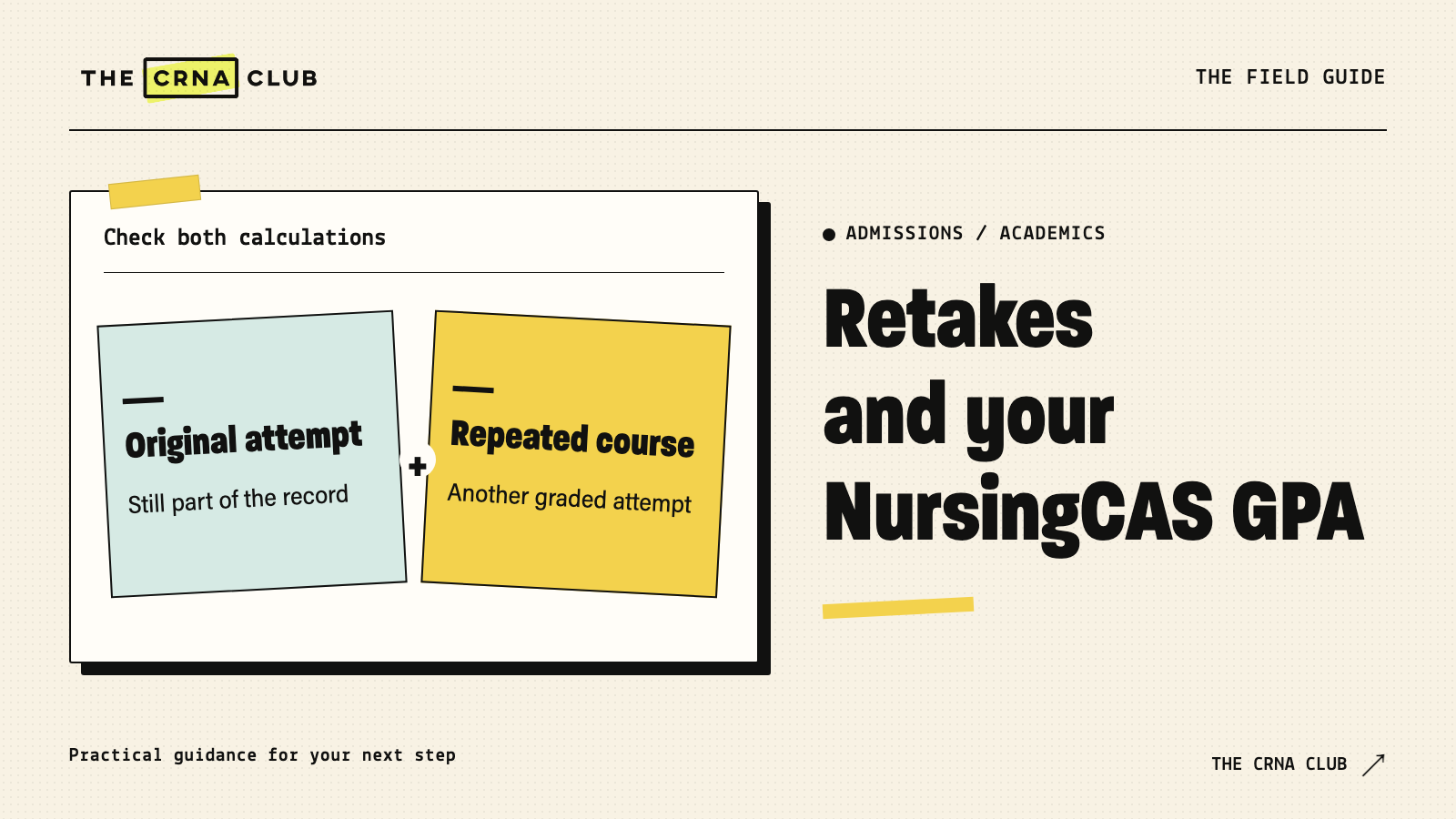
NursingCAS doesn’t use your college’s grade-forgiveness rule to erase the earlier attempt. Report the attempts as instructed, including the grade your college no longer uses in its own GPA. The later A still adds quality points. It just doesn’t delete the earlier C from the standardized calculation.
Read the official NursingCAS GPA calculation page before changing your entry. The page also explains standardized grade values and attempted-credit weighting, which create other possible differences from a college’s displayed number.
Don’t treat “repeated” as meaning “deleted.” A successful new attempt can show improved performance while the earlier grade remains part of a standardized calculation. Those statements are compatible.
Check whether your program uses full coursework entry, prerequisite entry or another setup. NursingCAS describes different calculation handling depending on the program’s transcript and entry requirements. Use the instructions for the application you’re completing rather than a screenshot from another applicant’s setup.
If the verified result looks wrong, investigate the actual entries and rules. A lower number alone doesn’t identify the cause.
How can the same two attempts produce different numbers?
The same transcript history can produce different results when the calculations include different attempts or use different review rules. Show the attempts first, then apply the named rule. Label a program-specific calculation as hypothetical unless the actual school confirms its method. You should never choose a preferred method without identifying who uses it.
Consider a hypothetical four-credit chemistry course. The first attempt is a C worth 2.0, producing eight quality points. The later attempt is an A worth 4.0, producing sixteen quality points.
| View of the two attempts | Included credits | Included quality points | Result for this example |
|---|---|---|---|
| Hypothetical college replacement policy using only later attempt | 4 | 16 | 4.00 |
| Both graded attempts included | 8 | 24 | 3.00 |
| Hypothetical program prerequisite review using higher attempt | 4 | 16 | 4.00 for that prerequisite review only |
See why the numbers differ? The first and third rows use only the later attempt under the made-up rules shown. The middle row keeps both. Check which rule actually applies before choosing a number for an application.
Different credit values add another reason to inspect the actual record. Suppose the original C carried three credits and the later A carried four. The first attempt contributes six quality points and the second contributes sixteen. Keeping both produces twenty-two quality points over seven credits, or about 3.14. Averaging the two grade values without weighting would give 3.00 instead.
This example does not establish course equivalence between institutions. It shows why you need the real attempted credits for each record. Check the program’s acceptance decision separately before assuming a differently credited course fulfills the original prerequisite.
That’s the GPA for these two attempts only. To find your science or undergraduate GPA, add the rest of the courses that belong in that group. We suggest keeping the course-level work visible so you can see which attempts and credits produced the total.
How does a retake affect a larger GPA when both attempts remain?
When both attempts remain included, add the new attempt’s credits and quality points to the existing group without deleting the old attempt. Calculate the new weighted average using the full included total. The later A changes the number and adds academic information, but it doesn’t make the original course disappear.
Suppose a hypothetical applicant has 60 graded credits and 180 quality points, a 3.00 GPA. That total already includes the original four-credit C. A new four-credit A adds sixteen quality points and four attempted credits.
The new result is 196 divided by 64, or about 3.06. Don’t subtract the original eight quality points if you’re modeling a rule keeping both attempts. That would answer a different calculation question.
If a college’s institutional GPA replaces the old attempt, its calculation may differ. Keep a separate labeled worksheet for that rule rather than changing the standardized estimate until it matches the college number.
Our science GPA calculation article helps you define the course group before doing the arithmetic. A repeated science class affects a science calculation only under the relevant classification and school rule.
Use actual quality points when available. A rounded GPA multiplied by credits produces an estimate, and small rounding differences shouldn’t become accusations of an error before the entries are checked.
What does the CRNA program decide separately?
A program decides how it applies its published admission requirements and whether it performs an additional academic review. NursingCAS’s standardized GPA does not establish every school-specific prerequisite or recent-credit calculation. Read the exact program wording and ask about an unresolved repeat rule before reporting a school-specific estimate.
Marian University’s DNP-CRNA FAQ, for example, describes an undergraduate GPA including all undergraduate coursework and additional consideration of science and recent credits. That statement illustrates a school-specific academic review, not permission to assume a higher-attempt replacement rule.
If another program explicitly states it recalculates a prerequisite using a particular attempt, record the exact wording. Keep the calculation beside the standardized record, with the school’s name and policy date.
Don’t infer a hidden committee preference from a policy silence. “The website doesn’t say” is an unresolved question if the answer would change eligibility or course choice. Ask the program directly.
A new A may provide useful evidence of changed performance even when both attempts count. But avoid promising how much that evidence will influence selection. Accurate reporting and verified requirements are the parts you control.
How should you check an unexpected verified GPA?
Open the transcript beside the entries and compare them. Are both attempts there? Are the credits and grades right? Does the repeat rule explain the difference? If something is wrong, you can now ask about that exact entry. If the data is right and both grades count, the lower number may be the correct calculation.
Compare these items with the original transcript:
- Attempts: Look for a missing or duplicated attempt in the course entry.
- Credits: Check attempted credits and whether the original unit is semester or quarter.
- Grade: Compare the transcript grade with the standardized numeric value.
- Academic level: Check the actual coursework classification.
- Subject: Compare the NursingCAS assignment with the supporting course information.
- Repeat policy: Check whether both reported graded attempts remain included.
NursingCAS provides a course-subject and GPA correction process. Follow the current process for a supported discrepancy rather than changing a subject merely to move a grade into a preferred category.
Save the explanation of what you found. “My college replaced the first attempt, while the standardized calculation kept both” is a useful resolved difference. “My GPA is wrong” leaves the actual issue unclear.
How should repeat policy affect the decision to retake?
Use repeat policy to calculate the expected numerical effect, then evaluate the prerequisite, recency and learning purpose separately. A repeat may be necessary even when the cumulative change is small. A large projected change under one school’s rule may still be irrelevant to another school’s calculation.
Before enrolling, write which requirement the class addresses and which GPA you expect it to affect. Ask whether the proposed course is accepted for the purpose. A related advanced course isn’t automatically an approved replacement for the original prerequisite.
The GPA + Prerequisites lessons walk through these academic decisions. Explore the seven-day membership trial if you want structured teaching while comparing your transcript with the actual requirements.
Keep the workload realistic. A retake intended to show improvement needs enough study time. Don’t assume familiarity with the material removes the need to review the syllabus, assignments and exam schedule.
Our Final Thoughts
Keep every attempt visible and name the calculation before comparing numbers. The college GPA, standardized GPA and program review may use the same history differently.
A later A still belongs in the story of your academic work. Report it accurately, understand the math and verify the rule that matters for each application.
Take the Next Step
Start with the free Transcript Analyzer, which includes one lifetime free analysis, and review the imported attempts and grades. Try our seven-day membership trial for GPA lessons and the manual GPA Calculator to explore the next-course effect. Use NursingCAS and school instructions for the official numbers you report.