How can I prepare for the CCRN while finishing my BSN?
Sachi, CRNA
CRNA
In This Article (10 sections)
- Which calendar should you build first?
- How much CCRN study fits in an ordinary BSN week versus a paper-due week?
- How do you fit CCRN study around a BSN paper due this week?
- Can BSN coursework count as CCRN studying?
- How should you choose an examination date?
- What should you do during a week with very little extra time?
- When should you consider postponing certification preparation?
- How do you use the CCRN planner with your BSN calendar?
- Our Final Thoughts
- Take the Next Step
Put your BSN deadlines, shifts and CCRN study on the same calendar before choosing an exam date. A paper needing four hours and six hours of certification work won’t fit into six available hours. Something needs to move.
We suggest starting with our free certification planner, then checking its schedule against your syllabus. It gives you one lifetime free plan. Our CCRN Toolkit adds video lessons and practice questions when you want the study materials beside the plan.
You don’t have to question your discipline every time a BSN assignment takes longer than expected. Look at the workload first. A useful plan needs to fit both goals.
Which calendar should you build first?
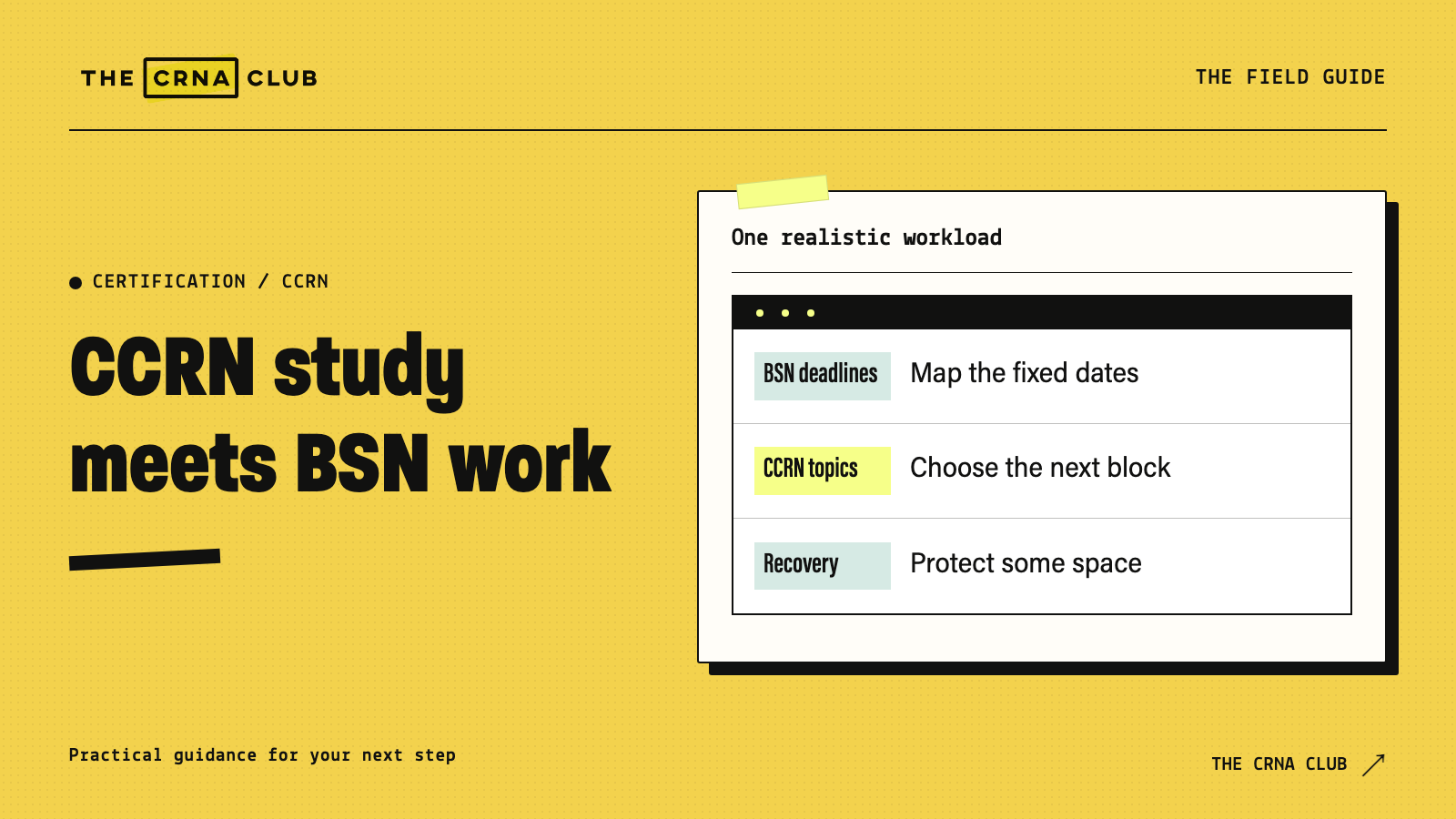
Put fixed commitments in one view:
- Course due dates.
- Exams or projects.
- Work shifts.
- Other responsibilities.
Then identify realistic study capacity around them. A separate CCRN calendar looks achievable when it hides the workload already assigned by your BSN program.
Look at the month before planning this week’s topics. Put major BSN assignments beside your shifts so you see the busy weeks early. Then use the certification planner for the available study time and compare it with those academic deadlines. It doesn’t import your syllabus automatically, so keep the course calendar visible.
Don’t estimate only the final submission date. Include time for reading, drafting and revising a substantial assignment. A paper due Sunday occupies more than the few minutes needed to upload it.
Also keep recovery visible. CDC NIOSH’s nursing guidance explains the sleep and recovery challenges associated with shift work and long hours. The hours outside work aren’t automatically available for another academic task.
How much CCRN study fits in an ordinary BSN week versus a paper-due week?
Start with hours you can actually use after shifts, sleep and other responsibilities. Then subtract the BSN work due that week. We suggest doing this before adding CCRN sessions to the planner, because a paper needs reading and revision time as well as a submission date.
Say you have six usable extra hours. These are made-up weeks to show the subtraction, not an estimate of what every BSN course requires:
| Work in those six hours | Ordinary course week | Paper-due week |
|---|---|---|
| BSN reading, assignments or paper work | 2 hours | 4 hours |
| Time left for CCRN learning and practice | 4 hours | 2 hours |
| CCRN plan | A focused lesson, questions and later review | One smaller learning-and-review sequence |
| What changes | Keep the extra practice block if it fits | Move the longer mixed set to another week |
Six minus four leaves two. Scheduling six hours of CCRN work as well as the paper would require ten hours, even though you only have six. The calendar can’t create those missing four hours.
Use your actual assignment estimate. If the paper needs all six hours, there may be no room for optional CCRN study that week. Update the plan and check what that changes about the remaining preparation before your exam date.
How do you fit CCRN study around a BSN paper due this week?
Put the paper’s remaining work on the calendar first, then give the CCRN time a specific task. In our example, four of your six hours go to the paper and two remain for certification study. You can still complete a useful lesson–practice–review sequence without pretending you have a normal study week.
For a Sunday paper deadline, the week might look like this:
| Protected block | BSN work | CCRN work |
|---|---|---|
| Friday, 2 hours | Finish reading and write the draft | None assigned |
| Saturday, 2 hours | Revise, check references and prepare the submission | None assigned |
| Sunday, 2 hours total if the paper is finished: 105 minutes now and 15 later | No remaining paper work assumed | One focused CCRN topic and review |
Now give those two CCRN hours a purpose. Suppose your practice showed that acid–base questions need more teaching. Our CCRN review includes ABG Interpretation & Acid-Base. We suggest using the relevant part of that lesson, then checking the explanation with questions:
| Part of the two-hour block | Example time | What you do |
|---|---|---|
| Lesson and your own explanation | 45 minutes | Review the confusing part, close the lesson and explain the reasoning in your own words |
| Small question set | 25 minutes | Try five unfamiliar questions related to that topic and mark guesses |
| Rationale review | 35 minutes | Review misses and uncertain correct answers; write the specific step you overlooked |
| Later recall | 15 minutes | Return to the explanation in a short block later, without the lesson open |
| Total | 120 minutes | Teaching, practice and completed review |
Reserve the last fifteen minutes for a later block within those two hours, such as later that day. If you move it to next week, include that task in next week’s available time. These times and question counts are examples. If the lesson takes longer, reduce the set or move the questions to the next session. Don’t rush the review to preserve a number.
If Saturday’s revision takes another hour, you have one CCRN hour left. Choose the lesson and explanation, then move practice and review together to the next available block. Update the planner so unfinished work has a real date. If the same collision keeps happening, reconsider the overall exam timeline instead of calling every week an exception.
Can BSN coursework count as CCRN studying?
Use coursework as background when it addresses a relevant concept, but check examination preparation separately against the applicable plan. A course title or completed assignment doesn’t establish coverage of every related certification topic. Ask what you now explain and which examination-specific gaps remain.
AACN’s preparation guidance points candidates to the test plan and self-assessment. Use those documents to check actual preparation instead of assuming any nursing academic work replaces the full review task.
For example, a course assignment might help you discuss evidence or patient education more clearly. That learning is useful. You still need to check how it connects to the applicable outline and whether you apply it in unfamiliar situations.
After a relevant BSN assignment, try a few unfamiliar CCRN questions on that concept. If you can explain the reasoning, move to the next gap. If you still need a particular step explained, put that part of the CCRN lesson on the calendar. The assignment can contribute to learning without standing in for the whole exam outline.
How should you choose an examination date?
Check eligibility first, then compare remaining preparation with actual capacity across the academic calendar. Include heavier assignment weeks and current scheduling rules. An examination date should give the work a practical timeline, while leaving room to respond when your learning needs or course workload differ from the first estimate.
Our CCRN overview gives general context for planning. Use official AACN documents for exact eligibility and process requirements rather than estimating from employment duration alone.
If you’re working toward a CRNA application deadline, check when each school requires the credential. One program might require it at application while another has a different policy. Read the actual criteria before treating the earliest assumed deadline as a reason to compress every goal into this month.
One program’s policy doesn’t establish another’s. Keep a short record of what each target program asks for and where you verified it before compressing both academic and certification work around an assumed deadline.
What should you do during a week with very little extra time?
Choose a small task with a clear purpose, or pause optional study deliberately. Retrieval of previously learned concepts fits some crowded weeks better than starting a large unfamiliar topic. Record when the next focused block will happen so a temporary reduction doesn’t become an undefined plan to resume eventually.
A short task might ask you to explain one prior error-log entry without notes. Another might involve checking which topics need attention after the major assignment is finished.
Don’t replace a missed hour with an unrealistic promise to study twice as long tomorrow. Look at tomorrow’s calendar first. If the assignment already occupies it, choose the next available appointment.
Also avoid comparing a low-volume week with someone else’s open week. Your useful measure is whether the choices fit the workload and preserve a realistic path for both goals.
When should you consider postponing certification preparation?
Consider changing the timing when the combined plan repeatedly leaves important coursework or learning gaps unaddressed, or when recovery keeps disappearing to make the schedule fit. Review what your target programs require before deciding. A deliberate timeline change sometimes creates space to complete the work more responsibly.
The decision needs evidence from your actual calendar. One busy evening doesn’t settle it. Several weeks of missed appointments and unfinished review tell you something different.
Our CCRN application strategy guide helps separate credential policy from broader preparation. Don’t assume another credential compensates for academic performance or removes a program’s degree requirement.
If your available time is uncertain, test a short planning period before booking around an optimistic estimate. Review what you completed, what needed more time and whether the next academic block looks similar.
How do you use the CCRN planner with your BSN calendar?
Use a planning tool to organize dates and topics around constraints you already understand. Keep the inputs accurate, review the result and adjust around academic deadlines. The tool shouldn’t require maintaining a second imaginary week with no coursework on it.
Try our planner, CCRN video lessons and practice questions in the seven-day membership trial. Use a week from your real course calendar. Choose a lesson you need, place it around work and coursework, and see whether the amount assigned fits the time you use.
The CCRN Toolkit gives you a focused option for the planner, CCRN teaching and questions. Broader membership is useful when you’re also working on other application needs. Choose the help matching what you’re doing now instead of adding another resource because the week feels stressful.
A tool becomes useful when it reduces the work of starting the next session. If you spend more time adjusting colors than learning or completing coursework, simplify the planning process.
Our Final Thoughts
Put the two goals on the same calendar. Protect the coursework already due, acknowledge recovery and assign certification tasks to the capacity you really have. A realistic slower week gives you more useful information than a packed schedule you keep missing.
Take the Next Step
Use the free certification planner after checking your course deadlines and shifts. It includes one lifetime free plan. Review the proposed calendar alongside your academic workload, then adjust the study blocks to fit both commitments.