How can I study for the CCRN while working three 12-hour shifts?
Sachi, CRNA
CRNA
In This Article (10 sections)
- How do you start a CCRN study schedule around shifts?
- What does a six-hour CCRN week around three shifts look like?
- What exactly would you do in those off-day blocks?
- How do you choose the next topic instead of repeating your strongest subject?
- How could you build an adjustable eight-week plan?
- What should you move when Saturday becomes an extra shift?
- How does night shift change the sample?
- How do you enter workdays and adjust the planner after overtime?
- Our Final Thoughts
- Take the Next Step
Build your CCRN week around your shifts and recovery first. Use longer blocks for new teaching and practice review, with lighter or optional workday tasks. Below, we’ll work through a six-hour sample week and an adjustable eight-week progression, including what to move when overtime takes a study day.
Start with our free certification planner. It gives you one lifetime free plan and lets you mark workdays for lighter assignments. Our CCRN Toolkit includes the planner, CCRN video lessons and practice questions when you want the teaching beside the calendar.
Four days off doesn’t mean four empty study days. Let’s give each usable block a specific job.
How do you start a CCRN study schedule around shifts?
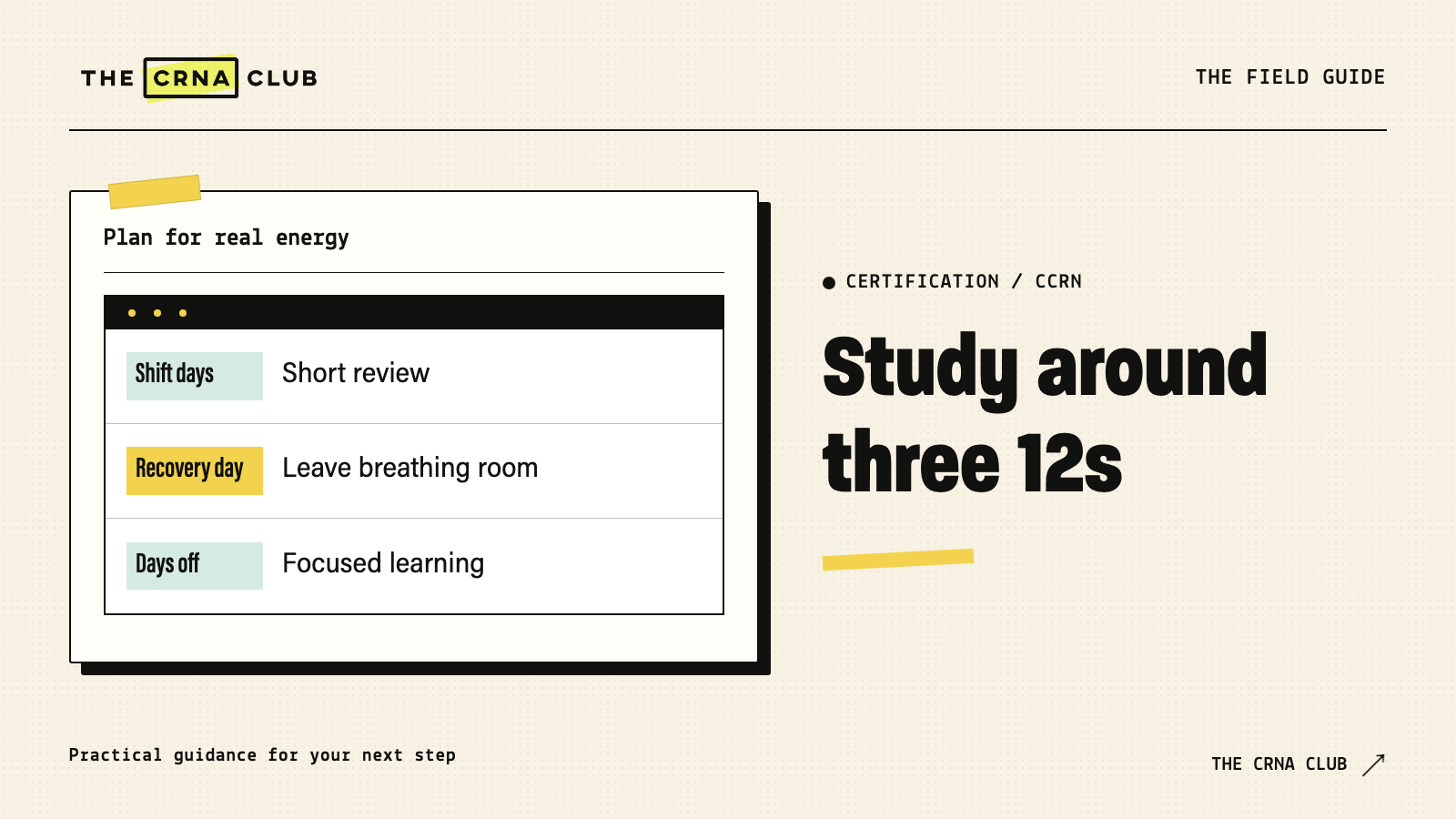
Mark shifts, fixed responsibilities and recovery before assigning topics. Look at the month to see clustered shifts and busy weeks, then choose the lesson and review task for each usable block. We suggest planning from time you’ve actually used successfully, rather than treating every empty square as available.
CDC NIOSH’s nurse training explains how shift work and long hours affect sleep and recovery. A calendar should leave room for those needs.
Write down the appointments you could realistically keep this week. If Friday has a reliable block and Thursday usually disappears into recovery and errands, put the difficult lesson on Friday. You don’t need to make all four days look equally productive.
What does a six-hour CCRN week around three shifts look like?
This example puts essential learning after the shift stretch and gives questions their own review time. It’s a manually adjusted sample, not an exact schedule automatically produced by our planner. Six hours is this hypothetical nurse’s available time, not a required weekly minimum or a promise that every learner will need the same amount.
Assume three twelve-hour day shifts, Monday through Wednesday, from 7 a.m. to 7 p.m. A previous check identified difficulty explaining respiratory versus metabolic acid-base problems.
| Day | Work and recovery | Sample study appointment |
|---|---|---|
| Monday | Twelve-hour shift | Optional ten-minute review of a familiar learning point, if rested |
| Tuesday | Twelve-hour shift | No CCRN task planned |
| Wednesday | Twelve-hour shift | Optional ten-minute familiar review, or leave it |
| Thursday | Recovery and home responsibilities | 20 minutes to check the outline, choose the gap and plan |
| Friday | Protected focused block | 100 minutes for acid-base teaching, explanation and initial practice |
| Saturday | Protected focused block | 120 minutes for fresh topic practice, review and follow-up |
| Sunday | Protected focused block | 120 minutes for mixed practice, review and next week’s plan |
The essential appointments total 360 minutes, or six hours. The optional workday reviews aren’t included. Skipping either one creates no catch-up assignment.
Use the lessons and question bank in our CCRN Toolkit for different parts of this week. The video helps with the explanation you don’t understand. The questions show whether you use it when the details change. The planner gives the follow-up a date, so you aren’t deciding what to study from scratch every evening.
What exactly would you do in those off-day blocks?
Give each appointment a topic, a resource and something you should be able to do afterward. For this sample, Friday’s goal is explaining the primary acid-base problem in a simple example. Watching a video is part of that work. Explaining it without the video is the check.
-
Friday, 100 minutes: Spend ten minutes identifying the part you can’t explain. Allocate forty minutes to the relevant section of our ABG Interpretation & Acid-Base lesson, pausing as needed. Use twenty minutes to explain a simple example without notes. Leave thirty minutes for a small topic set and initial rationale review. These are study allocations, not claims about video length.
-
Saturday, 120 minutes: Start with ten minutes recalling Friday’s explanation. Use thirty-five minutes for fresh topic questions and fifty-five for reviewing uncertain or wrong choices. Spend the remaining twenty on professional-caring practice or the unresolved clinical gap. If the review needs that time, use it there and move the other task.
-
Sunday, 120 minutes: Allocate forty-five minutes to unfamiliar mixed practice, including professional caring, fifty to review and targeted repair, and twenty-five to checking remaining coverage and adjusting next week.
Choose a set size that fits those blocks at your pace. A correct guess still deserves review. If you finish answering but don’t understand the rationale, the learning task remains open. Write what needs another pass and when you’ll return.
How do you choose the next topic instead of repeating your strongest subject?
Compare your gaps with the current official outline, including topics you rarely encounter at work. Then name the explanation you need, rather than writing an entire body system as one appointment. “Explain the difference between these two problems” gives you a clearer starting point than “finish respiratory.”
AACN’s preparation guidance recommends the test plan and self-assessment, including patient problems you don’t see often. Keep that full scope beside your calendar.
If Friday’s lesson raises another question, make the next task specific. Which part was unclear? Where will you find the explanation? What unfamiliar example will you use afterward? Our CCRN lessons help you return to that topic without restarting the whole course.
Keep professional caring in the rotation too. Our professional caring and ethics lessons help you work through the reasoning when those practice questions reveal a gap. Don’t leave that work until every clinical topic feels finished.
How could you build an adjustable eight-week plan?
Here’s one way to spread the work across eight weeks. Start with the gaps you can name, broaden your coverage, then make more room for mixed practice and review. Follow the full AACN outline and extend the plan when you need more time; eight weeks is an example, not an AACN requirement.
| Week | Example emphasis | What to check before moving on |
|---|---|---|
| 1 | Audit the full outline, try mixed practice and address the acid-base gap in the sample above | Did the appointments happen? What explanation still needs teaching? |
| 2 | Prioritize an actual cardiovascular or respiratory gap, such as Heart Failure or Respiratory Failure | Apply the explanation to new details, then revisit it later |
| 3 | Work on unfamiliar renal, endocrine, GI or hematology topics from your audit | Name remaining subtopics; one lesson doesn’t complete several systems |
| 4 | Broaden beyond usual patients, perhaps with a neuro or behavioral topic | Compare remaining coverage with observed time; extend the plan if needed |
| 5 | Address multisystem and omitted outline topics, such as sepsis or toxicology | Revisit earlier gaps while checking for areas you’ve avoided |
| 6 | Alternate fresh mixed practice with targeted teaching | Separate a small retrieval problem from a whole unfamiliar subject |
| 7 | Rehearse pace when useful and repair defined gaps | Protect a longer practice and review appointment by moving other work |
| 8 | Focus on remaining review and verify current appointment instructions | Reconsider timing if broad learning needs still don’t fit |
Include professional-caring practice throughout these weeks. The table’s example clinical topics don’t replace the full outline or prescribe equal time for every system. Use official topic weights and your actual gaps to guide emphasis.
At the weekly check, compare planned and completed time. If six hours repeatedly becomes three, plan from three while you work out what needs to change. More untouched material may require more weeks. Changing the calendar is more useful than pretending an entire system fits because it occupies one table row.
Our CCRN overview gives broader context while you build those appointments. Use official AACN materials for exact scope and examination requirements.
What should you move when Saturday becomes an extra shift?
Recalculate the time left before moving tasks. In this example, losing Saturday removes 120 minutes. Your week falls from 360 to 240 minutes, or from six hours to four. Sunday’s two-hour block doesn’t grow because Saturday’s learning still needs attention.
Suppose Friday revealed a gap that needs more teaching. Keep Thursday’s twenty-minute planning appointment and Friday’s hundred minutes. Use Sunday’s 120 minutes for the targeted follow-up and review. Move the mixed check into a real next-week block, replacing or shortening something else there if necessary.
If the explanation is clearer and broader coverage needs checking, keep Sunday’s mixed practice and move the remaining topic task instead. Choose from the actual learning need.
In the planner, drag the task to its new date and review the destination before saving. With the CCRN Toolkit or membership trial, you can save your adjusted plan to the calendar. The free planner lets you generate one plan, with calendar saving available through paid or trial access.
How does night shift change the sample?
Put recovery where it actually happens, including across calendar dates. If three night shifts begin Monday, Tuesday and Wednesday, the last finishes Thursday morning. Thursday isn’t automatically a free day for a long lesson. Our planner doesn’t infer your sleep needs or the hours a shift spans.
Move or omit the sample’s twenty-minute Thursday planning task if it doesn’t fit after recovery. Find its time in a usable later block, or accept a smaller total. Don’t stay awake longer just to preserve the six-hour example.
The optional workday reviews stay optional. Keep difficult new learning in a block where you’re alert enough to pause, explain and check understanding. Essential preparation shouldn’t depend on quiet clinical downtime or a recording playing during a commute.
Observe which appointments work during schedule transitions. If the same one repeatedly disappears, choose another time rather than keeping it because a daytime template used that date.
How do you enter workdays and adjust the planner after overtime?
Choose your study duration or target date, then mark your actual work dates. The planner uses those dates for lighter assignments and preselects shifts you’ve already entered in the CRNA Club calendar. Add recovery time yourself before choosing the final workload.
Review the generated calendar before relying on it. Drag tasks that don’t fit to a suitable date, then save changes when your access includes saving. Check workday assignments too, and move them when you need that time for rest.
Try the lessons, questions and planning together through the seven-day membership trial. Bring a real week, work through one gap and check whether the assigned amount fits.
If a CRNA deadline is adding pressure, check how CCRN fits an application and verify each target program’s timing before compressing the study calendar.
Our Final Thoughts
Give the next usable block a job you understand. Learn the explanation, practice using it and leave time to review. When work changes, change the dates and amount honestly. You don’t need identical study days to make progress.
Take the Next Step
Use the CCRN Toolkit for teaching, questions and planning together. If you already have materials, try the free certification planner for one lifetime free plan. Start with your actual workdays and adjust around recovery.