How Do CRNA Schools Calculate Your Last 60 Credits?
Sachi, CRNA
CRNA
In This Article (8 sections)
- What does a last-60-credit GPA mean?
- What information should you collect before calculating?
- How does a semester-credit ledger work?
- How does quarter-credit coursework change the ledger?
- What questions should you ask about the boundary?
- How should you use the result to choose your next action?
- Our Final Thoughts
- Take the Next Step
Your last-60-credit GPA is the credit-weighted average of your most recent 60 credits, using the program’s rules for which courses count, credit units and where to stop. We suggest starting with our Transcript Analyzer to bring your records together. Then check the school’s course and cutoff rules before using the result. The seven-day trial also includes GPA lessons and school research tools to help you plan the next step.
You go to School A’s website and see “undergraduate GPA.” School B mentions the last 60 credits too. Those phrases don’t give you permission to use whichever number looks best. They tell you which calculation questions you need to answer before choosing your school list.
We suggest checking which numbers your target schools actually use before taking another class. Our GPA types guide explains the broader categories. Let’s work through the recent credits here, including what to do when the cutoff lands halfway through a term.
What does a last-60-credit GPA mean?
It’s the weighted average of a specific group of recent courses. Which courses? That depends on the school. Check whether it means undergraduate work, whether graduate classes belong, and what happens when a term takes you past 60 credits. Earlier grades can still appear in the other GPAs the school reviews.
For example, Marian University’s current DNP-CRNA FAQ states its undergraduate GPA includes all undergraduate courses and that science GPA and the last 60 completed credits also receive consideration. Keep that description under Marian’s row in your school notes.
Put each school in its own row. Does it say last 60 undergraduate credits, or something broader? If graduate courses aren’t addressed, email and ask. We suggest keeping the answer with that school in your research notes so you don’t accidentally use School A’s rule for School B.
Keep an unofficial estimate labeled as an estimate. The program determines its official calculation. You want enough accuracy to make a useful plan without pretending an unresolved boundary rule is settled.
What information should you collect before calculating?
Gather course-level records from every institution that might contribute to the group, including repeated attempts. A list of degree GPAs alone doesn’t supply the details needed for a recent-credit calculation.
NursingCAS explains credit-weighted GPA calculation and quarter-to-semester conversion. Its standardized calculations and a program’s particular last-60 review are separate tasks. Don’t assume the application service automatically decides every school-specific boundary question.
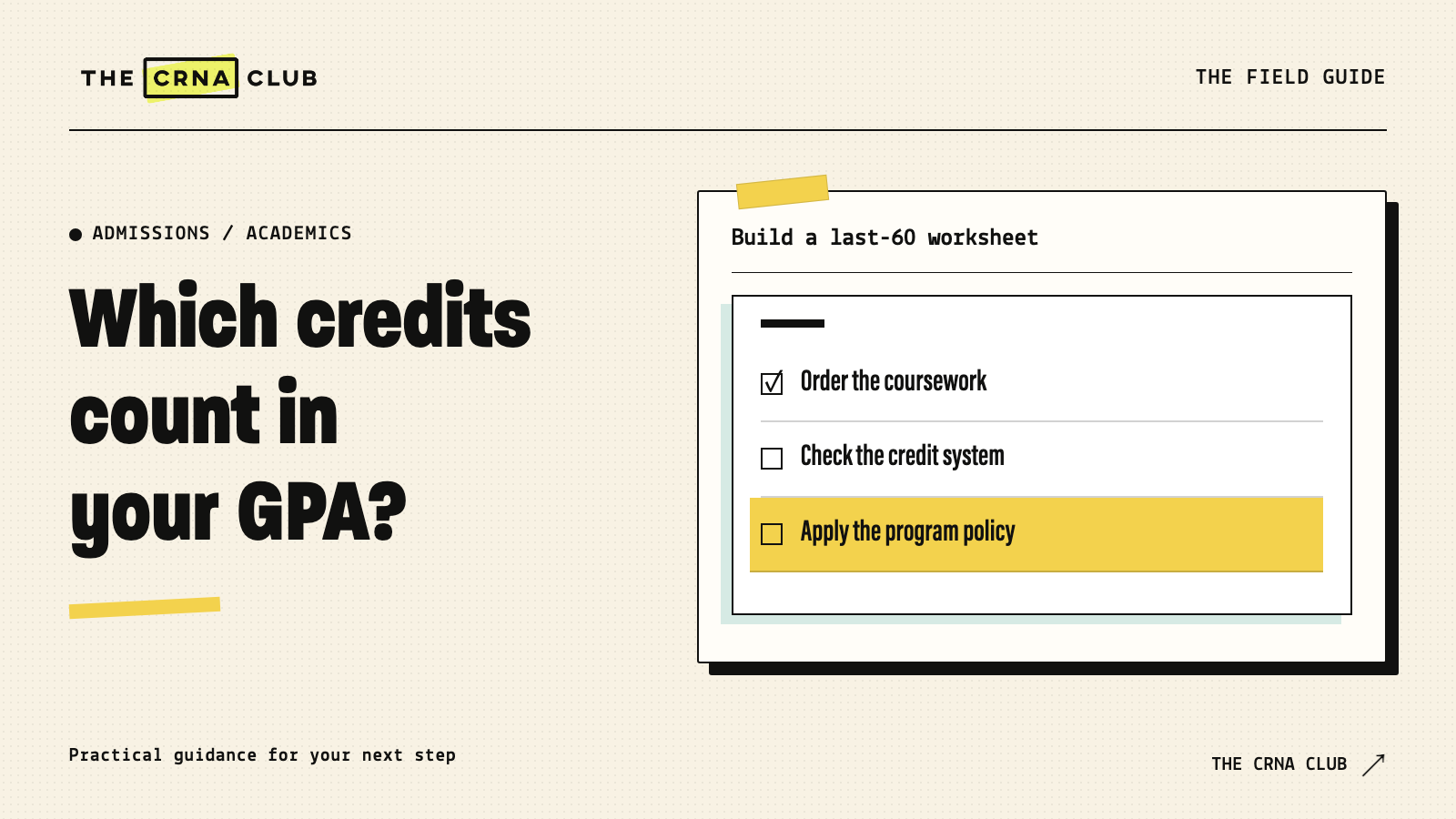
Use one row per course in your working ledger. Record:
- Institution and term: Keep the course date visible for chronological selection.
- Academic level: Use the actual course classification.
- Attempted credits and original unit: Keep semester and quarter credits distinguishable.
- Converted credits, if needed: Use the applicable conversion rules.
- Grade and numeric value: Follow the appropriate grade-value rules.
- Quality points: Multiply the numeric grade value by the included credits.
Sort chronologically using the program’s instructions. Courses in the same term need special attention when the boundary lands inside that term. Don’t choose the strongest grades from that term because the date order is unclear.
Also identify non-graded work before calculating. Whether a course belongs in a particular review and whether it contributes GPA quality points are different questions. Follow the actual calculation rules instead of assigning a letter-grade value to pass credit yourself.
How does a semester-credit ledger work?
Use these steps for a semester-credit calculation:
- Select the courses under your program’s instructions, including its boundary-term rule.
- Put them in date order and keep the included credits beside each grade.
- Multiply credits by the numeric grade value for each course to get its quality points.
- Add the quality points and included graded credits separately.
- Divide total quality points by total included graded credits.
The arithmetic does not decide which courses belong or how a boundary term should be handled.
The following hypothetical ledger uses grouped terms to keep the example readable. An actual working ledger should retain the individual courses. Assume the school accepts these courses and requires the whole term crossing the 60-credit boundary:
| Term, newest first | Graded semester credits | Quality points | Running credits |
|---|---|---|---|
| Most recent | 15 | 60 | 15 |
| Prior term | 15 | 49.5 | 30 |
| Prior term | 15 | 45 | 45 |
| Boundary term | 18 | 57 | 63 |
In this made-up example, the school includes the whole cutoff term. So you have 63 credits and 211.5 quality points. Divide 211.5 by 63 and you get about 3.36.
Retain the unrounded totals in your working file. Round only when the school or application instructions call for it, so a displayed estimate does not hide how you reached the result.
Is 63 credits automatically wrong? No. It works if that school includes the whole term. Another school may use a different cutoff, so use its instructions before doing the same calculation.
If the school instead specifies an exact-credit or whole-course method, follow that method. Don’t remove the lowest-grade course from the boundary term just to reach a convenient total. Ask how the school orders or includes the tied-term courses.
How does quarter-credit coursework change the ledger?
Keep the original credit unit and convert consistently when the calculation requires semester credits. NursingCAS uses a conversion of one quarter credit to 0.667 semester credits. A school’s specific recent-credit review still needs its own instructions, especially for mixed calendars and the term crossing the boundary.
Here is a second hypothetical ledger. For illustration, use an exact two-thirds conversion so the arithmetic is easy to inspect. The official system’s stated conversion and rounding rules control an actual application:
| Term, newest first | Graded quarter credits | Approximate semester equivalent | Quarter quality points |
|---|---|---|---|
| Most recent | 18 | 12 | 72 |
| Prior term | 18 | 12 | 63 |
| Prior term | 18 | 12 | 54 |
| Prior term | 18 | 12 | 72 |
| Boundary term | 21 | 14 | 63 |
| Total with whole boundary term | 93 | 62 | 324 |
The whole-term group extends beyond approximately 60 semester credits to 62. Its GPA is 324 divided by 93, or about 3.48. Converting both credits and quality points consistently preserves the weighted GPA, apart from applicable rounding effects.
You shouldn’t combine 324 quarter-based quality points with 62 semester credits. That mixes units and produces nonsense. Keep the units visible at every step, especially when one transcript uses quarters and another uses semesters.
If a program says “60 credits” without identifying the unit or conversion method, ask. The difference is too consequential to settle by assumption.
What questions should you ask about the boundary?
Ask how the program handles the course or term that takes the running total past the requested credit limit. Also ask which academic levels, repeated attempts and non-graded courses belong in the group. Request the method before submitting a self-reported number so your estimate follows the school’s actual instructions.
A useful email is specific:
I’m preparing my academic review for the upcoming application. Your page mentions the last 60 credits. Does this refer to semester-equivalent undergraduate credits, or does it include later graduate coursework? If the 60-credit boundary falls within a term, do you include the entire term, whole courses or another method? I have both semester and quarter transcripts and would appreciate the conversion instructions.
Keep the response with your policy ledger and note the date. If the program supplies a worksheet, use it. If it says admissions calculates the figure internally, don’t insist your own estimate should replace its method.
You don’t need to send a long story about every grade to ask a calculation question. Give the relevant issue and enough information to receive a useful answer. Save the full academic explanation for the place the application requests it.
How should you use the result to choose your next action?
Use the recent-credit result alongside the other GPA and prerequisite requirements, rather than as a reason to ignore them. Identify whether the number affects eligibility, adds context to an upward trend or answers a school-specific review question. Then choose coursework only if it addresses an actual remaining need.
Our science GPA calculation article covers a different course group. Keep that calculation separate. A strong last-60 estimate doesn’t establish a strong science GPA, and another science course won’t necessarily change the recent-credit group the way you expect.
The GPA + Prerequisites lessons explain how to connect these numbers with a practical school and course plan. Explore those lessons through the seven-day membership trial if you want help understanding which academic question to tackle next.
Before paying for another class, write which policy or evidence gap it addresses. If the only explanation is “I want the number to look better,” calculate the effect and check whether that number is one the school uses.
Keep a dated copy of the course list used for each estimate. If you finish another class before applying, the recent-credit window may change under that school’s rule. Rebuild the selection first, then recalculate. Adding the new grade to an old subtotal without checking which earlier credits move outside the window can produce the wrong result.
Our Final Thoughts
Get the school rule first, then do the math with the correct courses and units. An earlier degree and a strong recent record deserve accurate calculation, not guesswork around a cutoff term.
If one policy detail is missing, ask that specific question. A clear answer now is easier to work with than discovering later that your unofficial estimate used a different group of courses.
Take the Next Step
Start with the free Transcript Analyzer to organize your records and review the courses it extracts. It includes one lifetime free analysis. For help connecting those numbers with your school list, try our seven-day membership trial for GPA + Prerequisites lessons and school research tools. Keep each school’s last-60 instructions beside the calculation.