How do you organize postoperative cardiac-surgery complications for CSC study?
Sachi, CRNA
CRNA
In This Article (9 sections)
- How should you start a complication worksheet?
- How do timing and procedure help without deciding the diagnosis alone?
- How do you organize the physiology behind postoperative hypotension?
- How should you study tamponade without memorizing one classic picture?
- How do you cover complications outside the cardiovascular system?
- What should a worked comparison exercise include?
- How do you review complication questions you miss?
- Our Final Thoughts
- Take the Next Step
For CSC complications, connect the operation and timing with what changed in the patient, then compare the possible causes. We suggest our cardiac physiology lessons for the mechanisms, CSC questions for practice, and the CSC planner to cover the topics you rarely see. You can try them with the seven-day membership trial, then use the comparison worksheet below to organize your notes.
A list of complication names is a starting point. It doesn’t tell you why your patient’s perfusion changed or which piece of information would separate two plausible explanations. Build your notes around those questions.
The AACN CSC test plan, effective on or after November 19, 2026, assigns 37% to complications. Keep the whole list beside your notes so cardiac problems don’t crowd out respiratory, neurologic, renal and other complications you need to study.
How should you start a complication worksheet?
Start with what happened. Which operation did the patient have, how long ago, and what changed? Then ask what could explain those findings. An unexpected pressure drop gives you a finding to investigate. It doesn’t tell you whether the main problem is filling, ventricular function, vascular tone or more than one of those.
Use a hypothetical case with worsening perfusion after surgery. “Hypotension” describes a finding. It doesn’t identify whether the problem involves circulating volume, ventricular performance, vascular tone, mechanical obstruction or several factors together.
Write the known information before looking for a label. Which procedure occurred? What changed over time? Are the rhythm and measured pressures reliable? What do the exam and trends show? If important information is missing, leave the uncertainty visible.
Organize postoperative complications around the physiologic effects of surgery and support. Use that connection in the worksheet. Ask why the findings occur so the conditions don’t become an unrelated list of definitions to memorize.
For a focused drainage concern, use our cardiac-surgery chest-drainage article. This article takes the broader study task: comparing possible explanations and checking the rest of the complications outline.
How do timing and procedure help without deciding the diagnosis alone?
Timing and procedure shape which explanations deserve attention, but they don’t prove a diagnosis without supporting findings. Keep them beside the clinical picture. A useful study case asks how the operation and postoperative course affect your reasoning, then adds enough information to compare the plausible problems.
Consider a hypothetical case immediately after surgery and a second case later in recovery. Some questions and risks overlap, but the history and events between those points differ. Your explanation should account for those differences rather than treating “postoperative” as one uniform state.
Avoid rigid timing rules in your notes unless a current source supports the exact rule. A complication associated with an early period isn’t impossible later simply because your table has a different heading.
Write the procedure’s relevant implications too. If you haven’t learned what the procedure changes, review that foundation before memorizing the complication list. Otherwise, the postoperative findings feel arbitrary and the question becomes harder to reason through.
Keep these fields in your study worksheet:
- Procedure: What operation did the patient have?
- Time: How long has it been since surgery?
- Baseline: What did the earlier assessment show?
- Change: What is different now?
- Unanswered question: What do you still need to understand?
Use a hypothetical case for study; you don’t need to reconstruct a real patient’s chart.
How do you organize the physiology behind postoperative hypotension?
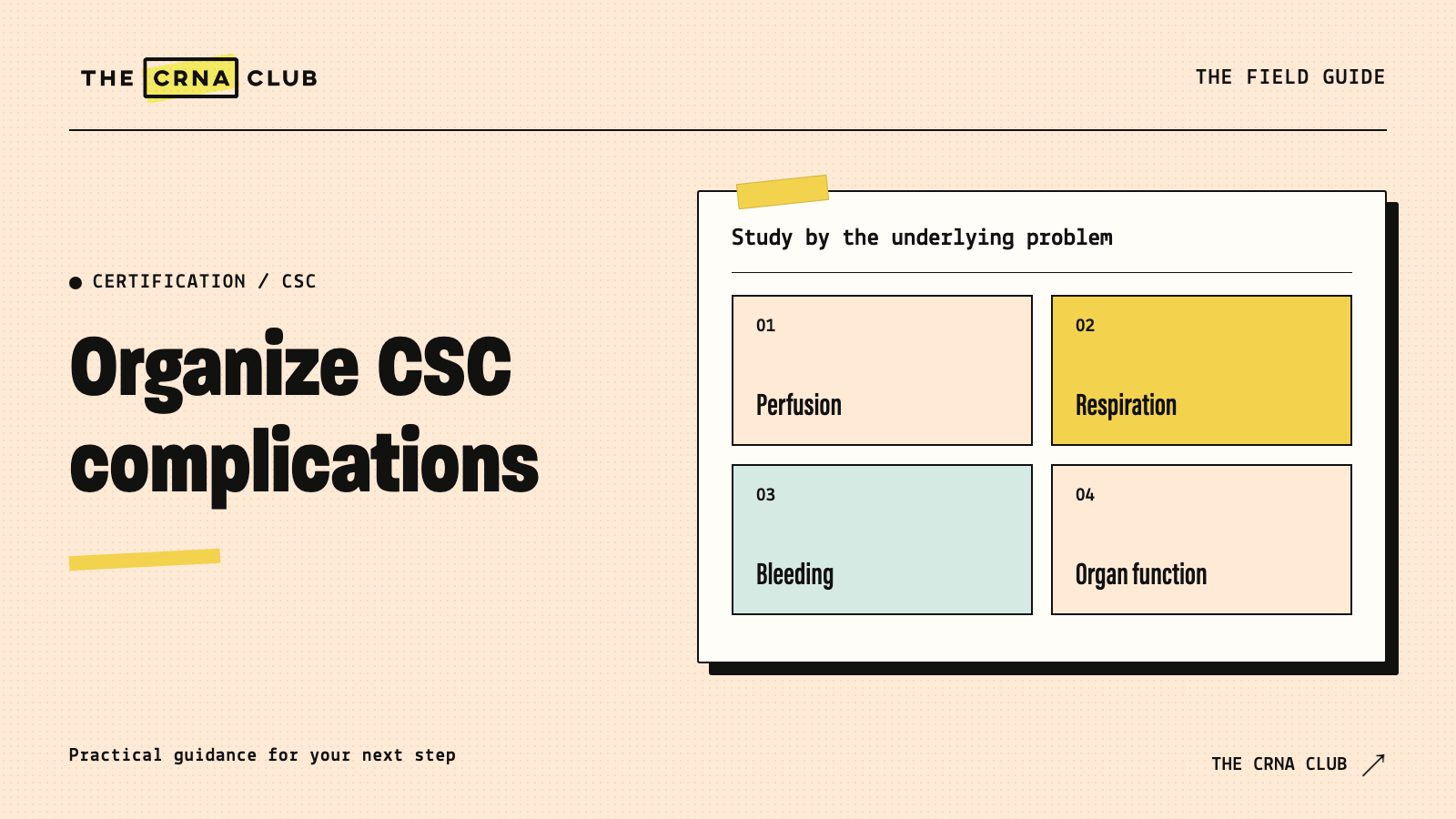
Compare the mechanisms that affect flow and pressure, while allowing mixed problems. Low vascular resistance, impaired ventricular performance, inadequate filling and obstruction require different explanations. A pressure reading alone doesn’t distinguish them. Use the complete hypothetical case and reliable measurements to decide which mechanism the evidence supports.
A suggested study comparison is:
| Mechanism to investigate | Question to explain | Information needing context |
|---|---|---|
| Inadequate circulating volume | What evidence supports loss or insufficient filling? | History, exam, trends and response |
| Ventricular dysfunction | What suggests impaired forward flow? | Flow assessment, congestion and ventricular findings |
| Reduced vascular tone | What suggests low resistance rather than pressure alone? | Pressure, output and the full situation |
| Mechanical restriction | What supports impaired filling or ejection? | Relevant imaging, procedure context and clinical findings |
| Rhythm contribution | How does the rhythm affect effective circulation? | ECG plus perfusion assessment |
Could more than one row fit the same patient? Yes. Poor ventricular function and low vascular tone can occur together. Use the table to compare the findings, then explain which questions you still need answered.
The 2025 AHA special-circumstances resuscitation guideline identifies important causes of arrest after cardiac surgery, including arrhythmia, tamponade and severe hypovolemia from bleeding. Arrest care has specific considerations. Don’t derive a generic emergency algorithm from a short study table.
How should you study tamponade without memorizing one classic picture?
Study tamponade as hemodynamic impairment from external cardiac compression, then compare the findings with other postoperative explanations. An effusion and tamponade aren’t interchangeable terms. The effect on filling and circulation matters, and the postoperative setting may not reproduce every classic textbook sign in a neat group.
We suggest the Cardiac Tamponade & Pericardial Effusion lesson when the filling problem feels unclear. External compression can limit filling, which reduces forward flow. But the patient can also have ventricular dysfunction. Learn the mechanism without assuming every postoperative case has only one problem.
For a hypothetical case, write what supports concern for restriction and what information would help assess it. Don’t make a single pressure value or drainage change sufficient proof. Connect the observations with the procedure and overall deterioration.
Keep the distinction between a study explanation and emergency treatment explicit in your own notes. Understanding the mechanism supports recognition, while current cardiac-surgery resuscitation guidance governs specific emergency actions. This worksheet isn’t a reason to wait for every classic sign in a deteriorating patient.
After reading, compare a second hypothetical case with a different mechanism. Explain why the same low blood pressure doesn’t make the explanations equivalent. That comparison is more useful than memorizing one dramatic presentation alone.
How do you cover complications outside the cardiovascular system?
Use the full outline as a checklist and give noncardiac complications their own study questions. Postoperative care includes respiratory, hematologic, neurologic, gastrointestinal, renal and other problems listed by AACN. Familiar hemodynamics shouldn’t absorb all the study time while these areas remain names you haven’t learned to interpret.
Choose an unfamiliar system and ask what changed, which observations matter and how the complication affects the rest of the patient. For a respiratory topic, connect ventilation and oxygenation concepts with the case. For a renal topic, connect trends and relevant exposures rather than memorizing a diagnosis beside one laboratory value.
Use a suitable reference section for the mechanism you don’t understand. The AACN CSC bibliography helps identify sources. Avoid copying outdated thresholds or statistics from older chapters into current notes without verification.
Track coverage separately from confidence. You might have strong cardiac explanations and untouched neurologic topics. Both facts belong in the plan. A mixed question set helps expose those uneven areas, but the outline is still necessary to find what the bank hasn’t sampled.
What should a worked comparison exercise include?
Compare two practice cases and explain why you choose different causes. Which findings support each one? What would make you change your mind? We suggest writing those answers before looking at the choices, then changing a rhythm or pressure detail to see whether your explanation changes too.
Use these two simplified study cases:
| Both cases have falling blood pressure | What you know | What to investigate |
|---|---|---|
| Case A | Output has fallen and the supplied echo describes reduced ventricular function | How impaired forward flow fits the rest of the assessment, and whether another problem is present |
| Case B | Output is preserved, measured resistance is low, and the setup has been checked | How reduced vascular tone fits the findings, and what other causes still need assessment |
The pressure is falling in both. The extra findings change your explanation. Now remove the output information: write what you would need to learn before treating the cases as equivalent. These are reasoning examples, not treatment algorithms.
Then add a rhythm change or uncertain measurement to one case. Does your original explanation remain sufficient? If not, name what needs reassessment. You are practicing how new information changes a working explanation.
Use our shock-pattern article for foundational comparisons. Keep mixed postoperative mechanisms in view when applying a simplified pattern. A study chart works best when you understand where it stops being a complete description.
How do you review complication questions you miss?
Record whether you missed the mechanism, the surgical context, a distinguishing finding or the question task. Then choose a targeted review and a different case later. Copying the complication name beside a score doesn’t show which part of the explanation needs work or whether a later correct answer reflects understanding.
A useful error entry might say, “I treated the pressure reading as the diagnosis and ignored the flow information.” The next task is interpreting a complete case, not memorizing another isolated pressure threshold.
Another entry might say, “I didn’t know the procedure described.” That needs procedure teaching before more complication questions. Keep the review aligned with the actual gap.
Our Final Thoughts
Keep the complication connected to the patient: the operation, timing, physiology and changing findings. Use the outline to protect breadth and a reference to deepen the explanations that remain unclear.
You don’t need every postoperative problem to fit one tidy chart. You need to recognize when a chart helps and when the case requires a fuller explanation.
Take the Next Step
Try our seven-day membership trial and choose a complication you still find hard to explain. Use the cardiac lessons for its foundation, CSC questions to practice, and surgical reading for the procedure-specific detail. Add the topic to your CSC planner alongside a later mixed review, so familiar cardiac cases don’t take all your study time.