How do you study ECGs, diagnostic tests and monitoring for the CMC?
Sachi, CRNA
CRNA
In This Article (8 sections)
- How should you organize ECG practice?
- How do you study tests you rarely see ordered?
- How should you interpret a laboratory result during practice?
- How do you connect a test result to a patient case?
- How do you prevent familiar rhythm questions from taking over your schedule?
- How should you use a 30-minute CMC practice block?
- Our Final Thoughts
- Take the Next Step
For CMC ECGs and diagnostics, learn what each test tells you, then connect the result with your patient. We recommend our CMC Review’s ECG and cardiac-laboratory lessons, followed by questions on the tests you use less often. The seven-day membership trial includes that teaching, CMC questions and a planner to help you make time for the unfamiliar topics.
If telemetry feels familiar while echocardiography or invasive monitoring feels less comfortable, give those gaps their own study time. The CMC outline covers several diagnostic tools. Repeating your strongest rhythm strips won’t teach you what an unfamiliar test measures.
Keep the AACN CMC test plan. The revised plan takes effect November 19, 2026, and places monitoring and diagnostics at 14%. Your study notes should match the version you will take.
How should you organize ECG practice?
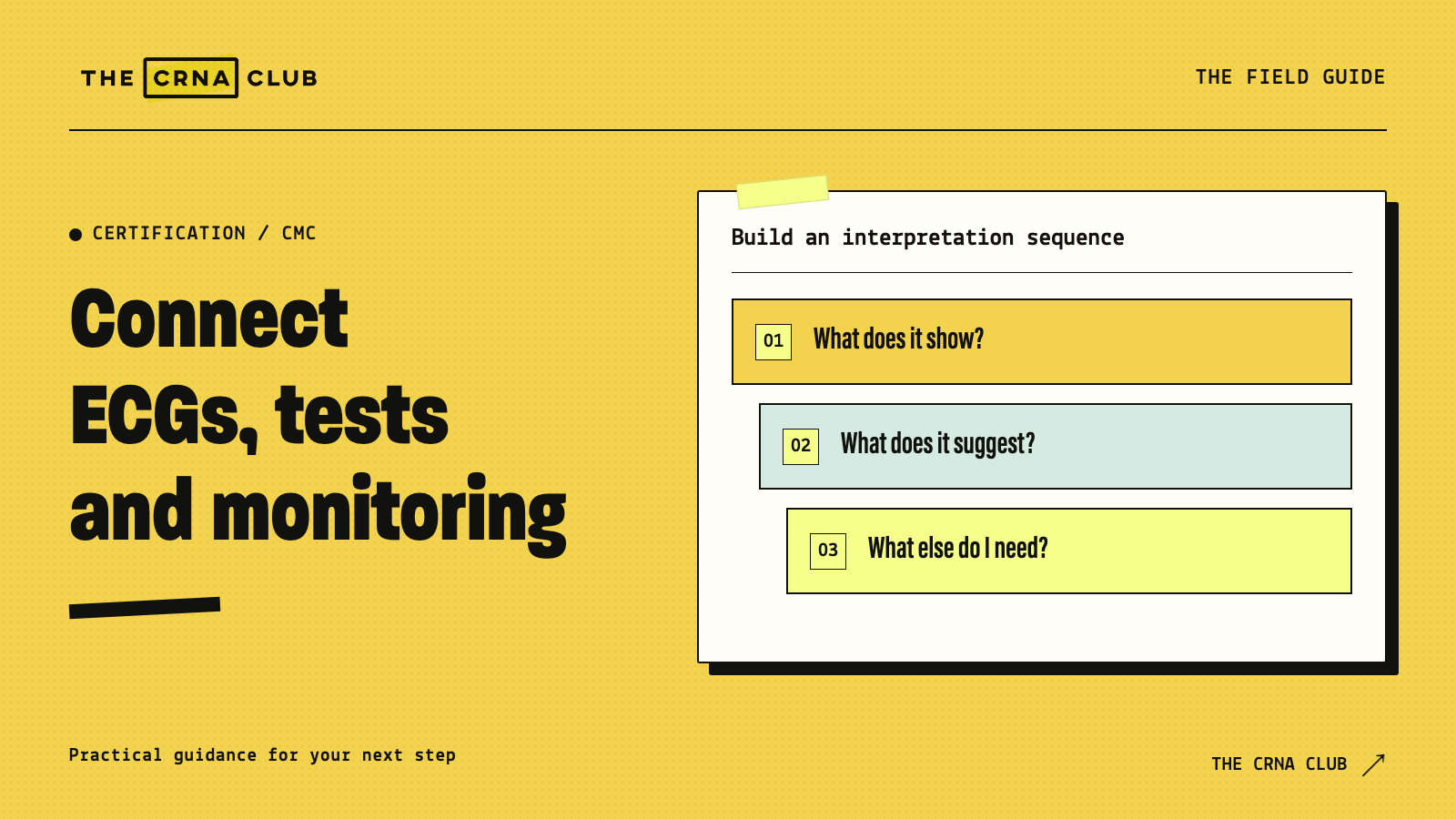
We suggest using the same order each time: rate, rhythm, intervals and conduction, then ST segments and T waves. Read the full tracing. If you stop as soon as you recognize one feature, you can miss the finding that changes your explanation. Then bring in the patient’s symptoms and stability.
Begin with an unlabeled tracing from an authorized teaching source. Before checking the answer, write what you see. “The ventricular rate is fast and the QRS complexes are wide” is a description. The next step is explaining the possible rhythm and the patient’s stability.
Keep descriptions and conclusions separate in your notes. This makes it easier to identify the error later. Did you mismeasure the QRS? Did you miss atrial activity? Or did you identify the tracing but ignore the symptoms in the case?
When you practice a 12-lead ECG, read beyond the lead group you expected to be abnormal. Compare related leads and use a reliable current ECG source to check your interpretation. Don’t treat one lead as a complete explanation of coronary anatomy or assume every acute coronary problem has the same pattern.
For a rhythm you understand well, change the clinical condition. A patient with a pulse and stable perfusion presents a different question from a patient who is hypotensive or pulseless. Avoid memorizing one intervention beside a rhythm name without the context required to choose it.
How do you study tests you rarely see ordered?
Ask what you want to know about the patient. Rhythm? Ventricular function? Myocardial injury? Different tests answer different questions. Write what each one tells you and what you still need to find out. Then compare two tests in a practice case and explain why you would use each.
For each test you study, answer these questions:
- ECG: Identify the electrical pattern. Add symptoms, stability and comparison tracings.
- Echocardiography: Identify the structural or functional findings. Read the specific reported findings in their clinical setting.
- Troponin testing: Look for evidence of myocardial injury. Add timing, serial results and evidence about the cause.
- Hemodynamic monitoring: Ask what pressure and flow suggest. Check measurement quality, the exam and trends.
- Remote cardiac monitoring: Identify what physiologic or rhythm information is collected over time. Check the device purpose and patient course.
These questions give your reading a purpose. If an echocardiography explanation uses an unfamiliar term, define it before adding more measurements. For example, a statement about ventricular systolic function and a statement about a valve describe different information.
You don’t need to become an imaging specialist to build a sound study explanation. You do need to understand what the report contributes to the patient problem described in a question.
How should you interpret a laboratory result during practice?
Interpret a laboratory result alongside its timing, trend and the patient’s clinical findings. An abnormal cardiac biomarker does not identify the entire cause by itself. During study, ask what the result supports, which explanations remain possible and what other evidence the case provides. Avoid assigning a diagnosis from an isolated number.
Our Cardiac Labs & Remote Cardiovascular Monitoring lesson starts with the distinction between myocardial injury and its cause. Carry this reasoning into your notes. Don’t reduce it to “high troponin equals heart attack.” That shortcut removes the very context you need to interpret the question.
Consider a hypothetical patient with chest discomfort and an initial result obtained early in the assessment. What information is missing? The time course matters. So do symptoms, ECG findings and the planned serial testing strategy. You shouldn’t create a universal timing or delta threshold from a brief study summary.
For technical definitions and current clinical interpretation, use the ACC’s chest-pain consensus pathway. Follow the specific current guidance and assay information relevant to the question, rather than a number someone remembers from a different laboratory.
In your error log, record whether the problem was the test’s meaning or the clinical inference. “I confused injury with a complete diagnosis” suggests a different review task from “I didn’t understand the laboratory units.” Both are fixable once you name them.
How do you connect a test result to a patient case?
Combine test results with the exam before choosing the explanation that best fits. In a study case, list the findings supporting your leading explanation and one finding that would make you reconsider it. This keeps you from selecting an answer merely because a single abnormal value resembles a familiar example.
Try a hypothetical case with worsening breathlessness, an irregular tachycardia and reduced urine output. The ECG describes the electrical pattern. It doesn’t tell you everything about filling, contractility or the duration of the problem. Additional assessment and testing answer different parts of the case.
Now add an echo report showing a structural finding. What does that help explain? Take the report away again. What don’t you know anymore? We suggest doing that with each piece of a practice case. You’ll see why the test matters instead of memorizing its name beside a disease.
For hemodynamic practice, use our preload, afterload and perfusion explanation as a foundation. Keep pressure and flow distinct. An elevated filling pressure doesn’t tell you the amount of blood in the circulation, and a pressure reading needs a reliable setup.
Work one case slowly enough to explain the information you would use. Then move to a fresh case with different details. Speed improves after the reasoning becomes clearer. Rushing through explanations you don’t understand gives you a score without a useful study direction.
Our CMC Review includes ECG and cardiac-laboratory teaching for these foundations. Explore the lessons through the seven-day membership trial if you need help connecting what a test measures with the question it can answer.
How do you prevent familiar rhythm questions from taking over your schedule?
Track coverage separately from accuracy. A high score on familiar ECG questions doesn’t show whether you’ve reviewed stress testing, blood gases, imaging or remote monitoring. Mark each applicable test-plan item as reviewed, practiced or still unclear, and give unfinished areas a scheduled block rather than waiting until you feel completely comfortable with ECGs.
Your worksheet might show ten completed rhythm sessions and no time spent on another listed tool. That’s a scheduling issue you can fix immediately. Choose the untouched tool and spend one block learning what it measures, followed by a few relevant questions.
Use the AACN CMC preparation page to locate the current handbook and authorized preparation options. AACN doesn’t require a particular commercial preparation product. Pick resources based on the gap they help you address.
Keep one main explanation source and a limited set of question sources. If the question rationale seems too brief, consult a targeted reference section. Starting another complete course every time you miss a topic adds more material without necessarily giving you more feedback.
At the end of the week, look at your list. Can you explain a test you couldn’t explain last week? Which lesson did you watch without checking what you learned? Put that topic in your CMC planner and use a few questions to see whether the explanation holds up.
How should you use a 30-minute CMC practice block?
A mixed session should require you to decide which information matters before interpreting it. Use unfamiliar questions covering different tests, then review uncertain answers as carefully as incorrect ones. Finish by writing a short explanation of the test choice and the patient context, rather than copying a long rationale word for word.
Try this 30-minute example: use five minutes to interpret one unfamiliar tracing, ten to check the explanation, ten to apply it to a second case, and five to write the missing step and a later review date. Stop the question set early if the rationale needs more time. You don’t need a large question count to make the block useful.
For each reviewed item, finish this sentence: “This test helped answer ___, but the case still needed ___.” Keep the answer specific. If you write “more information” every time, identify the missing symptom, trend, measurement or history.
Then check yourself after a delay using a different question. If you remember only the original answer, return to the test’s purpose and limitations. You want a method you can use when the question stem changes.
Our Final Thoughts
ECG study becomes more useful when it stays connected to the patient. Read the tracing carefully, explain what the other tests add, and keep track of the topics your normal assignments don’t expose you to.
You don’t need a perfect notebook. You need explanations you understand and an honest list of what still needs work. Keep the next study task small enough to finish well.
Take the Next Step
Try our seven-day membership trial and open the CMC lesson for the test you find hardest to explain. Use the CMC questions to practice, then put any remaining gap in the planner. If you want to start with your schedule, the free certification planner includes one lifetime free plan.