How do I study for the CCRN when my ICU specialty leaves gaps?
Sachi, CRNA
CRNA
In This Article (10 sections)
- How do you identify specialty gaps without guessing?
- Why doesn’t your unit name describe everything you know?
- How should you prioritize unfamiliar material?
- What does targeted teaching look like for an unfamiliar area?
- How do you use what you already know without overestimating it?
- Should you ask to shadow another ICU?
- How do you check whether gap review helped?
- Does a specialty gap mean you need another job before CRNA school?
- Our Final Thoughts
- Take the Next Step
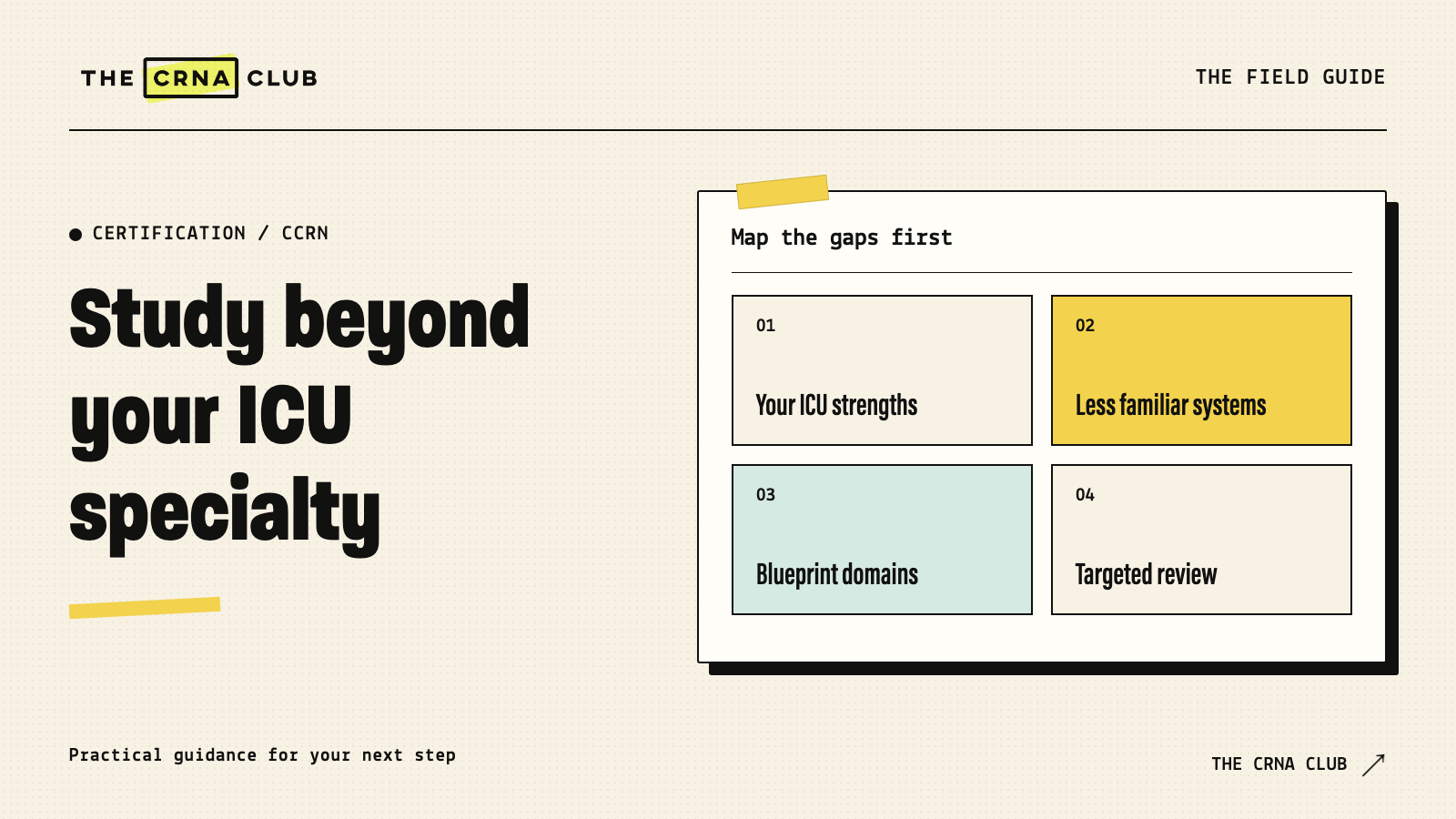
Use the current CCRN outline to find topics your ICU doesn’t give you much practice with, then study those deliberately. You don’t need to spend the same time on what you explain well and what you’ve never learned.
Our CCRN Toolkit gives you video lessons beyond your usual patient mix, practice questions and a planner. We suggest choosing your next lesson from the gaps you’re finding, rather than watching only the subjects you enjoy at work.
A STICU nurse and a CVICU nurse might need completely different review. Even two nurses in the same unit won’t have identical assignments or explanations. Start with what you understand today.
How do you identify specialty gaps without guessing?
Compare the current outline with what you explain without notes, then use a small unfamiliar set to check your assumptions. Pick the lesson from the gap you find. Working in a particular ICU gives you examples, but it doesn’t decide which parts of the outline you already understand.
AACN’s preparation guidance recommends reviewing patient problems you don’t see often and learning from certified colleagues or other patient populations.
What should you review when your ICU rarely sees cardiac patients?
Say you’re a STICU nurse comfortable discussing your trauma assignments. In this hypothetical example, unfamiliar cardiac questions expose two gaps: you can’t explain what a PA-catheter measurement represents, and you mix up flow with filling pressure. That gives you a starting point beyond “study all of cardiac.”
Use the PA Catheter and Hemodynamic Profiles lessons in our CCRN review. First explain what each measurement tells you. Then try a small related question set and review the uncertain answers. A later mixed set checks whether you recognize the same ideas without a cardiac label and reveals what else still needs attention.
Use specific rows like these. The other nurses are hypothetical too; they illustrate different gaps rather than assumptions about every unit.
| Topic | What you explain now | Teaching to use | Next practice check |
|---|---|---|---|
| STICU example: cardiac hemodynamics | Trauma routines are familiar, but PA-catheter measurements and flow versus pressure are unclear | PA Catheter and Hemodynamic Profiles lessons | Explain the variables with notes closed, then work through related questions and rationales |
| CVICU example: acute kidney injury | Familiar cardiac cases make sense, but an unfamiliar renal question leaves you guessing | Acute Kidney Injury lesson | Explain the relevant concept, try a different renal example, then include it in mixed practice |
| Professional-practice example | Daily conversations feel familiar, but you guess on advocacy scenarios | Ethics & Patient Advocacy lesson | Name the patient’s need and explain why the action addresses it |
For the STICU example, use your first focused block for the two hemodynamics lessons and a closed-book explanation. If the lessons need more time, finish that teaching before adding more topics. Use the next block for related questions with rationale review. Later in the week, return to a mixed set.
Write the remaining question in your planner after each block. “I still confuse what these two measurements represent” tells you where to return. A correct guess stays on the review list. If the explanation is now clear, move to the next gap instead of spending the whole week on cardiac because it finally feels comfortable.
Why doesn’t your unit name describe everything you know?
Two nurses working in the same type of ICU still have different patient assignments, roles and exposure. Your actual reasoning about patients provides a better starting point than the unit label. Use examples from your own practice, then check which parts of the outline those examples leave untouched.
One hypothetical CVICU nurse regularly discusses cardiac physiology but has little recent practice explaining a different organ-system problem. Another CVICU nurse works in a unit with a wider patient mix and has a different set of gaps. The same “CVICU study plan” won’t automatically fit both.
A similar issue applies to trauma experience. A STICU nurse might be comfortable discussing deterioration and monitoring, while needing focused teaching on unfamiliar cardiac conditions. Another nurse’s cardiac experience might be broader than the label suggests.
Avoid turning specialties into a hierarchy. The practical question is what you explain now and what you need to learn next. Your study plan works better when it begins there.
How should you prioritize unfamiliar material?
Prioritize unfamiliar material in this order:
- Start with the topics you barely understand and give them real teaching time.
- Look at how they’re represented in AACN’s outline.
- Check the full scope before giving every familiar topic another long review while the unfamiliar ones wait until the final week.
For a hypothetical nurse with several unfamiliar areas, start by identifying the foundational explanation needed for each. Some topics need a full lesson. Others need a clear comparison between two related problems or a short review of terminology.
Write the task at that level. “Study all renal” is difficult to start. “Explain this process, identify its findings and compare it with the related process I keep confusing” gives the next hour a useful purpose.
Then check the next topic before spending the entire week polishing one explanation. A favorite difficult subject sometimes takes over because it is interesting. The calendar still needs room for the rest of the scope.
Our CCRN overview helps place these tasks in the broader preparation plan. Keep the current official outline as the source for exact coverage.
What does targeted teaching look like for an unfamiliar area?
Use a focused video lesson to learn what goes wrong in the condition and why the findings follow. Then close it and explain a short case in your own words. We suggest that sequence for unfamiliar CCRN topics because a long question set is frustrating when you haven’t learned the explanation it assumes.
Say you usually care for surgical patients and an unfamiliar medical condition keeps appearing in review. Start with what changes in that condition. Which findings would you expect because of that change? What information would help you tell it from a similar problem? Write those questions before you watch the lesson.
Pause before the explanation and try answering. Afterward, close the material and work through the sequence again. A different example later shows whether it still makes sense when the wording changes. You don’t need to recreate years of experience in another ICU to begin learning the concept.
The specific clinical content requires current teaching sources. The study task stays the same: connect the findings rather than collecting an isolated answer list. You aren’t expected to recreate bedside experience through a few practice questions.
How do you use what you already know without overestimating it?
Use familiar cases to retrieve reasoning, then test the less familiar edges. Explain why the findings fit, what else you considered and what change would alter your interpretation. Frequent exposure gives you examples to work with, but it doesn’t automatically establish complete understanding of every related concept.
A nurse might perform a familiar task confidently and still struggle to explain its physiology when asked differently. That is a useful study gap, not a reason to discount the clinical skill.
Try explaining one familiar patient problem to a colleague without relying on shorthand. If you say “we always do this,” follow with why the choice fits the situation. If you cannot explain, identify the missing connection and review it.
Keep patient examples de-identified and follow your workplace’s privacy requirements. You need the clinical reasoning, not identifying details, for a study exercise.
Should you ask to shadow another ICU?
Appropriate cross-unit exposure sometimes helps you connect unfamiliar topics to practice, and AACN includes discussion of this option in its preparation guidance. Coordinate any experience through your institution. Use a clear learning goal so the visit addresses a topic instead of becoming an unfocused attempt to see everything.
Before asking, identify one or two concepts you want to understand better. Then ask an educator what suitable learning opportunities exist. A case discussion, teaching session or approved observation sometimes fits better than a full shift.
Afterward, write what the experience clarified and what still needs reference-based review. Seeing a device or condition once doesn’t replace studying its mechanism, uses and complications.
Also keep certification eligibility separate from learning exposure. AACN’s adult CCRN eligibility page defines qualifying experience. A helpful observation doesn’t automatically become qualifying direct-care time.
How do you check whether gap review helped?
Return to unfamiliar practice and explain the repaired concepts before opening the rationale. Then include them in mixed practice without a topic label. Look for clearer reasoning and fewer unresolved connections, while recording any new questions that require follow-up.
Avoid checking only with the same examples you studied. Remembering an explanation is a useful early step, but a different example asks whether you recognize the connection when details change.
For a weekly check, compare your worksheet with the calendar. Which unfamiliar areas received actual teaching time? Which ones stayed on the list without an appointment? Adjust the next week before adding another large question target.
Try our CCRN lessons in the seven-day membership trial with a topic outside your regular patient mix. Use a lesson, practice and then update your plan with what remains unclear. The library gives you somewhere to learn beyond the cases you happen to get on your next shift.
Does a specialty gap mean you need another job before CRNA school?
A study gap doesn’t by itself settle a career move or admissions decision. Certification scope, your clinical development and a program’s ICU requirements are separate questions. First identify the actual policy or experience issue rather than using discomfort with a review topic as proof you chose the wrong unit.
If your concern is whether your background meets a target program’s requirements, read its official criteria and ask a precise question when needed. General certification advice won’t decide that policy.
Similarly, review how CCRN fits a CRNA application before assuming another credential or examination date solves an experience requirement. Plan the academic, clinical and certification tasks with their own evidence.
Our Final Thoughts
Your specialty gives you a starting point. Use it honestly, then give unfamiliar areas enough teaching and practice to become explainable. A useful gap worksheet ends with specific calendar appointments and a later check, rather than a list of subjects you hope to get to eventually.
Take the Next Step
Start with the CCRN Toolkit for the lessons, questions and planner. If you’re organizing resources you already have, use the free certification planner for one lifetime free plan. Include the topics you’ve been avoiding so they get study time too.