How do I study Professional Caring and Ethical Practice for the CCRN?
Sachi, CRNA
CRNA
In This Article (10 sections)
- What is on the CCRN Professional Caring and Ethical Practice section?
- How does the Synergy Model help you study?
- How do you practice patient education scenarios?
- How do you answer CCRN patient-advocacy questions?
- What do collaboration and systems questions ask you to consider?
- What should your review worksheet contain?
- How do you review a missed professional-practice question?
- How much time should this domain get?
- Our Final Thoughts
- Take the Next Step
Give Professional Caring and Ethical Practice its own study time. It makes up twenty percent of the current adult CCRN plan. Work through scenarios by asking what the patient needs and why an action addresses that need, rather than choosing whichever answer sounds kindest.
Our CCRN review includes teaching on the AACN Synergy Model and Ethics and Patient Advocacy. We suggest using those lessons in our CCRN Toolkit, then practicing cases and scheduling another review with the planner.
It’s easy to spend the week on drips and ventilation and leave this domain for later. Don’t. You already have useful bedside experience, but you still need to learn how the concepts apply to the situation the question describes.
What is on the CCRN Professional Caring and Ethical Practice section?
Use the applicable official plan to check the domain and its listed areas. Build your review around the patient or family need, the relevant competency and the reasoning behind an action. Knowing the label helps organize studying, while a scenario shows whether you understand how the concept affects care.
The current adult CCRN test plan includes Professional Caring and Ethical Practice alongside Clinical Judgment. Look at its exact terminology instead of relying on an old review table or someone’s memory of an examination.
For a personal study page, choose one unfamiliar concept and write a short situation where it would matter. Explain the need in plain language before deciding which action fits.
You don’t need to force every case into a single category. Real care involves overlapping competencies. Your practice task is to identify what the question actually asks and explain the connection clearly.
How does the Synergy Model help you study?
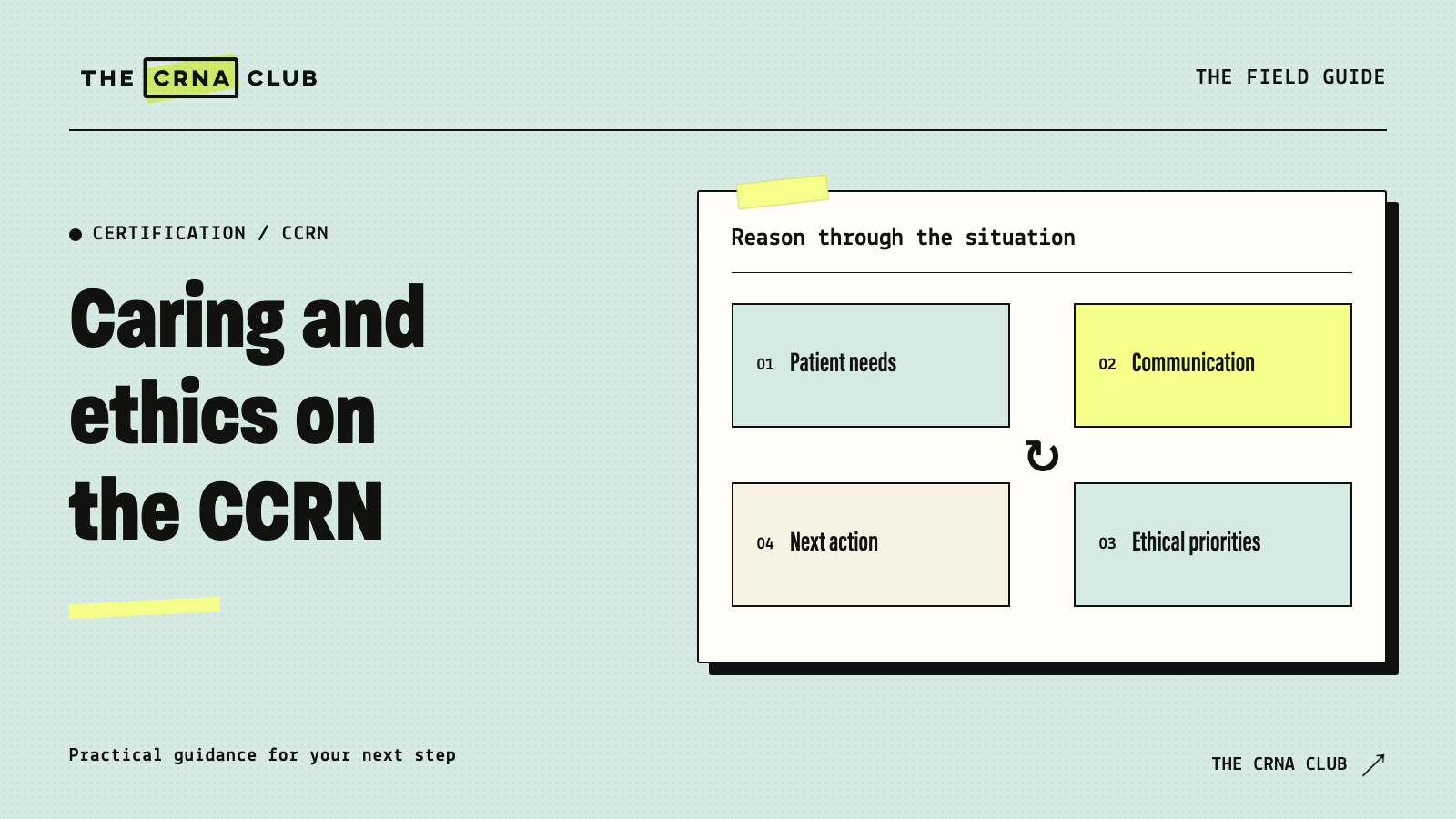
The Synergy Model starts with patient needs and the nursing competencies required to meet them. Use that relationship to interpret situations instead of memorizing isolated terms. Ask what this patient needs now and which competency helps address it. Then explain your proposed action using the facts supplied.
AACN’s explanation of the model says candidates aren’t expected to memorize every component. It encourages using the applicable test plan as a main study resource. So give the terminology enough attention to understand it, then move into examples.
Say you’ve explained a complicated next step and the patient still looks unsure. Repeating the same words louder won’t tell you what they understood. Ask them to explain the next step in their own words, then listen for the part needing another explanation.
That reasoning gives you a useful study question: which action would help clarify understanding? Compare the choices against the stated need, not against which option sounds most professional.
How do you practice patient education scenarios?
Identify what the patient needs to understand, how you will explain it and how you will check understanding. Don’t assume agreement or a nod establishes learning. Practice choosing an approach that fits the person’s needs, then examine what information would show the explanation worked.
AHRQ’s teach-back guidance describes asking patients to explain information in their own words or demonstrate an action. It also recommends clarifying and checking again when a misunderstanding appears.
The patient says yes when you ask whether the instructions make sense. Then, asked to explain the next step, they describe something different. Now you know which part needs clarifying. Explain it differently and check again. The point of the check is to improve your teaching.
For study, write why that check supplies more useful information than the original yes. You are explaining how the action addresses the learning need, not memorizing a phrase to choose automatically in every question.
Then change the situation. What if the barrier is language access? What if the patient needs a demonstration? Identify the barrier given in the scenario before selecting the action.
How do you answer CCRN patient-advocacy questions?
Identify whose concern is missing, which information needs clarification and what action addresses the specific issue. An advocacy answer needs to fit the situation. A slogan such as “always advocate” doesn’t tell you what to do when the question supplies several plausible responses.
Say a patient tells you an important concern hasn’t been addressed. Start by clarifying that concern and helping it be heard. Don’t decide what the person must want because of a diagnosis or background. Your answer needs to address the concern actually described.
Now compare two possible actions in your own words. One gathers and communicates the patient’s actual concern. Another assumes what the patient must want because of a diagnosis or background. Explain why the assumption doesn’t follow from the case.
Keep legal specifics separate. Consent authority, surrogate order and documentation requirements need current applicable law and policy. A short examination-preparation article shouldn’t invent universal legal rules to make an example simpler.
What do collaboration and systems questions ask you to consider?
Look at whether the problem requires communication or resources beyond one isolated action. Identify the people, information or process relevant to the stated patient need. Then explain how the proposed step helps resolve the actual issue rather than assuming every problem belongs to one person’s knowledge deficit.
Consider a hypothetical learning example about repeated missing information during transfer. One case might ask what to clarify for the current patient. Another might ask how to investigate a repeated process problem. The wording changes the task.
You don’t answer the second question by blaming one colleague without examining what happened. For study, identify the difference between addressing the immediate gap and examining a recurring process.
Avoid turning this into a universal answer shortcut. Read the actual request. Several competencies might contribute, but the question asks for one decision in a particular context.
What should your review worksheet contain?
Use a short scenario, the patient’s need, the concept you are applying and the reason an action fits. Add one changed detail that would alter your response. This last step helps you avoid memorizing a preferred phrase without understanding the situation where it belongs.
-
Situation: A person repeats instructions incorrectly after an explanation.
-
Need: A clearer explanation and a check of understanding.
-
Relevant concept: Facilitation of learning.
-
Why the action fits: It identifies misunderstanding and gives an opportunity to explain differently.
-
Changed detail: The barrier is access to an appropriate language service.
-
Follow-up question: What information do I need before choosing the next teaching approach?
This worksheet is an original study aid, not an official scoring system. Use the same fields on a few different situations. If your entries all end with the same generic sentence, make the need more specific.
For broader scope and preparation planning, our CCRN overview gives you a starting point. Keep the current official outline beside the worksheet so you don’t reduce the domain to only the examples discussed here.
How do you review a missed professional-practice question?
After a missed question, ask why your choice didn’t address the need. Did you misunderstand the term? Miss a patient detail? Answer a different question? Use our relevant CCRN lesson when the concept itself is unfamiliar, then write a new short scenario to check it.
An answer sometimes sounds kind and still fails to address the problem described. Another sounds familiar from workplace routine but assumes information the question never supplied. Check what each choice actually accomplishes.
If the rationale introduces an unfamiliar concept, review its source explanation and create a new short scenario. Then retrieve the reasoning later without seeing the original choices.
Correct guesses belong in this review too. You need to explain the connection before treating the concept as adequately covered.
How much time should this domain get?
Give it a defined place in the calendar, with more time where your explanations remain weak. The official weight helps you avoid skipping the domain, while your own diagnostic guides the work needed within it. Don’t assume familiarity with daily conversations removes the need for focused review.
Put a professional-practice session beside your clinical lessons this week. Work through an uncertain concept, practice a case and come back later to explain a different example. Use the planner so this domain gets an appointment instead of whatever time is left after cardiac review.
Try the AACN Synergy Model and Ethics and Patient Advocacy lessons through the seven-day membership trial. Bring one scenario you find hard to explain. Use the lesson to understand why an action fits, then change a detail and think through the response again.
End a review session by naming one scenario you now explain more clearly. Then change one relevant detail and explain how your answer changes. That small check exposes memorized phrases before they become your main strategy.
Our Final Thoughts
Give professional practice the same honest review you give an unfamiliar clinical topic. Identify the need, explain the relevant concept and choose an action that fits the facts. Specific reasoning helps far more than assuming every answer should sound compassionate or collaborative.
Take the Next Step
Use the CCRN Toolkit for professional-practice teaching alongside your clinical review and practice. If you need a calendar first, the free certification planner gives you one lifetime free plan. Include this domain when you make the week.