How Do You Answer 'What Is Your Weakness?' in a CRNA Interview?
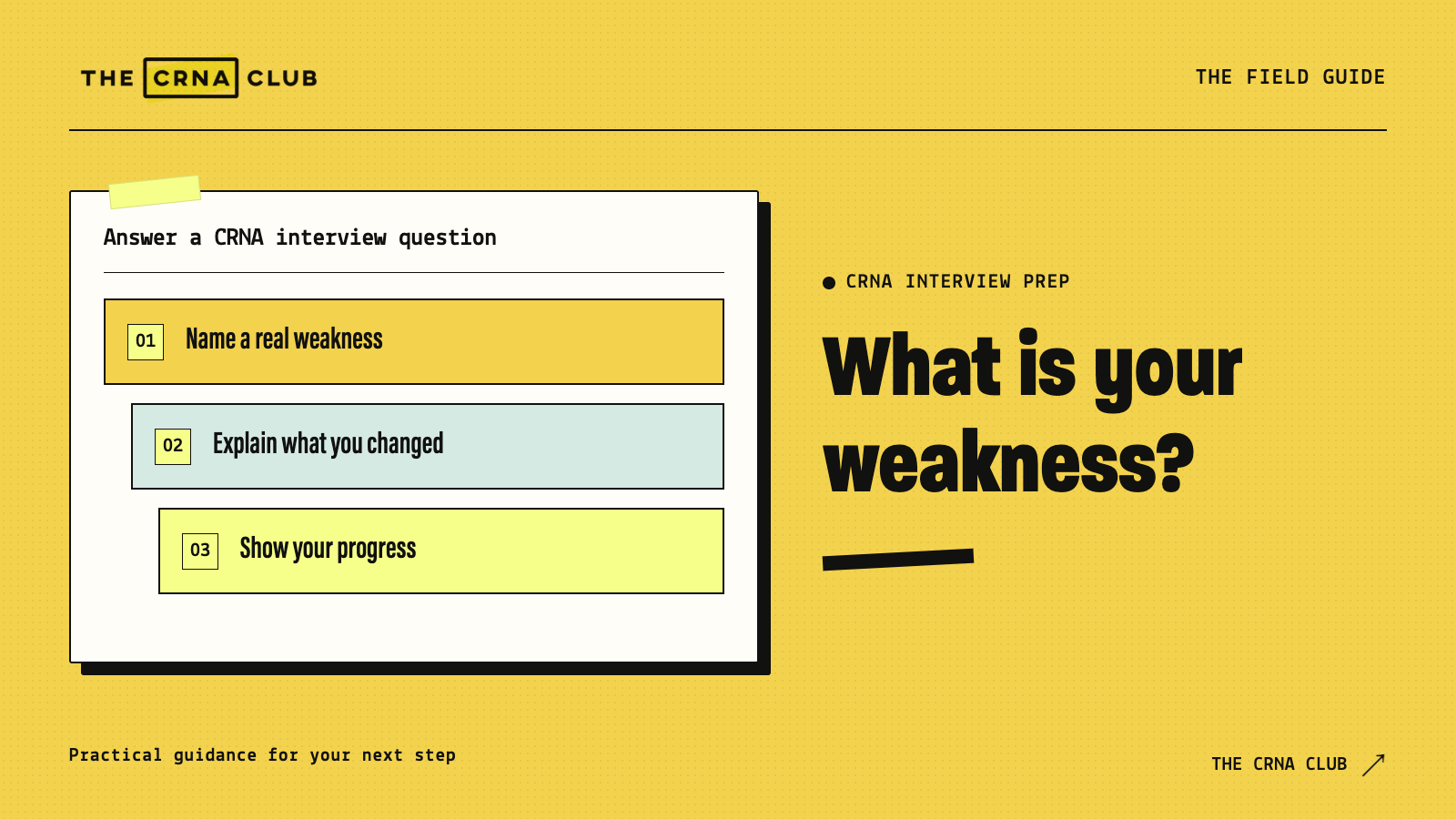
Choose a real weakness, explain what you’ve done about it and give an example of the progress you’ve made. You don’t need to disguise a strength as a weakness. You need an honest answer you can discuss when the interviewer asks a follow-up.
Sachi, CRNA
CRNA
In This Article (7 sections)
Our Mock Interview Lab helps you practice saying the answer and review feedback. The free entry includes one lifetime interview. For more interview practice, learning-library lessons and the EQ reflection tracker, try The CRNA Club free for seven days.
“I’m a perfectionist” leaves a lot unexplained. What do you actually do? How does it get in your way? What has changed? Start with those questions.
How do you choose a weakness to talk about?
Use a specific behavior or skill you are working on. Then connect it to an action you have already taken. We suggest this order:
- Name the weakness clearly. Skip the long introduction explaining why it’s secretly impressive.
- Show where it affected you. One brief example gives the answer context.
- Explain the change. Describe what you do differently now.
- Give evidence and a next step. Explain what improved and what still needs work.
In our interview lessons, we suggest acknowledging the limitation and explaining what you’re doing about it.
Try the answer aloud in the Mock Interview Lab after you’ve outlined it. Listen for the exact point where you stop explaining your action and start defending yourself. That’s usually where the answer needs a shorter sentence or a better example.
What does an honest answer sound like?
Here is a fictional practice example. Use it to understand the structure, not as a story to borrow:
“Academic writing takes me longer than I’d like. In my recent course, I spent too much time revising individual sentences before I had a clear argument. I started outlining first and taking an early draft to the writing center. That helped me identify the main problem before spending hours polishing. I’m still working on writing more efficiently, so I now put an outline deadline and a feedback deadline on my calendar.”
The weakness is clear. The response is something you can picture. And the speaker hasn’t claimed the problem disappeared.
A second fictional example focuses on speaking:
“I tend to give too much background when I explain a case. I noticed it when a colleague asked me to state my main concern earlier in report. I’ve been practicing a one-sentence opening, followed by the findings supporting it. I still catch myself adding detail, but now I stop and check whether it changes the point.”
Neither answer needs a dramatic event. Both need a truthful version from your own experience.
How do you improve a vague or rehearsed answer?
Replace the personality label with an observable behavior. Then add what you’ve actually done.
| Draft answer | What is missing | Better direction |
|---|---|---|
| “I care too much.” | A specific weakness and its effect | Name the behavior affecting your work or learning |
| “Public speaking.” | Any response to the difficulty | Describe the speaking practice or feedback you are using |
| “I’m too detail-oriented.” | What happens because of it | Explain a real problem with prioritizing or communicating detail |
| “I used to be disorganized, but now I’m fine.” | Evidence and ongoing awareness | Show the system you use and what still needs attention |
You don’t have to use the wording in the last column. Fill in facts from your own experience. If the action hasn’t happened yet, say you’re planning it instead of describing it as a completed improvement.
Should you talk about a weakness you have already fixed?
You should answer the question you’re asked. If the interviewer asks about a current weakness, choose something you still recognize and manage. A story about a problem you completely resolved years ago might avoid the actual question.
Explain progress without pretending you’ve finished learning. “I now ask for feedback after presentations, and I’m working on answering follow-up questions more concisely” gives a clearer picture than “I overcame public speaking.”
If you’re asked about a clinical mistake instead, use a truthful event and explain the response and learning. Our guide to discussing a clinical mistake in a CRNA interview covers that different task.
How do you prepare for follow-up questions?
Have someone interrupt your polished version with one of these:
- “When did you first notice that?”
- “What feedback did you receive?”
- “What would you do if the same issue came up during school?”
- “What still feels difficult?”
If the follow-up breaks the answer, check whether you memorized the paragraph before understanding your example. Keep a few talking points and practice explaining them in different words.
We go through this approach in the podcast episode “The EQ Interview Questions You Know You’ll Get Asked.” Listen on Apple Podcasts or Spotify.
Our Final Thoughts
You don’t need a clever weakness. Pick something real, describe the work you’re doing and leave room for an honest follow-up. A specific answer gives you much more to say than another polished line about perfectionism.
Take the Next Step
Record your first version in the Mock Interview Lab. To collect examples in the EQ tracker and work through our interview lessons, start the seven-day membership trial. Personalized mock-interview study guides are included with active membership or an active membership trial, rather than the free one-session entry alone.