How Do You Answer 'Why Should We Choose You?' in a CRNA Interview?
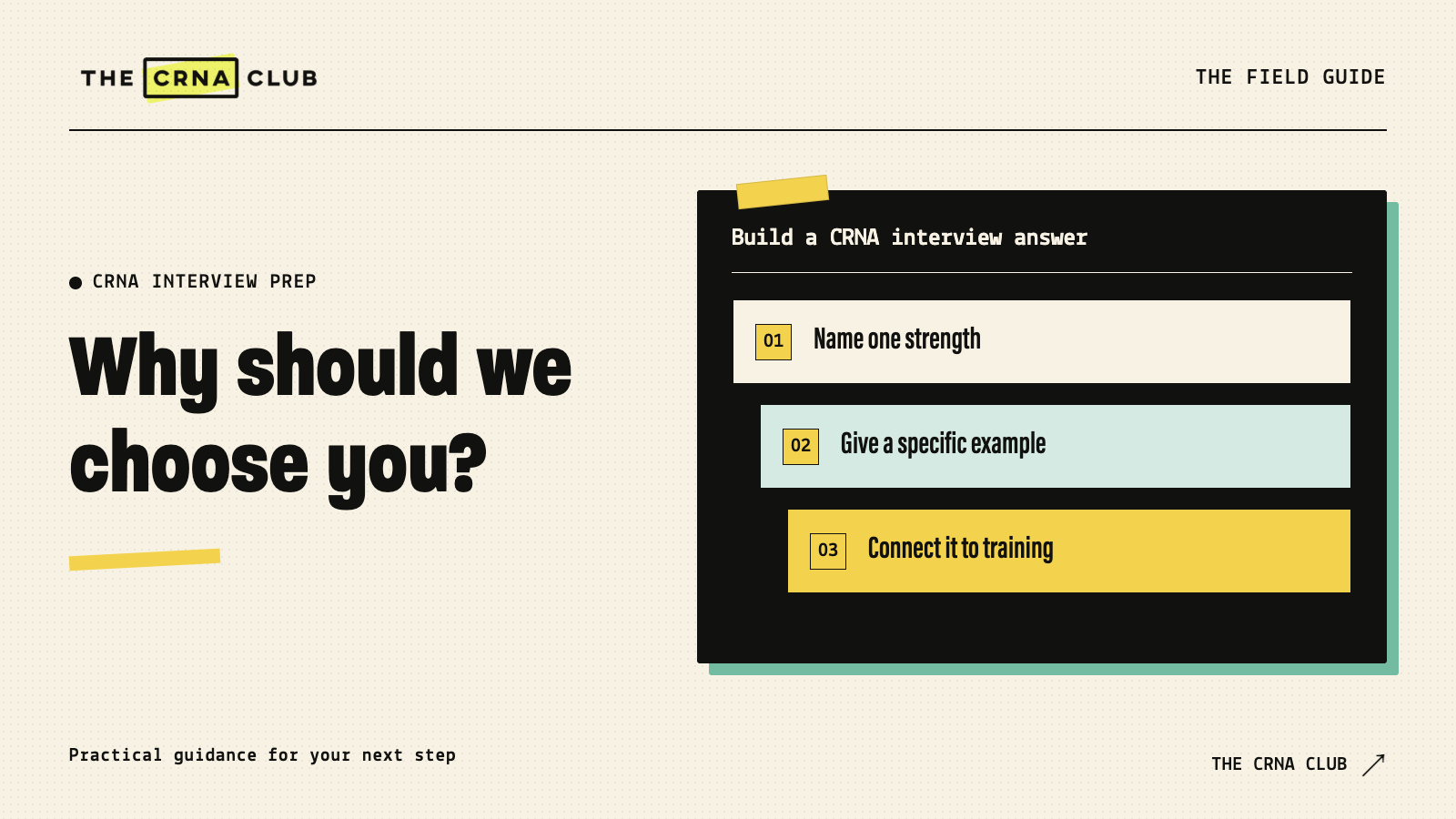
Answer “Why should we choose you?” by connecting a few relevant strengths to evidence from your own preparation. Explain what you’ve done, what it shows about you and how it relates to the program. You don’t need to prove you’re better than applicants you’ve never met.
Sachi, CRNA
CRNA
In This Article (7 sections)
We suggest practicing this answer in our Mock Interview Lab. You’ll hear whether your evidence is clear or whether you’re relying on words like hardworking and passionate. The free entry includes one lifetime interview. Try the full platform free for seven days for interview lessons, experience trackers and further preparation tools.
It’s an uncomfortable question because it sounds like an invitation to brag. Treat it as a request to explain your preparation. That gives you something much more useful to talk about.
How do you choose the strengths to discuss?
Look at your application and identify claims you can support. Clinical judgment, academic preparation or how you respond to feedback might fit. The strongest choice for your answer depends on your actual record.
Write an evidence note for each possible strength:
- Claim: What do I want to say about myself?
- Evidence: What did I personally do?
- Meaning: What does the example show, without exaggerating it?
- Relevance: Why does it belong in this answer?
“I’m a great team player” doesn’t tell the listener what happened. “I asked for feedback after a difficult handoff and changed how I communicated the plan” gives you an event to explain.
Our EQ reflection tracker and clinical experience tools help you save those events while you still remember them. Record your own actions and learning. You don’t need patient identifiers to develop a useful interview example.
What does a complete answer sound like?
This fictional practice answer combines preparation with a concrete example:
“I’d bring a habit of preparing carefully and asking for feedback early. In my ICU role, I noticed I was comfortable following familiar routines but needed to explain the physiology more clearly. I started choosing one clinical question after a shift, reviewing it and discussing my explanation with an experienced colleague. That helped me identify what I didn’t understand instead of repeating the routine. I’ve used the same approach in my recent coursework. I’m interested in your program because of the clinical education model you described, and I’d bring that willingness to prepare, ask questions and keep improving.”
The final program detail needs to be specific and accurate in your version. Replace the placeholder with something you’ve verified and value.
Also notice what the speaker doesn’t claim: to know more than the cohort or to need less help than other students. The answer describes how this person learns and backs it with an example.
How do you make the answer more specific to the program?
Use a published program detail you can explain. Read the curriculum and clinical information, then ask why that detail matters to your learning. Don’t attach the school’s name to an answer that would otherwise fit anywhere.
Try this revision exercise:
Vague: “Your program is excellent, and I know I’d be a great fit.”
More useful: “The way your program introduces clinical learning interests me because I learn well when I connect coursework to a case. I’ve been building that habit by explaining my ICU patients’ physiology rather than memorizing isolated facts.”
That is a fictional example of making the connection. Only use it if the program actually has the model you’re describing and the learning example is true for you.
Our guide to researching a CRNA program before an interview helps you find the details worth asking about. The School Database helps organize your targets; confirm the specific facts on the program’s current site.
What should you cut from the first draft?
Read the answer and remove anything you can’t support or don’t need:
- Comparisons with other applicants. You don’t know their preparation well enough to judge it.
- A list of every credential. Choose the evidence needed for your point rather than reading your resume aloud.
- Promises about future performance. Explain the work you’ve done and the habits you intend to continue.
- A second answer to “Why CRNA?” Include your motivation briefly if it helps, but answer why your preparation is relevant to this opportunity.
For that separate motivation question, use our Why do you want to be a CRNA? guide. Keep the two answers connected without making them identical.
How do you practice confidence without sounding entitled?
State your evidence directly. You don’t need to apologize for being prepared, and you don’t need to announce that acceptance is inevitable.
Ask a practice partner to follow up with “What is an example?” and “What do you still need to improve?” A useful answer should hold up to both. If it only sounds convincing while no one interrupts, spend more time with the underlying experience.
Then record it. Listen for sentences that add praise without adding evidence. Cut those and try again. Our article on reasoning, rambling and confidence covers those broader delivery habits.
Our Final Thoughts
You have a record of preparation to explain. Pick the parts that matter, show what you personally did and connect them to a real reason for choosing this program. You don’t need to speak for the admissions committee or compare yourself with the entire applicant pool.
Take the Next Step
Practice your evidence-based answer in the Mock Interview Lab. For the learning library and trackers that help you develop more examples, try The CRNA Club free for seven days.