How to Find a Mentor Before CRNA School
Sachi, CRNA
CRNA
In This Article (10 sections)
- What kind of guidance do you actually need?
- Where can you meet potential mentors?
- How do you write a first request that is easy to answer?
- What should you ask during the conversation?
- How does one conversation become an ongoing relationship?
- What should you track after meeting someone?
- What if someone doesn’t respond or the advice conflicts?
- Is a mentor the same as a recommender?
- Our Final Thoughts
- Take the Next Step
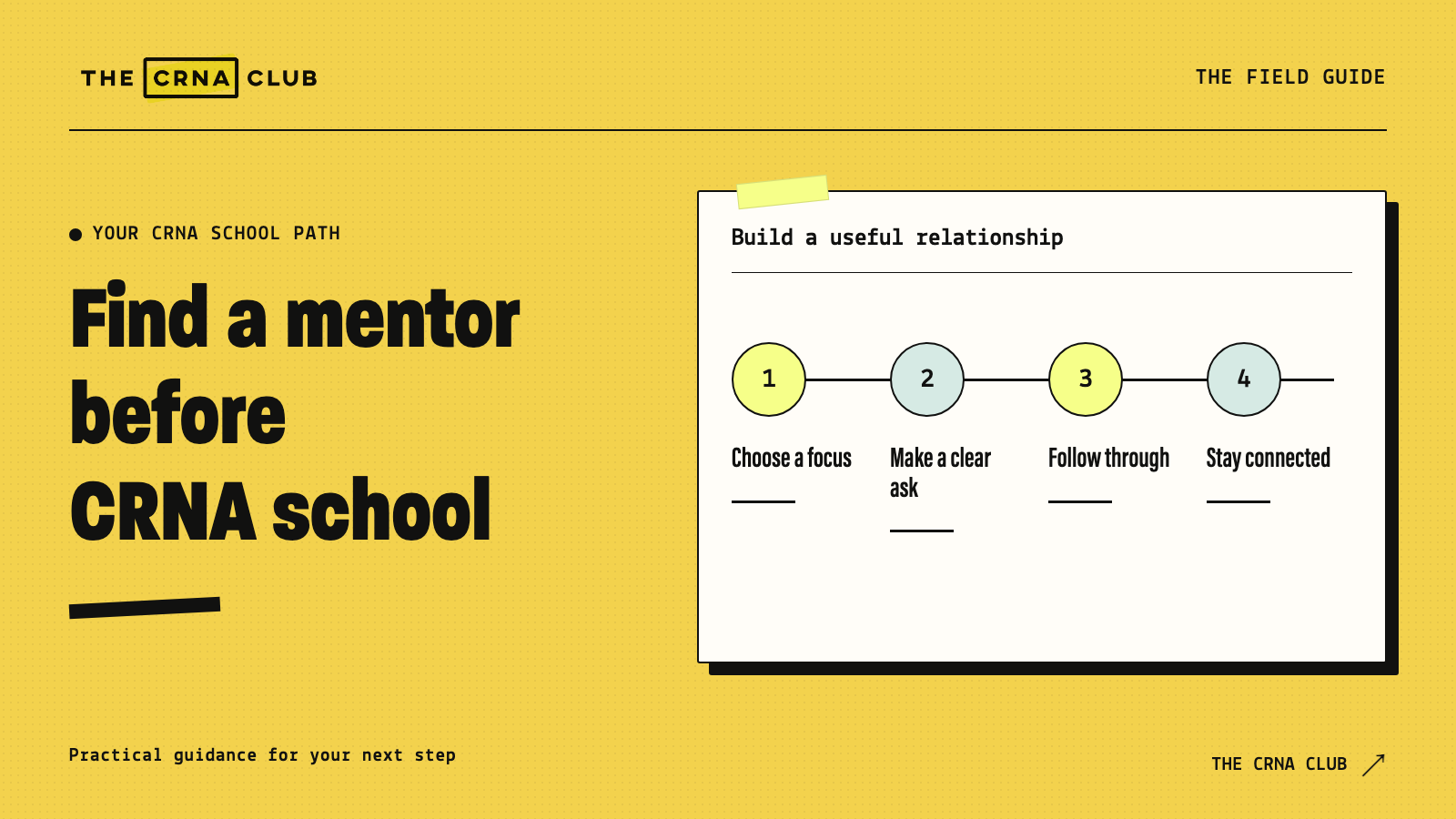
To find a mentor before CRNA school, begin with one focused question and a small request for guidance. Ask an educator, a CRNA you’ve shadowed, or an appropriate professional contact about a problem they understand. Follow through on useful advice and share what you learned. An ongoing relationship develops through those interactions; you don’t need to ask a stranger for a long-term commitment immediately.
“Will you be my mentor?” sounds like a simple question, but it’s a big request when somebody has never met you. What are you asking them to do? Read every application? Talk every week? Help you find shadowing? They don’t know yet, and you might not know either.
Inside The CRNA Club, our networking lessons help you prepare for those conversations, and the events calendar gives you a place to look for professional opportunities. We suggest using those alongside the shadowing and events trackers to remember who you met and what you agreed to do next. You can explore the platform free for seven days. Start with the question you need help answering.
What kind of guidance do you actually need?
Identify the problem before choosing the person. A clinical educator helps with questions about your development in the ICU. A CRNA offers perspective on practice and the educational transition. A program’s admissions office answers its own application rules. One person doesn’t need to fill every role, and a friendly conversation doesn’t make them responsible for your application.
Use a short question map:
| Your question | A useful place to start | What to prepare |
|---|---|---|
| What experience should I develop in this ICU? | Educator or supervisor who knows your work | Your current responsibilities and one learning goal |
| What should I observe during shadowing? | The CRNA or coordinator arranging the day | What you’ve already seen and what you want to understand |
| Does this course meet a school’s requirement? | The program’s designated admissions contact | Course description, syllabus and exact requirement |
| What surprised you during the transition to school? | A willing nurse anesthesia student or recent graduate | A specific question about the transition |
| How should I compare professional events? | Someone familiar with those events | Your purpose, available time and budget |
This helps you avoid sending one enormous message asking someone to assess your grades, choose schools, rewrite your essay, and predict whether you’ll get accepted.
And if you don’t know the question yet, begin there. “I’m deciding what to investigate before applying” is more honest than asking someone to approve a plan you haven’t made.
Where can you meet potential mentors?
Start with appropriate relationships you already have, then look for professional settings where conversation is welcome. Educators, shadowing contacts, professional associations, and events create opportunities to learn. Respect workplace channels and event rules. Meeting a CRNA doesn’t guarantee mentorship, and you don’t need an expensive conference to begin asking thoughtful questions.
If your hospital has CRNAs, ask about the established shadowing or professional development process. If it doesn’t, our shadowing guide provides a starting point for finding an observation opportunity. A shadow day should first help you understand the role and follow the facility’s requirements.
AANA currently offers an RN-APRN membership category for nurses interested in nurse anesthesia, with professional resources and networking opportunities. Review its current benefits and costs before deciding whether it fits your goals. Check which networking opportunities are useful to you before joining.
AANA’s Resident Mentoring Program is a different opportunity, with selection through nurse anesthesia program leadership. Don’t assume a program with “mentoring” in its name accepts pre-admission applicants. Check whom it serves before applying.
How do you write a first request that is easy to answer?
Introduce yourself briefly, explain why you’re contacting that person, and ask one question within their experience. Make the time request clear and give them an easy way to decline. You can ask for a short conversation or a written response. Don’t attach a full application packet unless they’ve invited you to send it.
Here’s an original example you can adapt with your own circumstances:
Hi [Name], I’m an ICU nurse exploring nurse anesthesia education. I appreciated your explanation of [specific topic or interaction]. I’m trying to understand [one focused question]. If you have time, would you be open to a brief conversation or sharing one suggestion by email? I understand if your schedule doesn’t allow it. Thank you for considering it.
“Specific” doesn’t mean writing a paragraph of praise. Mention the actual reason their perspective is relevant. If you’ve never met, say how you found their professional contact information and why you’re reaching out appropriately.
If they agree, prepare. Read the public information you can find first. Bring the remaining question, rather than asking them to recite a program webpage for you.
Also be clear about the limit of the request. A ten-minute conversation shouldn’t turn into a surprise hour of transcript review. If another topic comes up, ask whether they want to continue or would prefer you to follow up separately.
What should you ask during the conversation?
Ask questions that invite perspective and give you something useful to investigate afterward. Focus on the person’s experience and the decision you’re facing. Questions about how they learned, what they wish they’d understood, or how they approached a transition usually create more useful discussion than asking whether your application is good enough.
For example:
- “What helped you understand the responsibilities of the role before you applied?”
- “What did you underestimate about preparing for the transition?”
- “When you were developing in the ICU, how did you identify what to learn next?”
- “What would you suggest I investigate before making this decision?”
Listen for context. Advice from one person’s school or application cycle might be helpful without matching your current target program. If a policy affects your decision, confirm it with the school.
Our conversation about state versus national professional meetings discusses how those experiences differ. Use that perspective to choose an event with a purpose, rather than attending because you heard networking belongs on a checklist.
How does one conversation become an ongoing relationship?
Follow through on the advice you decide to use and send a brief, relevant update. Explain what you did and what you learned. If a new question arises, ask whether the person is comfortable with another conversation. Consistency and respect give the relationship room to develop without assuming somebody has agreed to an open-ended role.
Suppose a CRNA suggests exploring a second practice setting before deciding what you want from shadowing. You investigate the facility’s process and arrange an appropriate observation. Your update could explain what that experience helped you understand and thank them for the direction.
You don’t need to send every milestone. A thoughtful update after a meaningful action usually gives the other person more to respond to than weekly messages saying you’re still working on your application.
If you want a more formal arrangement, discuss it once you’ve established a useful connection. Ask what contact frequency works, which topics they’re comfortable discussing, and whether they want you to prepare anything before a conversation.
What should you track after meeting someone?
Keep a small private record of the contact, the advice, the next action, and any agreed follow-up. Record only what helps you maintain the relationship respectfully. You don’t need to turn every interaction into a transaction. A few clear notes prevent you from forgetting a promise or asking the same question again.
For example, a follow-up note could contain:
- Context: Met during an approved shadow day.
- Topic: Discussed exploring different practice settings.
- Your next action: Contact the facility’s shadowing coordinator.
- Permission: A brief email update is welcome.
- Follow-up: Send the update after the observation is complete.
Keep patient information out of these notes. If you discuss clinical learning, record the question or concept rather than identifying details.
Inside the platform, the shadowing and events trackers help you keep experiences and follow-up organized. The learning library also has networking and professional-event lessons. Explore those tools through the seven-day membership trial if scattered notes are making it harder to act on good advice.
What if someone doesn’t respond or the advice conflicts?
People get busy. Give them space, follow any communication preference they’ve stated, and ask another appropriate person when you need to move forward. If advice conflicts, identify whether you’re hearing different experiences or a factual policy question that requires an official answer.
Don’t keep changing channels to get around a decline. A polite “I don’t have capacity” answers the request. Thank them and move on.
For conflicting advice, write the actual decision down. Two CRNAs might reasonably prefer different study routines. A school’s current prerequisite rule has a designated source. Separating those situations makes the next step easier to choose.
Is a mentor the same as a recommender?
A mentor and a recommender serve different purposes. A mentor offers guidance within a relationship you’ve agreed on. A recommender needs to meet the program’s evaluator requirements and describe what they’ve actually observed. Someone being helpful doesn’t obligate them to write a letter, and knowing a prominent person doesn’t replace relevant firsthand evidence.
Read our recommendation guidance before deciding whom to ask. Check the required evaluator roles for each school. Give a potential recommender room to say whether they know your work well enough to provide the kind of evaluation requested.
Our Final Thoughts
Choose the question you need help answering and send one manageable request to someone with relevant experience. If you use their advice, tell them what you learned before asking for the next conversation.
Take the Next Step
Choose one question you need help with and one appropriate person to ask. If you want a place to organize the experiences, event follow-up, and application tasks behind those conversations, explore the CRNA Club seven-day trial.