How Do You Go From ER Nursing to a Competitive CRNA Application?
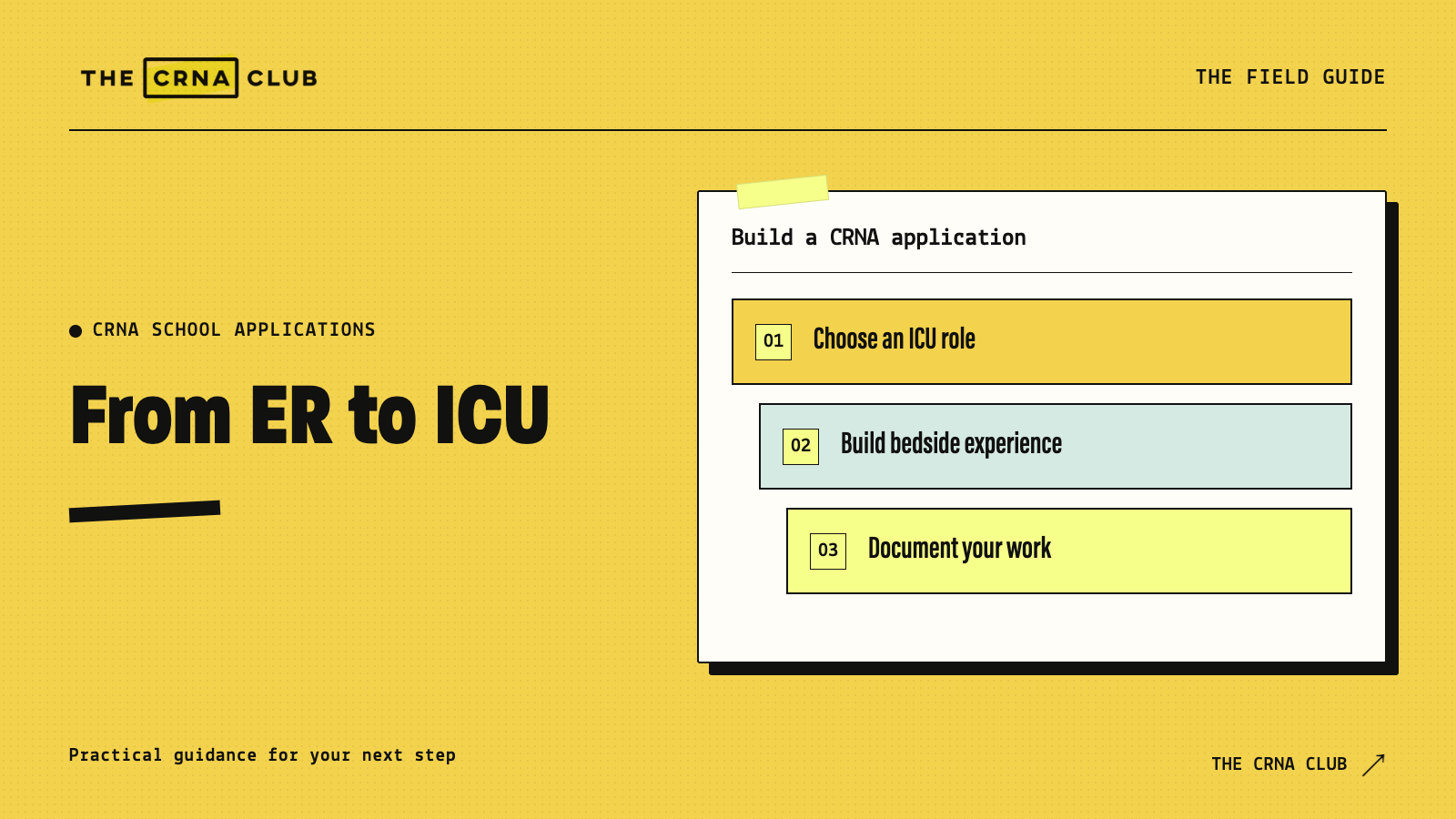
Start with the CRNA programs you would attend, then decide whether your ER experience meets their rules or whether an ICU transition belongs in your plan. If you need to move, choose the unit for the sustained critical-care experience you’ll build. Your goal is to develop clinical reasoning you can explain throughout an application and interview.
Sachi, CRNA
CRNA
In This Article (6 sections)
Our clinical experience tracker and ICU-preparation lessons help you record the patients, medications and devices you’re learning. Try them through the seven-day CRNA Club trial, so your new experience becomes useful material for your resume, essay and interview later.
Should you apply from the ER or transfer first?
Check actual school policies before making a job decision. Your ER title alone doesn’t settle eligibility, and an ICU requirement deserves a direct answer from the program.
The University of Iowa’s nurse anesthesia FAQ excludes emergency-room experience from its critical-care requirement. Columbia’s FAQ describes case-by-case review of ER experience. Those are different policies, so the same nurse has different questions to resolve for each program. If you’re still deciding whether to transfer, our guide to which CRNA programs consider ER experience gives you a starting list to verify.
Use our experience-eligibility guide for that first check. This article takes the next step: planning the transition once you know what your schools require.
Write a short description of your own work before emailing admissions. Include the patients you routinely manage, the monitoring and support involved, and how long you remain responsible for reassessment. Avoid describing every intervention your emergency department offers as something you personally perform.
If the schools you want require ICU experience, plan for it. Continuing to collect ER certifications won’t change a written ICU requirement.
Which ICU job should you choose?
We suggest comparing the patients and teaching you’ll receive rather than choosing by the unit name. A cardiac label sounds attractive, but you need to know what happens there day to day.
Ask the hiring manager or educator:
- Which patients stay on the unit, and which get transferred elsewhere?
- How do nurses develop ventilator, invasive-monitoring and vasoactive-infusion skills?
- How are assignments adjusted after orientation as your competence grows?
- Who helps you review a case when you don’t understand the physiology?
- What does orientation include for an experienced ER nurse entering ICU practice?
Consider two fictional job offers. Unit A has a cardiac name, but transfers most complex patients and has limited structured education. Unit B is a mixed medical-surgical ICU with sustained care of ventilated patients and regular case review. We’d investigate Unit B closely instead of assuming the cardiac name makes A better preparation.
Our ICU-experience guide explains the broader comparison. Pick a setting where you expect to learn and receive useful feedback.
The podcast “What is the BEST type of experience for CRNA school?” also explains why patient responsibilities deserve more attention than a unit name. Listen on Spotify or Apple Podcasts.
What should you learn differently after transferring?
Bring your ER strengths with you. Then give yourself time to learn the longer course of critical illness: how the patient responds over a shift, what happens after an intervention and why the plan changes the next day.
For each learning experience, write a brief anonymous note:
- What was the problem? Name the physiology you were trying to understand.
- What changed? Record the relevant trend and your reasoning about it.
- What did you learn? Identify the explanation you needed to revisit.
- What will you study next? Choose one knowledge gap instead of an entire textbook chapter list.
For example, a fictional nurse notices improved arterial pressure while urine output remains low. The learning task is to explain why a better pressure doesn’t establish adequate organ perfusion. That is more useful interview preparation than a note saying “managed pressors.”
Use the clinical tracker to keep those learning points together without patient identifiers. The learning library’s physiology and pharmacology lessons help you work through the reasoning when a familiar bedside action is still difficult to explain.
How do you build the application timeline after an ICU transfer?
Work backward from each school’s experience checkpoint. Ask whether its minimum applies at application, interview or enrollment, and how it treats orientation and part-time work. Don’t start the clock from whichever date gets you to a deadline fastest.
Here’s a planning sequence, rather than a promise about how quickly you’ll be ready:
| Stage | Practical task | Evidence to keep |
|---|---|---|
| Before transferring | Confirm the target programs’ experience rules | Current policy and written clarification |
| Orientation | Learn the unit’s patients and identify gaps with your educator | Your development plan |
| Independent ICU practice | Build and explain sustained critical-care responsibilities | Accurate dates and anonymous learning notes |
| Before applying | Check experience, academics and required certifications together | Program-specific completion records |
Suppose a fictional program requires 12 months of eligible independent ICU practice by September 1, 2027. If you finish orientation on October 1, 2026, you have 11 months by that deadline. Your actual programs decide which dates and duties count.
Keep CCRN eligibility separate from school admission eligibility. Passing a certification doesn’t replace a program’s required work experience, and the school doesn’t decide AACN’s certification rules.
Our Final Thoughts
An ER-to-ICU move is a real professional transition. Choose a learning environment you’ll grow in, give yourself room to become confident with sustained care, and keep a record of what changes in your practice. You’ll have more to discuss than the date you transferred.
Build your experience into your application
Use the seven-day trial for the clinical tracker, ICU-preparation lessons and application tools. Log one recent learning experience, then use it to choose the next physiology or pharmacology topic you need to understand.