How Do You Prepare for a CRNA School Critical Care Exam?
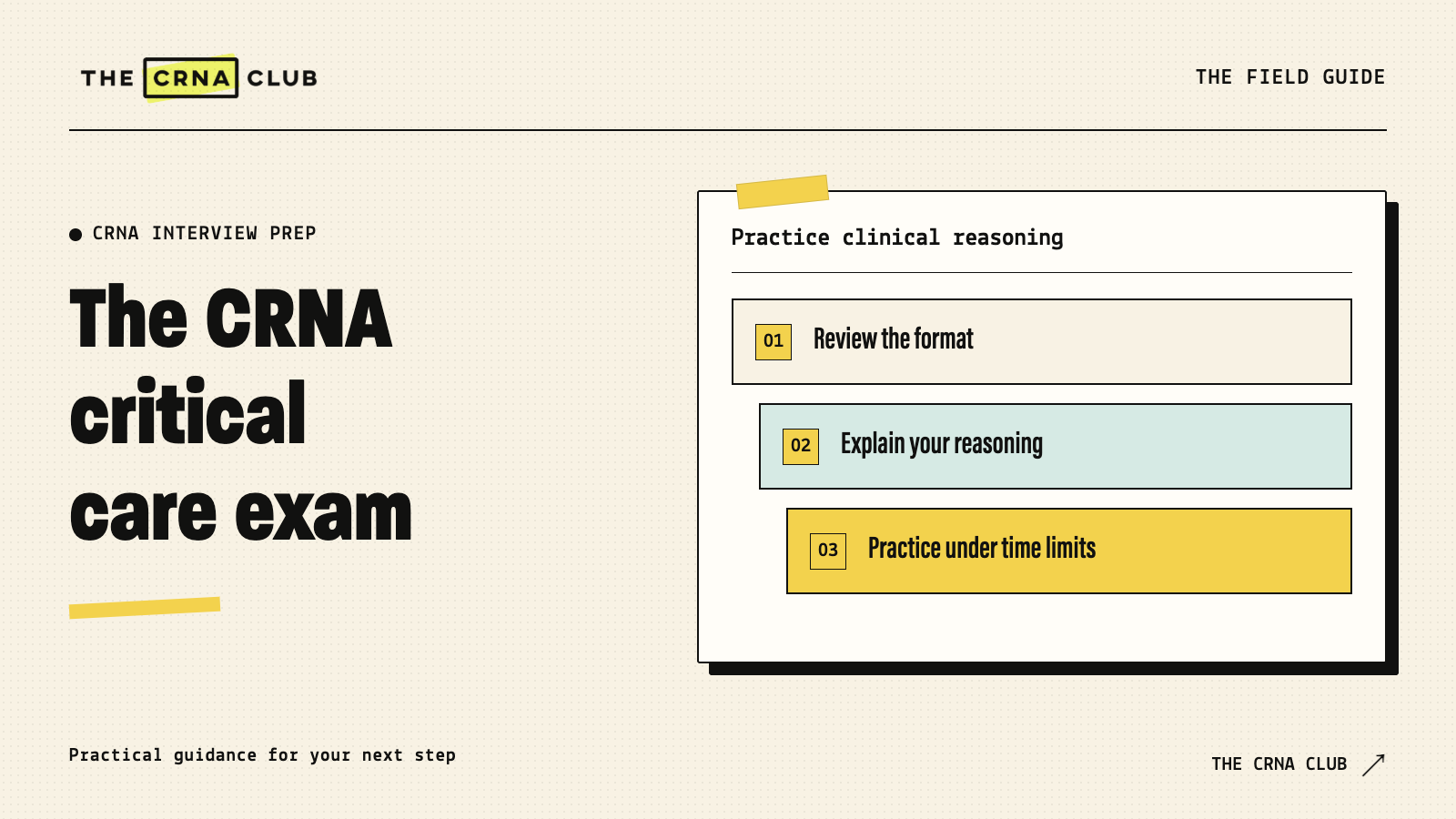
Start with the school’s exam instructions, then practice retrieving and applying the critical care knowledge you already use. A CRNA school critical care exam might sit alongside an interview or happen at a separate stage. Don’t assume it follows the CCRN format or covers the exact same material.
Sachi, CRNA
CRNA
In This Article (7 sections)
We suggest using our Interview Prep Plan to organize clinical review and spoken practice around the time you have. The learning library gives you explanations when a practice question exposes a gap. Try The CRNA Club free for seven days and work on the topics you actually need.
You don’t need another folder of questions before you begin. You need to know what you’re preparing for and which parts you struggle to explain.
What should you check before choosing study material?
Read the invitation and the program’s current admissions page together. Record the details in one place:
- Is this a multiple-choice test, a written response, a calculation assessment or something else?
- Does it happen before the interview, during the visit or through a separate proctor?
- What topics or preparation resources does the program actually name?
- What are the timing, technology and permitted-material requirements?
- Who should you contact if the instructions leave a practical question unanswered?
For a real example, OHSU’s published application steps describe an invitation to a critical care exam and writing assessment for selected applicants. That tells you to prepare for both tasks. It doesn’t establish another school’s exam format.
Ask about published logistics or recommended preparation. Don’t ask someone to send confidential questions from a prior exam.
Is studying for the CCRN enough?
CCRN review gives you a useful critical care foundation. It doesn’t tell you everything a particular school assesses. Compare your study material with the school’s instructions before deciding what to add.
At The CRNA Club, we suggest checking whether you can do three things with a topic: explain the concept, apply it to a new example and show your work when numbers are involved. A familiar multiple-choice answer doesn’t test all three.
If the explanation is missing, use the relevant lessons through our seven-day membership trial. Then close the lesson and try again. Keep a written clinical test and your spoken interview preparation on the calendar so one doesn’t crowd out the other.
For medication review, start with the drugs you mention in your application. Explain what the medication acts on and connect it to a patient effect. Follow any additional topics the school specifically assigns.
How do you find the gaps worth studying first?
Use a short baseline before filling the week with review. Choose a calculation, a clinical explanation and a written prompt. These are original practice exercises, not reported school questions:
- Calculation: A teaching solution contains 200 mg in 100 mL. How many milligrams are in 1 mL? Show the units.
- Explanation: Pick a medication you titrate at work. Explain its mechanism and one effect you reassess.
- Written response: Describe a real occasion when feedback changed your approach. State what you changed and what happened next.
For the first exercise, 200 mg divided by 100 mL equals 2 mg/mL. If your number was right but you couldn’t explain the units, practice the setup again. If your medication explanation stopped at a receptor name, review the next step in the mechanism.
Write the gap as a task: “Practice concentration calculations with units” or “Explain how this receptor changes vascular tone.” “Study everything” won’t help you choose tomorrow’s session.
What does a focused preparation week look like?
This example gives each block a different job. The times are planning choices, not a required study dose or a promise of readiness.
| Available block | Task | What you should have afterward |
|---|---|---|
| 20 minutes | Read the official instructions and try a baseline | A list of confirmed requirements and specific gaps |
| 30 minutes | Review one weak concept | An explanation you can give without notes |
| 20 minutes | Work a few unfamiliar calculations or questions | Your reasoning and units checked |
| 30 minutes | Practice a written response and a spoken follow-up | A response addressing the actual prompt |
| 15 minutes | Check logistics and review unresolved errors | A clear next task and confirmed exam arrangements |
That’s 115 minutes in this fictional week. Add, shorten or move blocks around your shifts and the gaps you find. Don’t schedule a full mock test if you haven’t left time to review it.
Our CRNA interview study plan covers the broader shift-work calendar. Use this exam-focused checklist inside that plan.
How should you review practice results?
Separate an unfamiliar concept from a reading or calculation mistake. Each calls for a different repair.
- You didn’t know the content: Review the relevant teaching, then explain it from memory.
- You answered a different question: Restate the requested task before looking at the options.
- You lost the units: Write the conversion until unwanted units cancel.
- Your written answer wandered: Keep the details explaining your action and learning. Cut the rest.
If you’re preparing for a spoken follow-up too, try our Mock Interview Lab. The free entry includes one lifetime interview. Use its feedback as a practice aid; it doesn’t predict how a school will score you. Personalized study guides require active membership or an active membership trial.
Our Final Thoughts
The school’s instructions choose the task. Your baseline chooses the first study topic. Start there, fix a specific gap and check it with a different example. That’s much more useful than guessing which confidential questions might appear.
Take the Next Step
Use the Interview Prep Plan and learning library to put those review tasks on a realistic calendar. Start your seven-day platform trial with one concept you need to explain more clearly.