How Does a Previous Non-Nursing Degree Affect Your CRNA GPA?
Sachi, CRNA
CRNA
In This Article (8 sections)
- Which parts of the old degree do you need to report?
- How do you separate undergraduate, graduate and overall work?
- What would a multiple-degree GPA example look like?
- What if the earlier degree was in science?
- How should you use a strong recent record?
- What questions should you send to a target program?
- Our Final Thoughts
- Take the Next Step
Your earlier non-nursing degree still belongs in your academic history. How it affects your GPA depends on which courses each school counts. We suggest using our Transcript Analyzer to bring the degrees together, then checking cumulative, nursing and recent-credit groups separately. The seven-day trial includes GPA lessons and school research tools to help you use those numbers in your plan.
A strong BSN doesn’t make the earlier degree disappear. It also doesn’t mean the BSN’s performance has no value. Keep the different numbers clear so you can describe the record accurately and choose programs using their actual requirements.
You might have a 3.8 in nursing and a lower cumulative GPA once the first degree is included. Both can be correct. Our GPA types guide explains the categories. Let’s put the degrees together without losing what each part of the record shows.
Which parts of the old degree do you need to report?
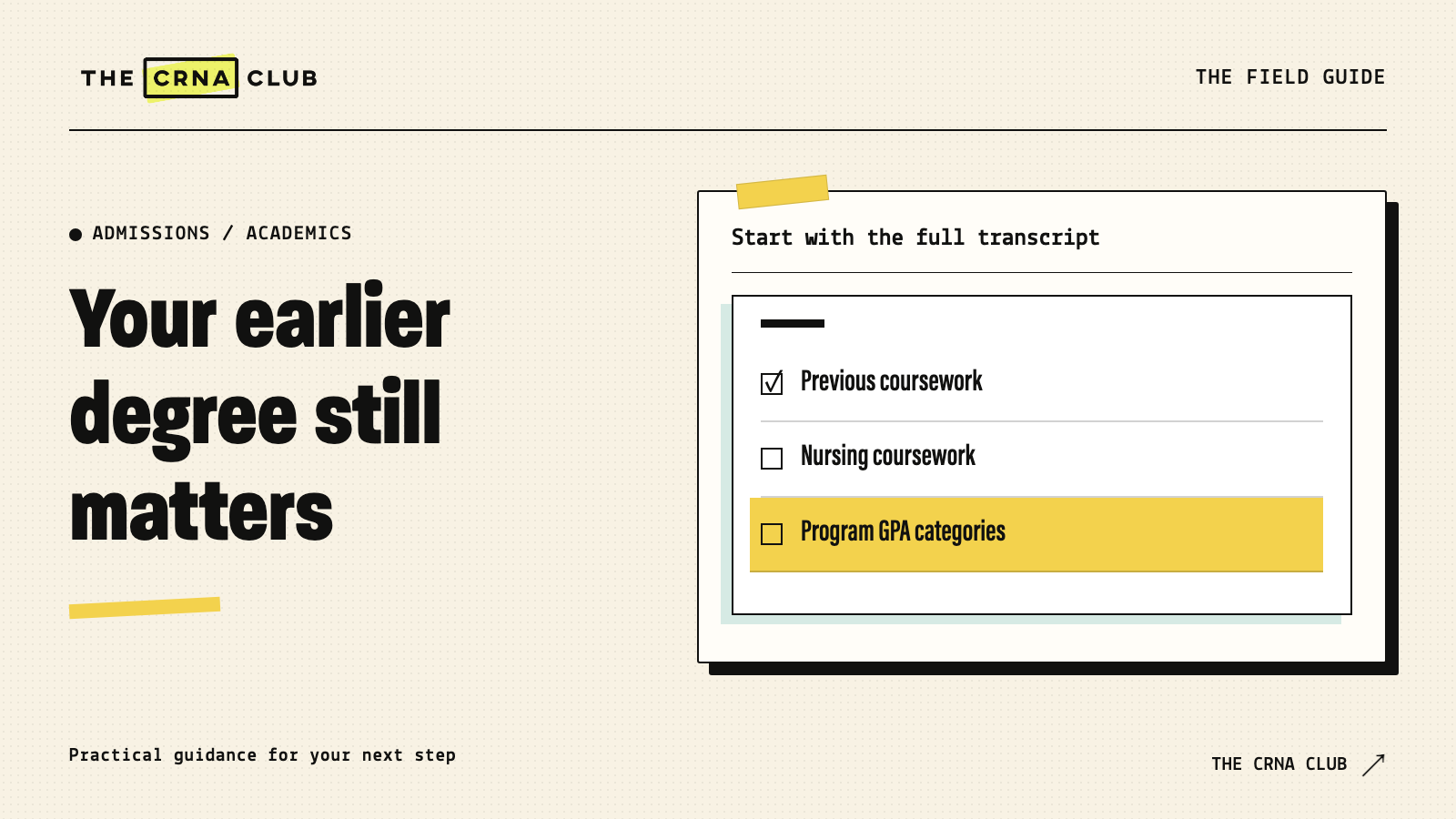
Follow the application’s instructions for every institution attended and every required course entry. NursingCAS requires institutions to be reported regardless of their relevance to the intended program, including earlier and transferred coursework. Don’t omit an institution because its classes were unrelated to nursing or later appeared as transfer credits elsewhere.
Read the current NursingCAS Colleges Attended instructions. Your selected programs determine their transcript requirements, so check those instructions alongside the institution list.
Start your transcript map with:
- Original institution: Include community-college and summer courses taken outside your main degree institution.
- Dates attended: Keep the original academic periods visible.
- Degree or coursework status: Record the work accurately, including study without a completed degree.
- Records needed: Follow the application’s transcript requirements for that institution.
A transfer notation on a later transcript doesn’t automatically replace the reporting steps for the original school.
If the application requires full transcript entry, use the official course-entry guidance. Keep courses under the original institution as instructed rather than entering the same course twice under both the source and receiving schools.
We suggest listing every original institution before entering courses. It helps you spot a missing transcript or a transfer course entered twice. Once the history is right, the GPA comparison becomes much easier.
How do you separate undergraduate, graduate and overall work?
Separate undergraduate and graduate courses first. NursingCAS combines undergraduate and post-baccalaureate work for cumulative undergraduate GPA. Graduate work also enters its overall calculation under its rules. A school may look at nursing or recent credits too. Label each group so you know which number you’re discussing.
The NursingCAS GPA calculation page describes these categories. Use the actual course classification and current instructions, particularly if you completed coursework after one degree but before entering another.
Create a map with one row per academic period:
| Academic record | Original institution | Level to verify | Possible calculation role |
|---|---|---|---|
| Earlier non-nursing degree | Original college | Undergraduate | Cumulative undergraduate and overall under the applicable rules |
| Later nursing degree | Nursing institution | Undergraduate if that is the degree level | Nursing review if defined, plus applicable broader calculations |
| Courses after bachelor’s degree | Course provider | Post-baccalaureate or graduate, as appropriate | Depends on actual classification |
| Graduate degree or courses | Graduate institution | Graduate if correctly classified | Graduate and applicable overall review |
The phrase “taken after my bachelor’s” doesn’t automatically mean graduate level. Verify the course record. Keeping the level accurate matters more than choosing the label that gives the most attractive calculation.
What would a multiple-degree GPA example look like?
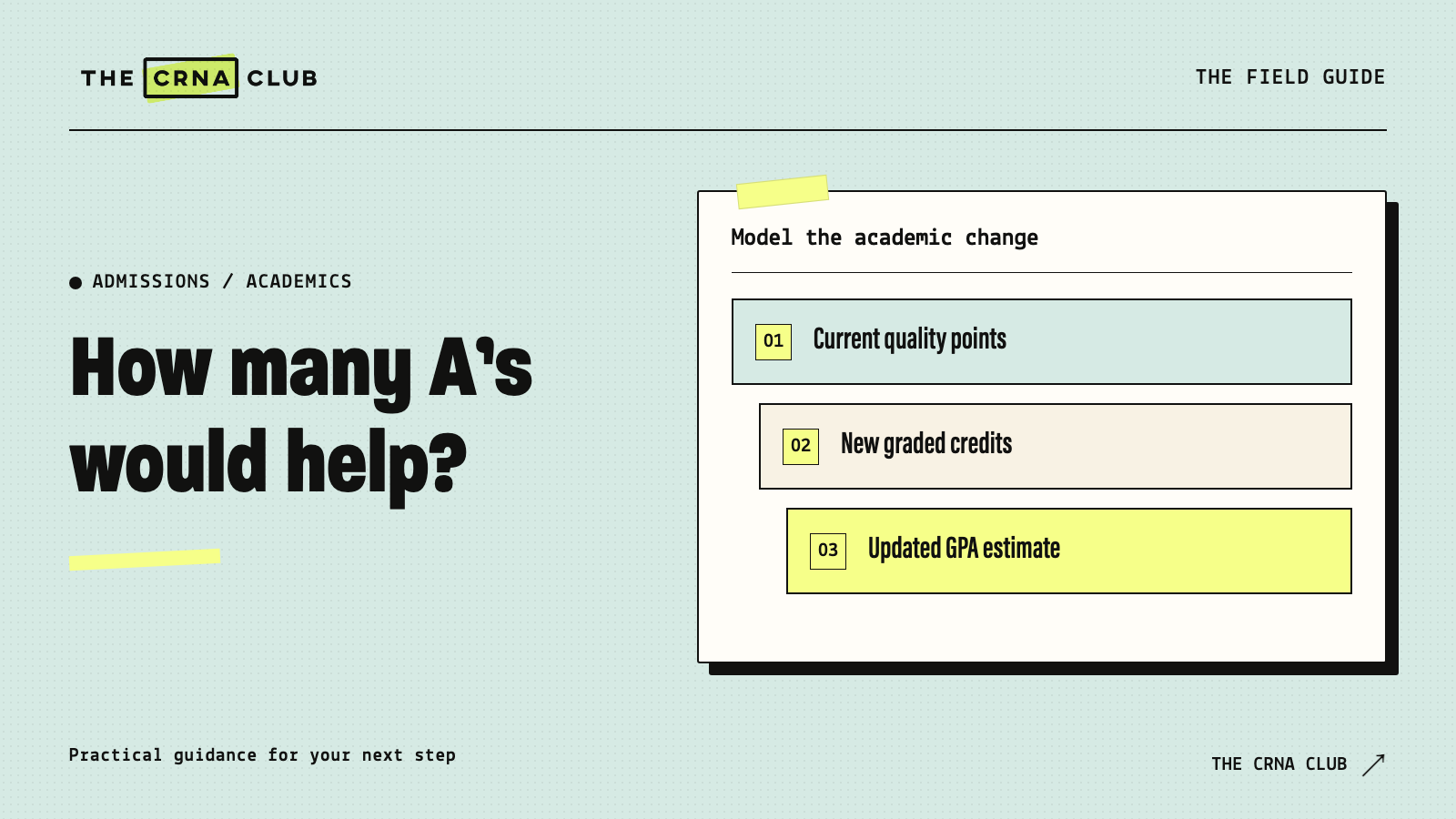
Add the credits and grade points for each group, then divide. Don’t average the degree GPAs. The first degree may have twice as many credits as the nursing work, so it carries more weight in the combined number. Let’s use a made-up record to see the difference.
Consider this hypothetical record on a four-point scale:
| Record | Graded credits | GPA | Quality points |
|---|---|---|---|
| First non-nursing undergraduate degree | 120 | 2.80 | 336 |
| Later undergraduate nursing coursework | 60 | 3.80 | 228 |
| Post-baccalaureate undergraduate courses | 12 | 4.00 | 48 |
| Graduate courses | 9 | 4.00 | 36 |
If the applicable cumulative undergraduate group includes the first three rows, it contains 192 credits and 612 quality points. Divide 612 by 192 to get about 3.19.
If the applicable overall group also includes the graduate row, it contains 201 credits and 648 quality points, or about 3.22. The later nursing-course row remains 3.80 when considered by itself. A school-defined nursing GPA might use a different course selection, so don’t assume that row is the official nursing calculation.
Keep each source subtotal in the working file. If a program later clarifies which courses it wants, you can change the group without losing the original history. This also makes it easier to catch a duplicated transfer course or an academic level entered incorrectly before the final application review.
The example shows why averaging 2.80, 3.80 and 4.00 without considering credits produces the wrong result. A 120-credit degree carries more weight than a nine-credit group in a combined credit-weighted calculation.
What if the earlier degree was in science?
Look inside the old degree. A biology degree includes science, but it may also include math, humanities and electives. Which of those belong in the science GPA depends on the calculation you’re using. We suggest reviewing the courses in the Transcript Analyzer, then comparing the school’s actual science list with those entries.
An earlier biology degree may include biology, chemistry, mathematics, humanities and electives. Those subjects don’t automatically enter the same science calculation. A non-science degree may still contain qualifying prerequisite or science courses.
Our science GPA calculation guide helps organize the course-level review. Keep the original grade, credits and subject information with each row so an updated school rule can be applied without rebuilding the record.
If a course title is vague, retain the description or syllabus for clarification. Don’t change the subject simply to keep an old low grade out of a category. Use the documented course and the applicable classification process.
The old degree’s label matters less than the actual academic work inside it. This is why a complete transcript map is more useful than comparing degree GPAs alone.
How should you use a strong recent record?
Use the recent record accurately within the calculations and application sections the program requests. A stronger later pattern may provide context, but it doesn’t waive a published minimum automatically. Check whether the program considers recent credits, graduate work or a nursing-specific group, and ask about unresolved definitions before choosing a strategy.
If your earlier grades are weaker, compare each program’s actual calculation method. Keep your complete academic record in view. Don’t assume the school only sees whichever number is most favorable to your application.
For a school mentioning the last 60 credits, ask which academic levels and cutoff method it uses. For a school using cumulative undergraduate GPA, calculate that group rather than replacing it with the later BSN GPA on your own.
If an explanation is requested, keep it concise and factual. State the earlier issue, what changed and what the later record demonstrates through actual completed work. Don’t claim every committee will interpret the pattern the same way.
Before taking another class, identify what the class would change. It may satisfy a prerequisite, add recent graded work or affect a particular GPA. A new course shouldn’t become an automatic response to the discomfort of seeing the old degree included.
What questions should you send to a target program?
Ask which GPA definition controls eligibility and how the program treats the specific levels in your record. Include a brief academic map rather than sending a long unstructured explanation. Keep reporting requirements separate from questions about additional academic review or possible exceptions.
A focused email might read:
I completed a non-nursing bachelor’s degree, a later nursing degree and the attached subsequent coursework. Your admission page refers to ___. Does that mean cumulative undergraduate coursework across institutions, the nursing degree or another defined group? Do you also review graduate or recent-credit performance? I would appreciate the current calculation instructions for the upcoming cycle.
If the program states a clear minimum, don’t ask whether a different GPA automatically replaces it. Ask about the actual rule and follow the answer. Keep the response and date in your school ledger.
The GPA + Prerequisites lessons explain how to connect these academic categories with a school and course plan. Explore the seven-day membership trial if you want structured teaching while organizing your own record.
Our Final Thoughts
An earlier degree makes the calculation more detailed, but the steps are manageable. Gather the original records, label the academic levels and calculate the groups the schools actually use.
Your later work still deserves accurate description. You don’t need to hide the old record or pretend the strongest new number is the only one. Keep the full picture clear and choose the next task from verified requirements.
Take the Next Step
Start with the free Transcript Analyzer to bring your course history together. It includes one lifetime free analysis. Review the institutions, levels and attempts it extracts, then try our seven-day membership trial for GPA lessons and school research. Use the complete record to find your next academic step, rather than judging everything from the old degree GPA.