How Many A’s Would Raise Your GPA for CRNA School?
Sachi, CRNA
CRNA
In This Article (8 sections)
- What numbers do you need before calculating?
- How much does one A change a 120-credit GPA?
- How do you calculate the credits needed for a target GPA?
- Why does the same class move a smaller GPA group more?
- How do repeated courses affect the estimate?
- What should you check before enrolling in enough classes to reach the target?
- Our Final Thoughts
- Take the Next Step
How many A’s you need depends on the graded credits you already have and which GPA you’re trying to change. We suggest using our Transcript Analyzer to organize the record, then our manual GPA Calculator to try adding courses yourself. The calculator and GPA lessons are available through the seven-day membership trial. Let’s do the math before you pay for more classes.
If you already have a long transcript, a few excellent grades may move the cumulative number less than you expected. The denominator is large. A smaller science-course group might change more with the same class, provided the class belongs in that school’s science calculation.
A new A can be useful even when the cumulative number barely moves. It might satisfy a prerequisite or add recent strong science work. But choose the class for the problem you actually have. A harder-sounding course won’t automatically replace one your school requires.
What numbers do you need before calculating?
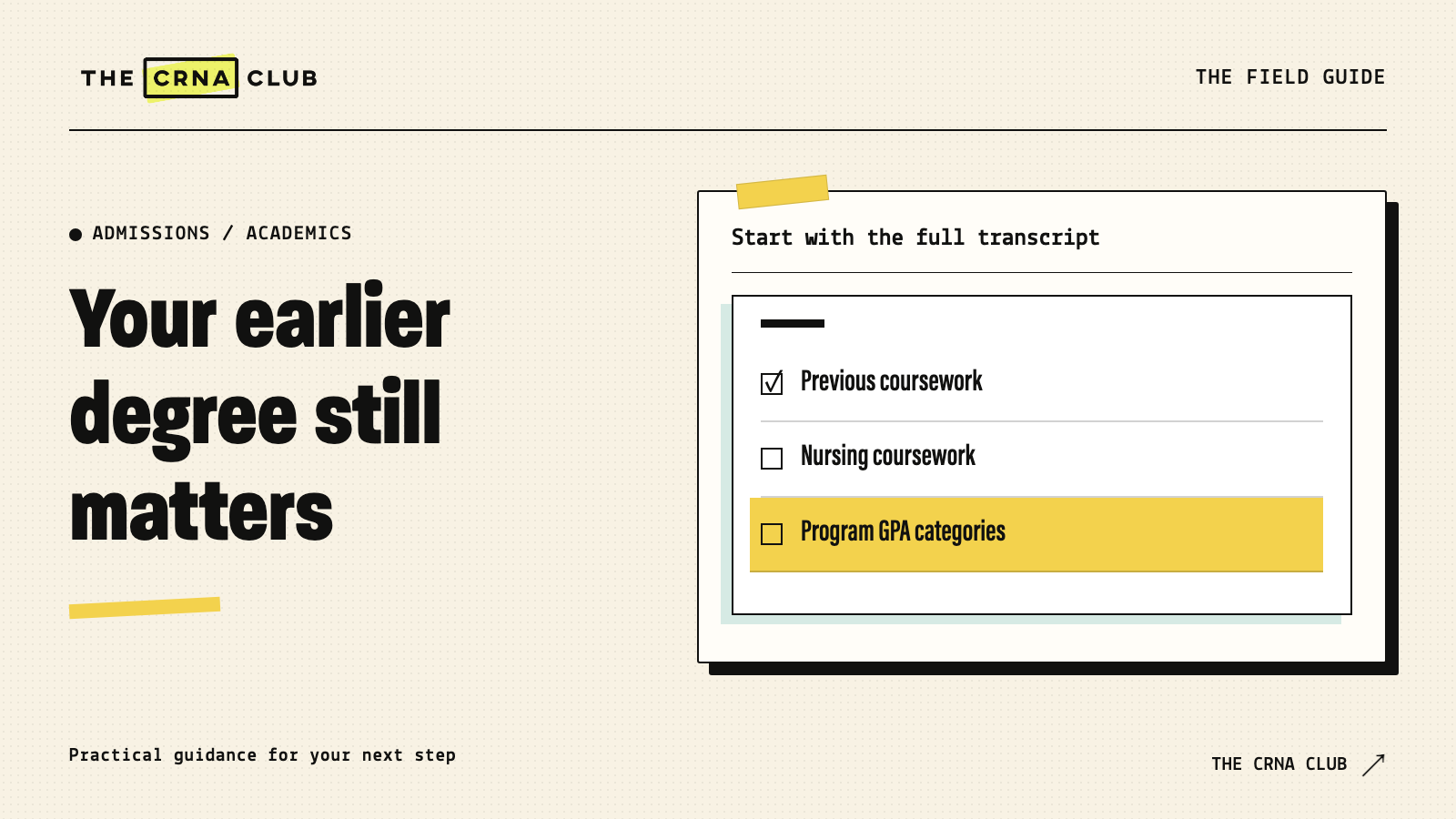
First choose the GPA. Cumulative undergraduate? Graduate? The science GPA one school uses? Those can include different courses. Pull the credits and grade points for that group, then add the proposed class only if it belongs there. Otherwise, you’ll model an increase in the wrong number.
NursingCAS explains its credit-weighted calculation: multiply the numeric grade value by attempted credits to get quality points, then divide total quality points by the included attempted credits. Its published categories also distinguish undergraduate and overall calculations.
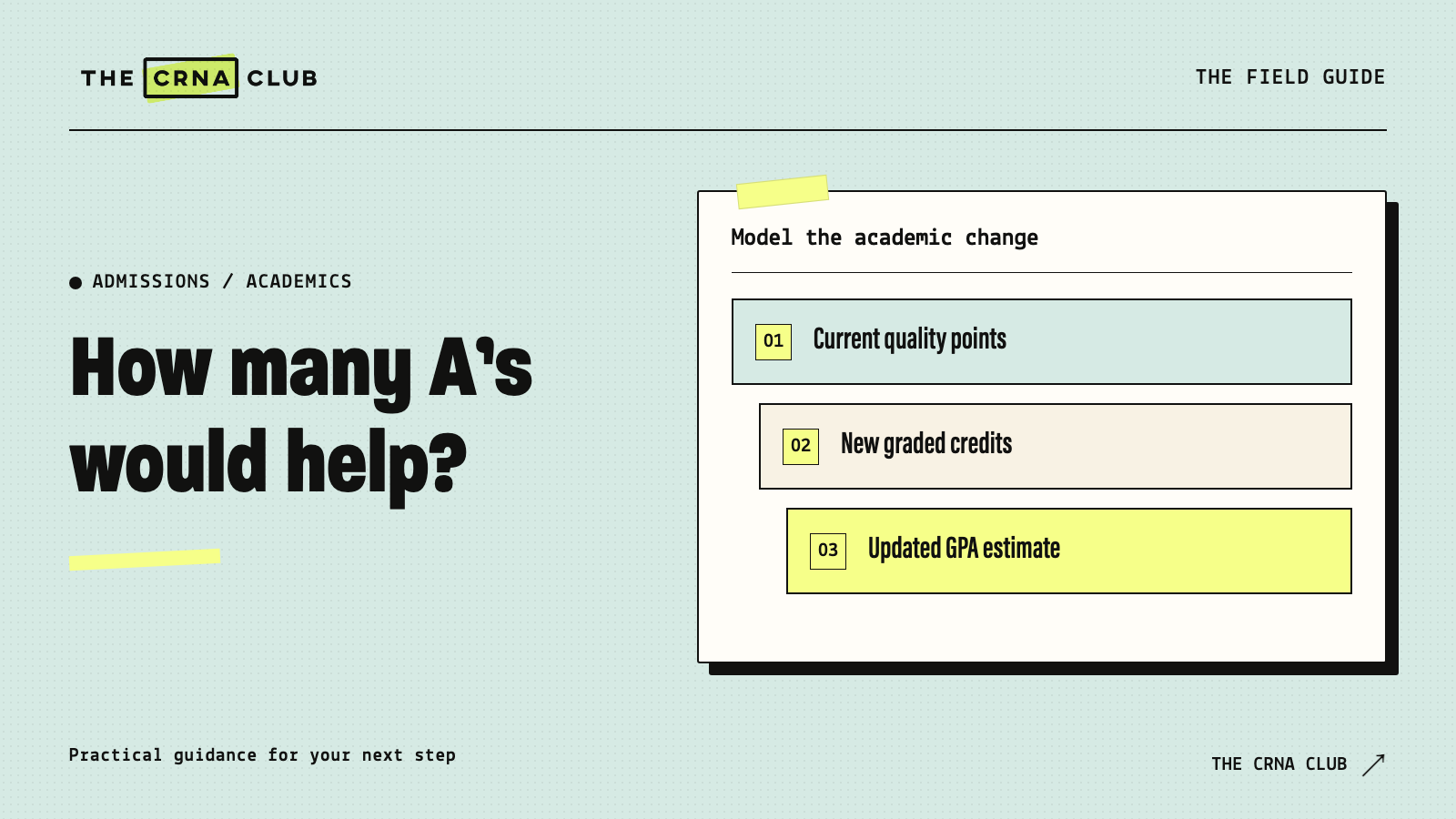
For an unofficial planning estimate, record the current group, credits, quality points and GPA. If you only have a rounded GPA, multiplying it by credits gives an approximation. Use course-level data for a more accurate result.
Our science GPA calculation guide helps you define a different course group. Don’t use the cumulative credit total when you mean the science total, or vice versa.
Keep the school’s policy beside the numbers. Otherwise, you may spend time improving a calculation the program doesn’t use in the way you assumed.
How much does one A change a 120-credit GPA?
One new four-credit A changes a 120-credit GPA according to its starting quality points and the added credits. The change is usually modest because the new class is a small part of the total. Calculate it directly instead of assuming the retake replaces the original grade or produces a fixed GPA increase.
Consider a hypothetical applicant with 120 included graded credits and a 3.00 GPA on a four-point scale. Her existing quality points are 120 times 3.00, or 360.
A new four-credit A adds 16 quality points. The new total is 376 quality points over 124 credits. Divide 376 by 124 and the GPA is about 3.03.
| New A-grade credits | Total credits | Total quality points | New GPA |
|---|---|---|---|
| 4 | 124 | 376 | 3.03 |
| 12 | 132 | 408 | 3.09 |
| 30 | 150 | 480 | 3.20 |
We’re assuming every new grade is an A worth 4.0 and every class counts in this same group. The 30-credit row shows how slowly a long transcript moves. We aren’t suggesting you sign up for 30 credits. Compare the benefit with what the class actually needs to accomplish.
A class might still serve another purpose, such as satisfying a prerequisite or documenting more recent work. Keep that purpose separate from the size of the cumulative GPA change so you can evaluate the expense honestly.
How do you calculate the credits needed for a target GPA?
For new credits all earning 4.0, subtract your current GPA from the target, multiply by current graded credits, then divide by 4.0 minus the target. The result estimates new A-grade credits needed for that group. The calculation assumes the existing record remains included and the proposed credits all count.
Write the equation in plain notation:
new A credits = current credits × (target GPA − current GPA) ÷ (4.0 − target GPA)
Use the hypothetical 120-credit, 3.00 starting record and a 3.20 target. The numerator is 120 times 0.20, or 24. The denominator is 0.80. Divide 24 by 0.80 to get 30 new A-grade credits.
Now change the target to 3.40. The numerator is 48, and the denominator is 0.60. The result is 80 new A-grade credits. That’s a very different time and cost commitment.
If the target is already at or below your current GPA, this equation doesn’t create a need for new coursework. If your starting GPA is below 4.0, adding a finite number of 4.0 credits won’t make the combined GPA exactly 4.0. The old lower quality points remain in the total.
Round the required course plan up to actual available credit amounts, then calculate the result again. You can’t enroll in an arbitrary fraction of a course simply because the equation produced a decimal.
Why does the same class move a smaller GPA group more?
A class carries more weight when it is added to fewer existing credits, assuming it belongs in that calculation. This is why a science GPA may change more than a long cumulative record. The arithmetic only applies after the course classification and program rule are clear.
Consider a hypothetical science group with 30 graded credits at 2.90. The existing quality points are 87. Add a four-credit A worth 16 quality points and the new total is 103 over 34 credits, or about 3.03.
Compare that with the 120-credit example. Same four-credit A, much bigger change in the smaller group. Why? The new class makes up more of those 34 credits. That’s why we suggest checking both the science and cumulative effect instead of assuming one class changes every GPA equally.
Don’t assume every nursing, statistics or pharmacology course belongs in every science group. Marian’s DNP-CRNA FAQ gives one program-specific science description. Other schools may define the group differently.
Write “included if approved under this school’s rule” beside a proposed class until the classification is settled. A favorable hypothetical result isn’t a reason to skip the policy check.
How do repeated courses affect the estimate?
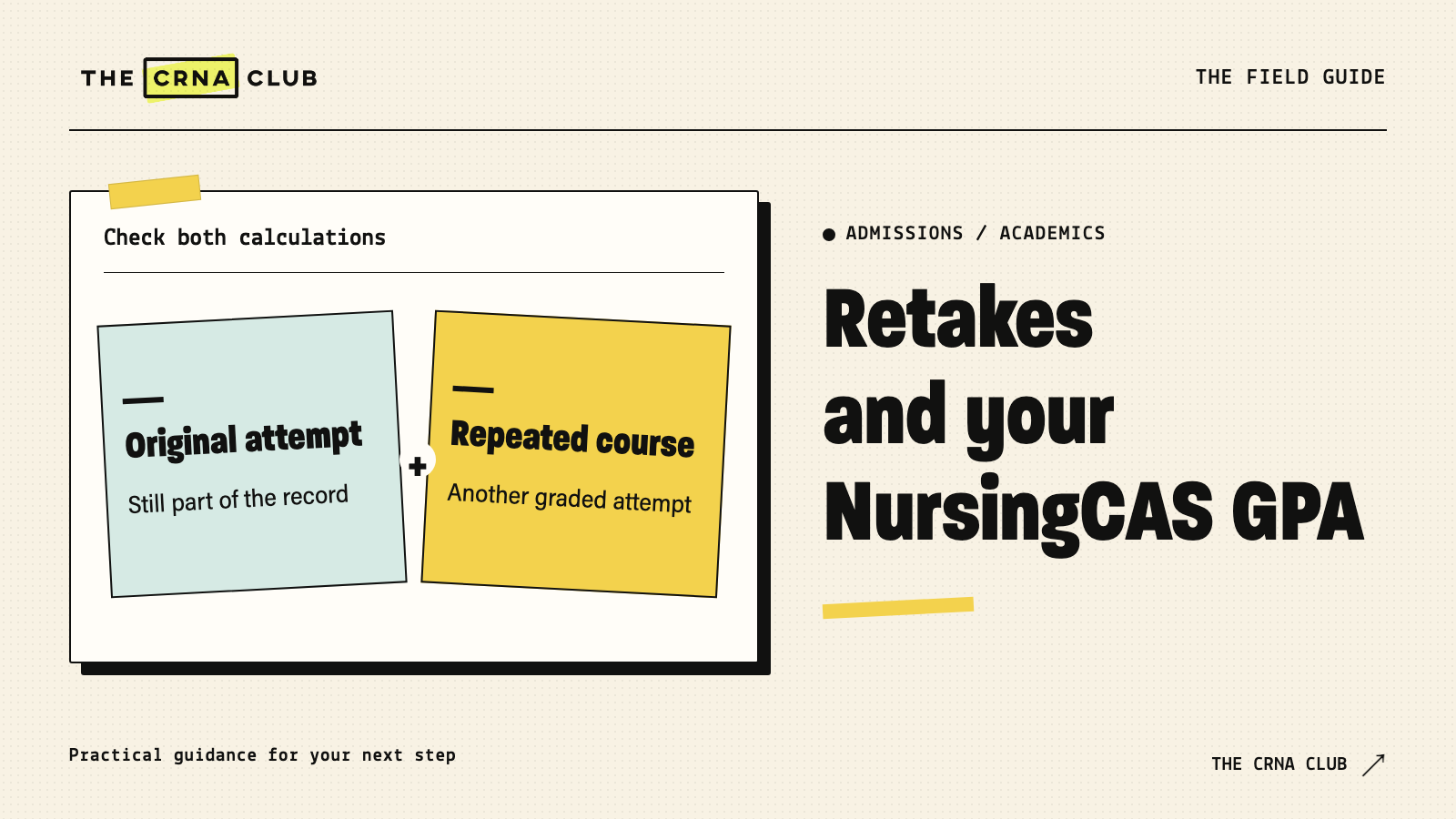
Model a repeat according to the actual calculation rule. NursingCAS’s standardized GPA guidance does not adopt an institution’s grade-forgiveness policy automatically, and reported repeated grades remain relevant to its calculation. A school may also review a prerequisite using its own stated method, so keep the two calculations separate.
Suppose the hypothetical record already includes a four-credit C. If the new A is treated as another attempt while the old C remains, you add the new credits and quality points. You don’t remove the original attempt to create a higher unofficial GPA.
Our GPA types and NursingCAS guide explains why an institutional transcript number and a standardized number can differ. Use the appropriate rule for the number you’re reporting.
If a program specifically recalculates a prerequisite using a newer or higher attempt, document that policy separately. Don’t transfer one program’s calculation to another school or to the application service’s standardized result.
The retake decision also includes grade minimums, course recency and whether the course meets the actual prerequisite. A larger GPA increase under one rule doesn’t prove the class solves every academic issue in the application.
What should you check before enrolling in enough classes to reach the target?
Why are you aiming for that number? If it’s a school minimum, calculate exactly what you need under its rule. If it’s your own goal, compare the time and tuition with the benefit. We suggest trying the course combination in the GPA Calculator before enrolling, then checking whether the class addresses a prerequisite or recent-science need too.
Create a short enrollment decision:
- Which GPA are you changing? Name the school-defined or standardized course group.
- Why this target? Record the published rule or label it as your personal goal.
- Do the classes count? Confirm classification and prerequisite acceptance.
- What is the expected change? Keep the credit-weighted calculation and its assumptions.
- What else does the course address? Identify the missing requirement, recency issue or learning need.
- Is the plan workable? Check tuition, workload and final-grade timing.
The GPA + Prerequisites lessons help connect the math with course choices and school requirements. Explore the seven-day membership trial if you want structured teaching while deciding which academic task comes next.
Don’t treat a new class as the only available action. Once published academic requirements are met, other unfinished application work may deserve the next block of time. The calculation helps you choose deliberately.
Our Final Thoughts
Do the math before paying for the class. A clear credit-weighted estimate shows what the new A’s would change and how much work the target actually requires.
Then return to the application question. The best next course is one with a specific purpose, a verified place in the calculation and a workload you can complete well.
Take the Next Step
Use the free Transcript Analyzer to bring the existing record together. It includes one lifetime free analysis. Then try our seven-day membership trial for the manual GPA Calculator and GPA + Prerequisites lessons. Model the proposed classes, check the school rules, and decide whether the change is worth the work.