How many CCRN practice questions should I do each day?
Sachi, CRNA
CRNA
In This Article (10 sections)
- Why isn’t a fixed daily target enough?
- If you have 30, 60 or 90 minutes, how many CCRN questions should you plan?
- Should your question count change on workdays?
- When should you reduce the set size?
- When is increasing volume reasonable?
- How do you plan a week without turning it into a quota contest?
- What if you’re behind the count you planned?
- Should you count repeated questions differently?
- Our Final Thoughts
- Take the Next Step
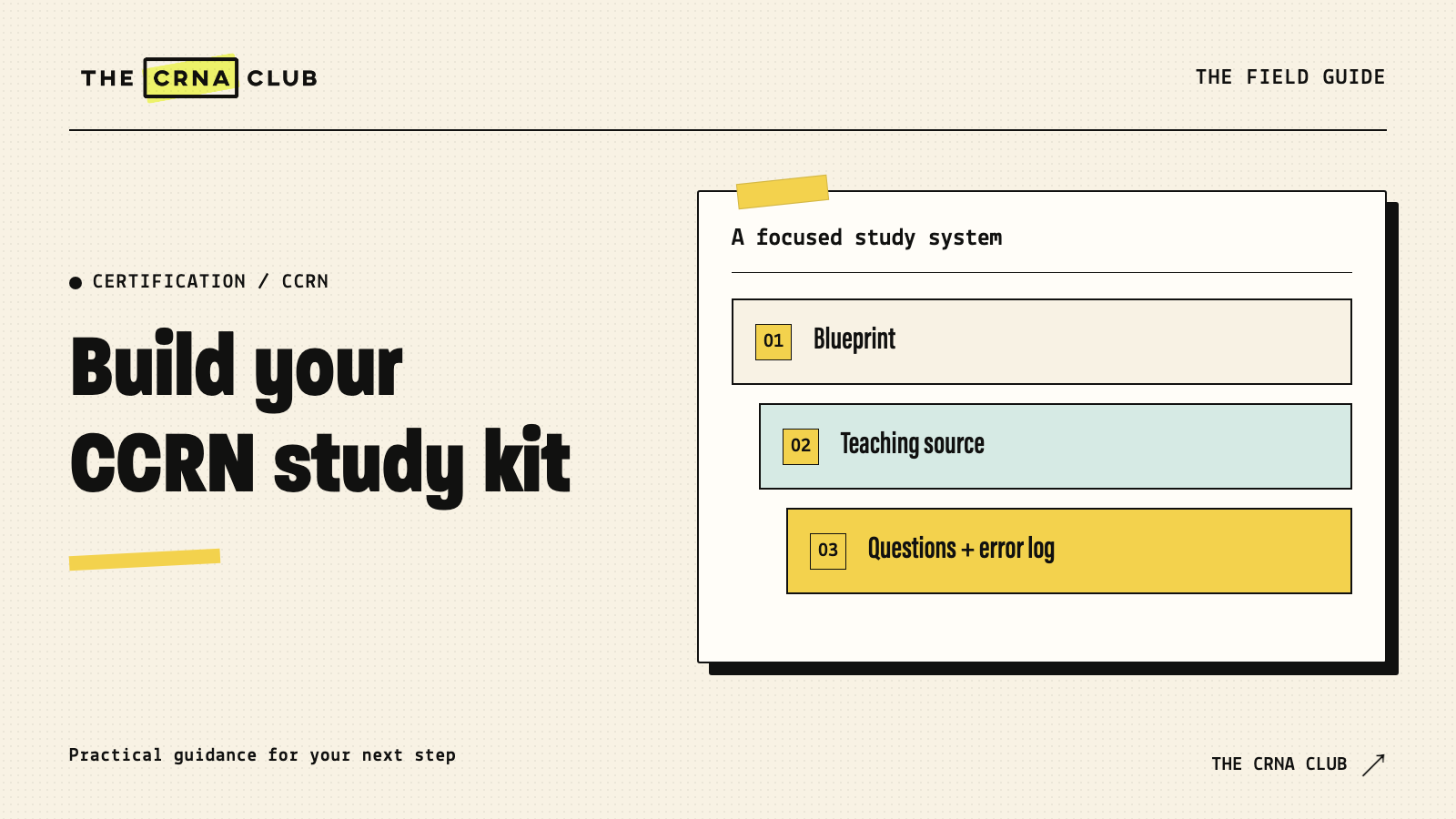
Start with the number of CCRN questions you have time to review, rather than aiming for a hundred every day. If you have an hour, leave part of it for explanations and the topic you missed. Adjust the next set after seeing how long that work takes.
Our CCRN Toolkit gives you practice questions, video teaching and a planner together. We suggest using the planner to fit those steps around your shifts. A question count helps you get started. It shouldn’t crowd out the explanation you need afterward.
Ten carefully reviewed questions and a lesson on the main gap might be the right session today. A longer mixed set might fit another day. Let’s work out how to choose.
Why isn’t a fixed daily target enough?
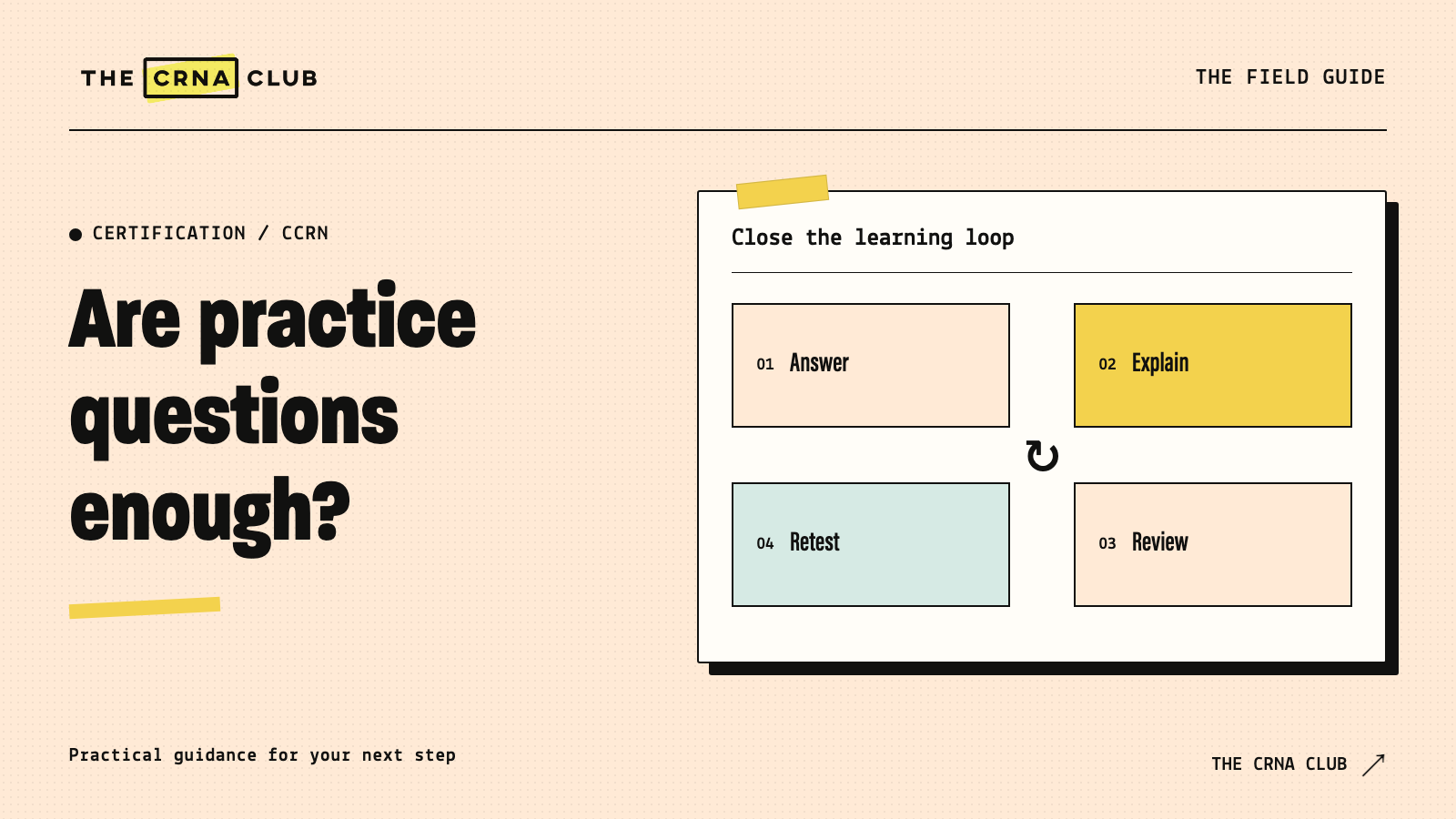
Question count measures how many attempts you made. It doesn’t describe difficulty, familiarity, understanding or time spent reviewing. The same count takes different amounts of work depending on the gaps it reveals. Use a target to start a session, then adjust it to protect the review that makes practice useful.
AACN’s preparation guidance recommends attention to the test plan and areas needing further study. It doesn’t establish a daily question quota as proof you are ready.
Think about two nurses who each answer twenty questions. You understand the material and need to review a few uncertain choices. Your coworker finds whole concepts they haven’t learned. Same count, very different amount of study left to do.
If you’re the second nurse, tomorrow’s plan needs teaching time. Adding twenty more questions without that time means carrying the same gaps into another set. Use the video lesson for the subject you don’t understand, then return to practice.
If you have 30, 60 or 90 minutes, how many CCRN questions should you plan?
Time a small set from answering through rationale review and the note about what to study next. Divide your available minutes by that average time per fully reviewed question, then round down. Use your own pilot result. A difficult topic sometimes needs a lesson instead of a larger set.
In this fictional pilot, a nurse completes ten questions. Answering takes fifteen minutes, reviewing rationales takes twenty-five, and writing follow-up notes takes five. That’s 15 + 25 + 5 = 45 minutes for ten fully reviewed questions, or an average of 4.5 minutes each.
Using that measured pace from the fictional session:
| Time available | Calculation | Starting count, rounded down | Estimated time for answering and review |
|---|---|---|---|
| 30 minutes | 30 divided by 4.5 = about 6.67 | 6 questions | 6 times 4.5 = 27 minutes |
| 60 minutes | 60 divided by 4.5 = about 13.33 | 13 questions | 13 times 4.5 = 58.5 minutes |
| 90 minutes | 90 divided by 4.5 = 20 | 20 questions | 20 times 4.5 = 90 minutes |
These are planning examples, not expected speeds or daily requirements. Your own review might take longer. The ninety-minute row also leaves no extra room if a concept needs deeper teaching, so choose fewer questions when you want time for a lesson in the same block.
Suppose the first few questions show you don’t understand a topic. Stop expanding the set. Use the relevant video in our CCRN Toolkit and schedule the next check. Next time, use what answering and reviewing actually took to adjust the count. The point is to finish the learning, rather than reach thirteen because a table said so.
Should your question count change on workdays?
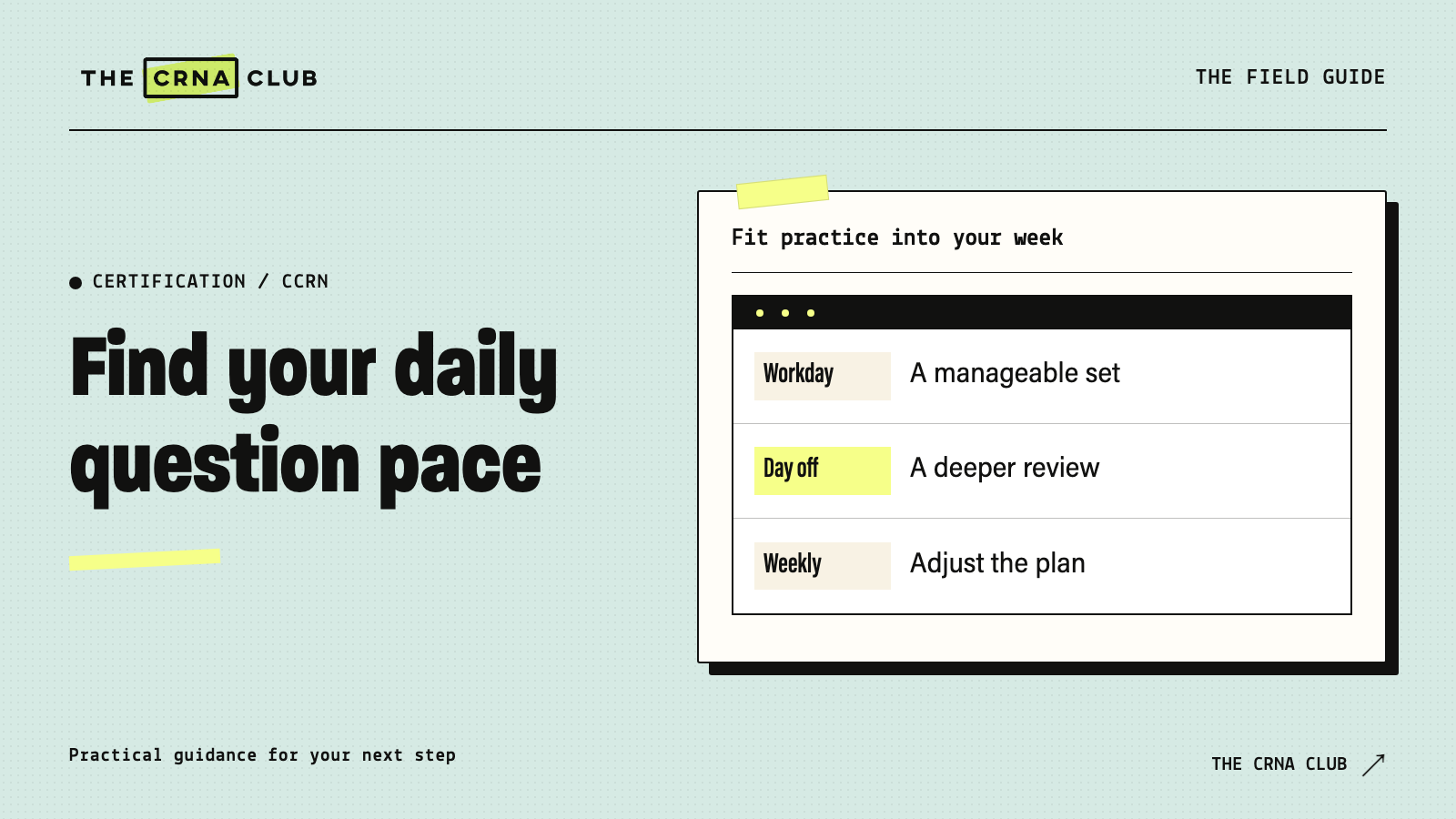
Yes, your task should fit the attention and time available. A workday sometimes supports a brief retrieval session or review of a few previously missed concepts. A longer off-day block allows unfamiliar practice and deeper teaching. You don’t need to force identical work into days with very different demands.
Suppose you work three shifts in a row. You have one protected study block before the stretch and another afterward. Make those blocks do the heavier work, with short optional reviews during the shift stretch if you are rested enough to use them well.
Avoid building a plan dependent on uninterrupted clinical downtime. A patient’s needs decide whether that downtime exists. Protected time away from work gives you a more reliable place for new learning.
And don’t treat a missed daily streak as permission to abandon the week. Move the specific task into the next realistic block. Doubling tomorrow’s count without adding review time often recreates the same problem.
When should you reduce the set size?
Reduce the set size when:
- You repeatedly rush explanations.
- You stop recording uncertainty.
- You carry unfinished review into the next session.
- Many questions address material you haven’t learned.
A smaller set gives you room to investigate the gap instead of repeatedly confirming you don’t understand it yet.
Pay attention to the point where your work changes. You might begin by explaining choices and end by clicking through to finish the target. The last fifteen attempts still count on the dashboard, but their learning value deserves a closer look.
A useful stopping rule is practical: stop adding new attempts when you no longer have time to address the uncertainty already identified. Finish reviewing, choose a follow-up task and return later.
If one subject is unfamiliar, use the next block for the relevant CCRN lesson. Explain it back before returning to questions. A day with more teaching and fewer clicks still belongs in your preparation. The planner should leave room for learning, rather than treating every block as a question quota.
When is increasing volume reasonable?
Increase volume when you review fully, explain the concepts and have time for additional practice. Larger sets sometimes help you examine stamina or timing. Decide that purpose before starting, and keep enough time afterward to review the results rather than treating the larger number as an achievement by itself.
If a twenty-question session leaves you with clear reasoning, few unresolved gaps and unused time, try a modest increase. Observe whether the quality of review stays similar. You don’t need to jump to a much larger set because someone online reports doing it.
For a timing rehearsal, set appropriate conditions and review afterward. Keep its purpose distinct from a slower learning session where you pause to investigate unfamiliar content.
The official CCRN FAQ provides examination format and directs you to the handbook. Check those details when planning a rehearsal rather than assuming every practice platform’s default settings match the examination you will take.
How do you plan a week without turning it into a quota contest?
List the learning tasks first, then estimate how many attempts fit. Include focused teaching, questions, explanation review and later retrieval. Track whether you completed the tasks and what remains unresolved. Weekly question totals are useful context, but they shouldn’t replace the learning record.
A hypothetical week might look like this:
| Day | Main task | What counts as useful completion |
|---|---|---|
| Monday | Unfamiliar mixed practice | Reviewed uncertain answers and identified the next topic |
| Tuesday | Focused teaching | Explained the difficult connection without notes |
| Wednesday | Workday, brief retrieval if practical | Recalled one prior learning point accurately |
| Friday | Topic practice after teaching | Applied the explanation to different details |
| Sunday | Review the week’s gaps and plan next week | Assigned unresolved issues to real calendar blocks |
The count will vary across those days. That is fine. A day spent repairing an important gap doesn’t become unproductive because another nurse answered more questions.
Our CCRN overview provides the broader preparation context. Use the official scope to keep a weekly plan from drifting entirely toward your favorite subjects.
What if you’re behind the count you planned?
First ask whether the count was realistic and whether the missed work represents unanswered questions or unresolved knowledge. Those are different scheduling problems. Recalculate the remaining calendar around the learning still needed instead of dividing a large leftover total by the days before your examination.
Suppose you planned to finish a certain bank but used more time understanding unfamiliar topics. You now have fewer completed questions and clearer explanations. Check remaining coverage and fresh practice needs before deciding you must rush the entire remainder.
If you are behind because study time kept disappearing, change the calendar. Remove an unreliable block, protect a realistic one and reconsider the examination timeline if necessary. The same imaginary hours won’t become available next week because you wrote the plan more firmly.
When a CRNA deadline is driving the urgency, check how CCRN timing fits an application. Confirm each program’s actual policy before building a study schedule around an assumption.
Should you count repeated questions differently?
Record familiar attempts separately when you use totals to understand your preparation. Repeats help review, but they don’t give the same information as unfamiliar questions. If today’s larger count mostly repeats yesterday’s set, explain its review purpose rather than treating it as an equivalent fresh diagnostic.
Also record correct guesses as learning needs. A high completion count with hidden uncertainty gives you a misleading picture of the work remaining.
A short end-of-session note helps: what you attempted, what needs teaching and when you will return. That note gives tomorrow a useful starting point, even if today’s total was smaller than planned.
Our certification planner lets you mark workdays for a lighter schedule. Try it alongside the CCRN lessons and questions in the seven-day membership trial. Start with your actual week, including the days you won’t have much attention left for new material.
Our Final Thoughts
Choose a number that leaves room to learn. Start with available time, watch what review requires and adjust the next session accordingly. Consistent, completed learning tasks will serve you better than a daily target you reach by skipping the explanations you need.
Take the Next Step
Use the CCRN Toolkit to plan your video review and practice together. If you want to start with the calendar, use the free certification planner for one lifetime free plan. Bring your shifts and leave space for reviewing answers.