How much study time should you plan for CSC after CCRN or CMC?
Sachi, CRNA
CRNA
In This Article (9 sections)
- What carries over from CCRN or CMC preparation?
- How do you estimate the actual work remaining?
- How do you calculate usable weekly study hours?
- What would two different CSC preparation calendars look like?
- How should practice questions change the calendar?
- What if your CRNA application deadline is close?
- When should you revise the exam date?
- Our Final Thoughts
- Take the Next Step
There’s no fixed CSC study timeline after CCRN or CMC. We suggest using our CSC questions to find what you still need to learn, then the CSC planner to fit that work around your shifts. The seven-day membership trial includes those tools and cardiac lessons for foundations you need to revisit.
Someone else’s four-day preparation story doesn’t describe your starting point. You might see different patients, need more surgical context or have less usable time between shifts. Build a plan you can explain using your own gap list.
Check your hours and other AACN CSC eligibility requirements before choosing a date. Then let’s compare what you’ve already learned with the surgical topics you still need. That will tell you what belongs in the calendar.
What carries over from CCRN or CMC preparation?
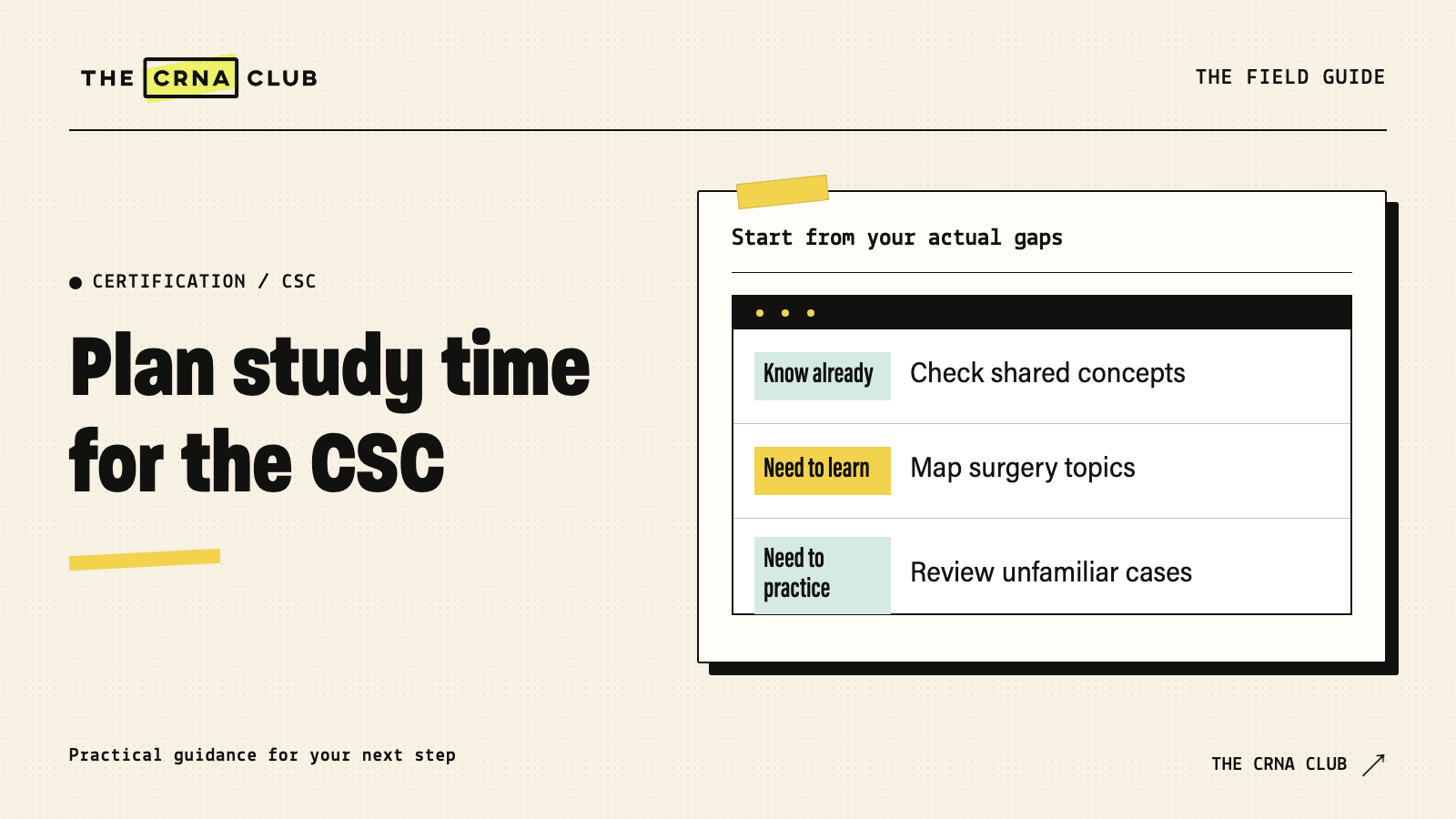
Some cardiac physiology, medication mechanisms and monitoring concepts carry over, while CSC still requires its own surgical coverage check. Use earlier preparation to shorten review where you understand the material. Don’t mark a CSC topic finished merely because a related word appeared in another course or question bank.
Start with a foundation you learned previously, such as cardiac output. Explain it without notes and apply it to an unfamiliar case. If the explanation is accurate but the postoperative context is unfamiliar, schedule the context. If the mechanism itself is shaky, schedule a fuller review.
This is more useful than dividing all topics into “already studied” and “new.” Prior exposure varies. You may remember a definition while needing help using it, or understand a mechanism while needing a refresher on a related procedure.
Our hemodynamics and perfusion article supports one foundation you can check. Use a case afterward to see whether the explanation carries over. Reading the same familiar page again isn’t enough evidence by itself.
Keep your earlier notes if they are accurate. You don’t need to recreate every diagram for the new credential. Add the missing surgical application and keep the relevant source beside it.
How do you estimate the actual work remaining?
Try a few CSC questions you haven’t seen, with the outline beside you afterward. Which topics need a quick refresher? Which need a lesson or surgical reading? Put those tasks in the planner, then leave time for mixed questions and reviewing misses. Adjust the estimate as you see how long the work takes.
Use the applicable CSC test plan to build your list. The revised plan applies on or after November 19, 2026. Use the earlier applicable plan for an earlier exam.
For each topic, write an action and a first estimate. A hypothetical line might read, “Review an unfamiliar procedure, explain the postoperative implications, then work related questions.” Another might read, “Check an already familiar mechanism with mixed questions.” Those tasks should receive different estimates.
Don’t turn the first estimate into a judgment about your ability. If the unfamiliar procedure takes twice as long, update the plan. You learned something about the work. Compressing every later session to preserve the original date hides that information.
Include review time from the beginning. A calendar filled entirely with first-pass reading assumes understanding and retention will happen automatically. Your error log will need room too.
How do you calculate usable weekly study hours?
Calculate usable hours from actual protected blocks after shifts, sleep, travel and other obligations. Leave some flexibility for interruptions. A blank evening on a calendar doesn’t always represent a high-quality study session. Use the amount you consistently complete, then revise after the first week of real work.
Try a weekly availability worksheet:
- Day off, morning: Reserve a focused explanation and case-review block before other commitments.
- Day off, later block: Try unfamiliar mixed questions and leave time to review the answers.
- Short workweek block: Use delayed retrieval from existing notes rather than starting a dense chapter.
- Flexible block: Allow for unfinished learning or interruptions. Don’t count the same block twice.
Suppose you reliably complete three 90-minute blocks and two 30-minute reviews. That gives 5.5 hours per week. If your remaining task estimate is 22 hours, the arithmetic suggests four weeks before allowing for disruptions or newly identified gaps.
At two completed hours a week, the same 22-hour task list takes eleven weeks before interruptions. Track completed time during week one and redo the division if your actual schedule differs.
After the first week, compare planned and completed time. Use the result to adjust the next week. Don’t keep counting sessions that repeatedly disappear after a run of shifts.
What would two different CSC preparation calendars look like?
Let’s compare two nurses who both qualify for CSC. One needs a few refreshers and has more study time. The other needs more surgical teaching and has fewer hours each week. They shouldn’t use the same exam date just because they both passed CCRN. These made-up numbers show why.
Nurse A has recent surgical experience and clear explanations of many foundations. Her audit identifies several focused refreshers and unfamiliar outline items. She estimates 18 hours of initial work, plus mixed review and time for errors. She protects six hours weekly and uses the first week to test the estimate.
Nurse B has an eligible background but needs more teaching for several surgical contexts and interventions. She estimates 36 hours of initial work, plus mixed review. With four usable hours weekly, the first-pass estimate spans nine weeks before additional review and interruptions.
| Planning question | Nurse A | Nurse B |
|---|---|---|
| Initial estimate | 18 hours | 36 hours |
| Usable weekly time | 6 hours | 4 hours |
| Arithmetic first pass | 3 weeks | 9 weeks |
| Still required | Mixed review, error correction and reassessment | Mixed review, error correction and reassessment |
Neither nurse should book solely from this division. Both need to see how learning progresses. The examples show why comparing the number of weeks without the work and available hours creates confusion.
How should practice questions change the calendar?
Use unfamiliar questions to identify whether your time estimates match the learning needs. Add targeted review for recurring reasoning gaps and reduce unnecessary repetition where understanding is stable. Keep coverage visible so a good score on familiar topics doesn’t eliminate time for material you haven’t studied yet.
Imagine you planned one session for a monitoring topic. The questions reveal a recurring problem interpreting the measurement. Add an explanation session and a later unfamiliar case. Don’t respond by repeating the same remembered set until the percentage looks reassuring.
For each miss, choose the next step. If the drug mechanism is unclear, open the relevant cardiac lesson. If you missed a postoperative detail, read about that procedure or complication. If you misread the question, practice stating what it asks before choosing an answer. More questions alone won’t fix every kind of error.
Keep uncertain correct answers in the same review list. A score can rise while some explanations remain unclear. The calendar should reflect the gaps, rather than following the percentage alone.
Use our cardiac-surgery chest-drainage article for a focused postoperative topic when relevant. Check other complications against the full outline. One strong topic won’t cover the material you have yet to review.
If your time estimate grows because a cardiac mechanism needs clearer teaching, our learning library and CMC Review offer lessons for those foundations. Explore the teaching, CSC quiz questions, and planning tools through the seven-day membership trial, then revise your calendar around the work you actually need.
What if your CRNA application deadline is close?
Read the program’s current instructions before allowing an application deadline to dictate a rushed optional exam. Confirm which credentials are required, when they must be held and whether the subspecialty exam serves a specific need. Keep an earned credential separate from a planned test in every application document.
Our certifications beyond CCRN article explains the broader planning question. Your own program list needs its current requirements beside the study calendar.
If a prerequisite, reference or required application item remains unfinished, account for that work honestly. Optional certification study shouldn’t consume the time needed to submit an eligible application. A later CSC date is a reasonable choice if it fits your goals better.
If a program’s wording leaves the timing unclear, ask the program directly. Don’t assume a pending exam receives the same treatment as a certification already earned. Keep the answer and date in your notes.
The result may be a longer plan than you hoped. That’s useful information now, while you still have options, rather than a week before two deadlines collide.
When should you revise the exam date?
Reconsider the date when the remaining learning tasks don’t fit the time available, when major outline gaps remain untouched or when the appointment changes the applicable exam version. Check current rescheduling rules before acting. Use a clear task review to decide, rather than one discouraging practice set or an online comparison.
Write down what remains, the study blocks available and the gaps needing more than a quick refresher. If the calendar has no room for mixed review or errors, revise it. A schedule supported only by perfect uninterrupted days needs more space.
The November 19, 2026 revision adds a version check. AACN’s announcement says existing materials remain useful. Compare coverage if you move across the date rather than rushing to avoid the change.
Our Final Thoughts
Your earlier certification gives you a starting point. The CSC outline and your own explanations show what comes next. Let the calendar follow the actual work.
You don’t need to match another nurse’s fastest timeline. You need enough time to learn the topics you haven’t mastered and check them in unfamiliar cases.
Take the Next Step
Try our seven-day membership trial and use a CSC question set to identify your first few review topics. Put those topics in the CSC planner around your actual workdays, with cardiac lessons or surgical reading where needed. After the first week, compare the plan with what you finished and adjust the date if the work needs more room.