How should CCRN studying change when I start preparing for a CRNA interview?
Sachi, CRNA
CRNA
In This Article (11 sections)
- What should change first in your study sessions?
- How do you turn a multiple-choice concept into a spoken prompt?
- What does explaining your reasoning sound like?
- How do you use your ICU patients without telling an endless story?
- How should you practice follow-up questions?
- What if you don’t know an answer during practice?
- Do all programs use the same interview format?
- What should you listen for in a recorded answer?
- How can you organize clinical review and spoken practice together?
- Our Final Thoughts
- Take the Next Step
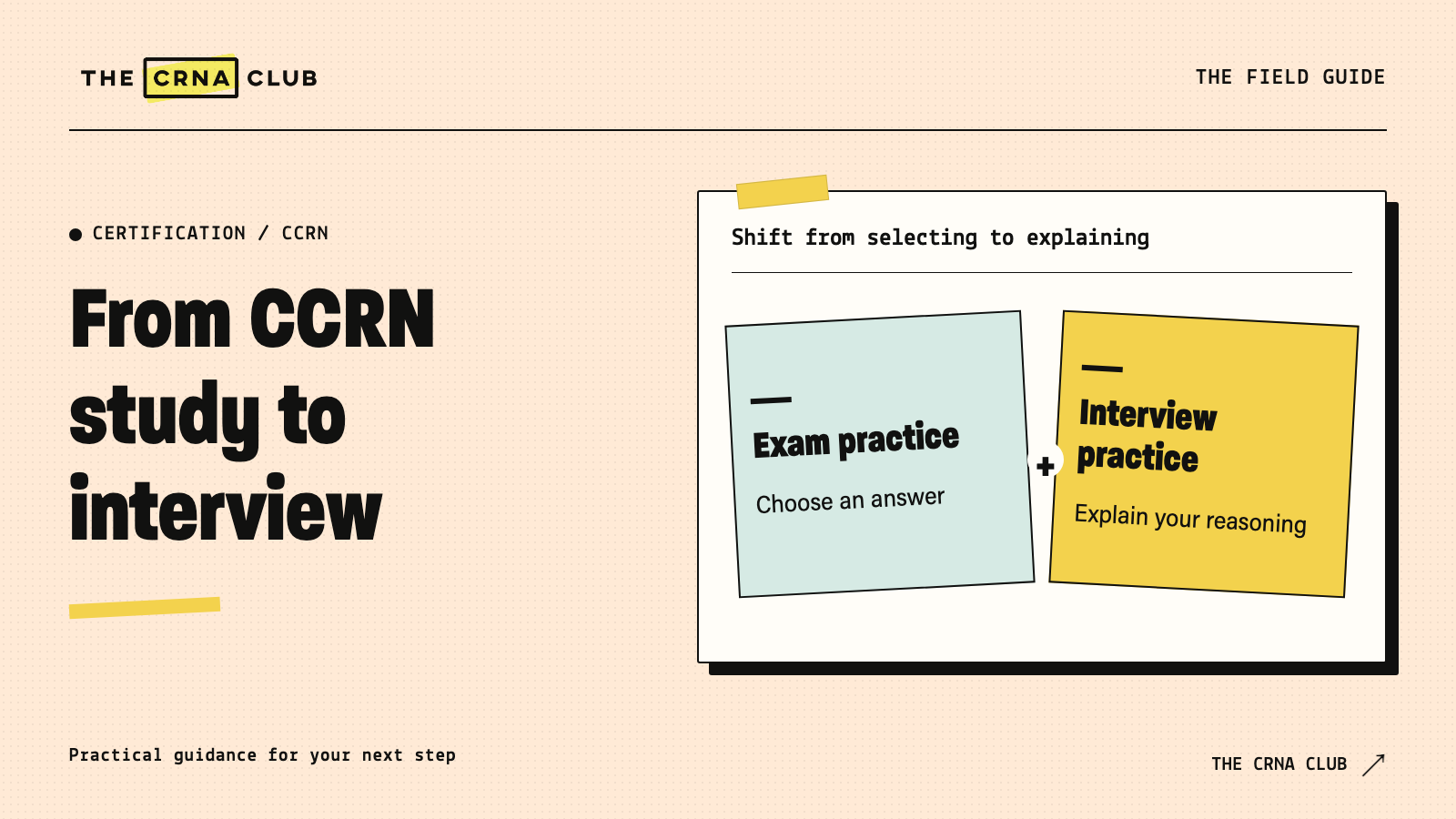
Keep the knowledge from CCRN preparation, then practice explaining it without answer choices. Start with the answer, say why it fits and leave room for a follow-up. Recognizing a correct option and explaining your reasoning aloud need different practice.
We suggest starting with our free Mock Interview. It includes one lifetime free interview with feedback you use to choose the next improvement. Broader membership brings interview practice and clinical lessons together when you need both clearer explanations and help communicating them.
If you know an answer in the question bank but lose the sentence when someone asks why, that’s a useful gap to work on. Let’s turn it into something you practice.
What should change first in your study sessions?
Use this sequence to change the study task:
- Hide the answer choices and explain the concept aloud before reviewing.
- Start with the question asked and give the relevant explanation.
- Stop when you have answered it.
- Identify where you guessed, skipped a connection or added unrelated detail.
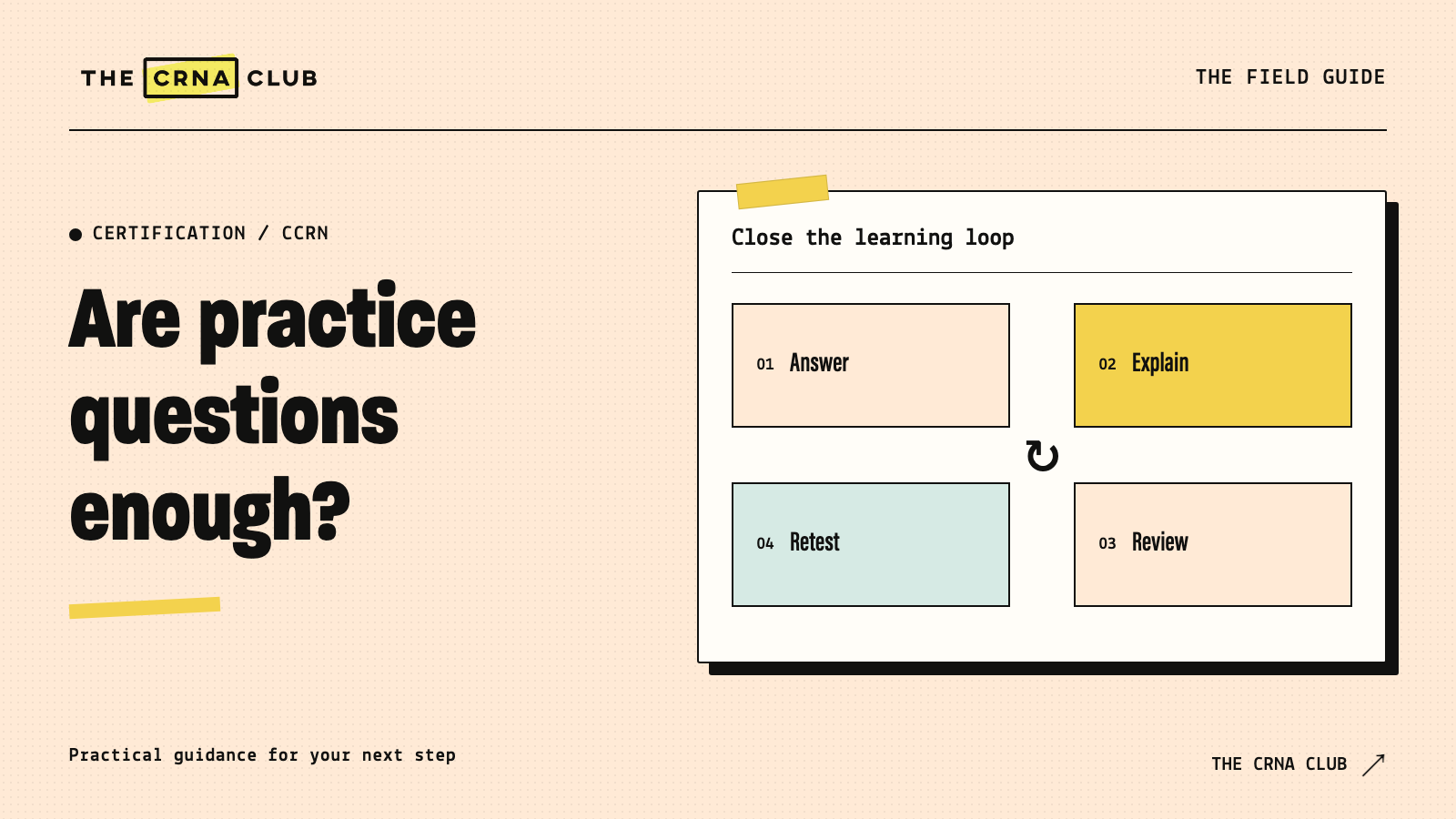
That review gives the next session a clear communication or learning task.
The AACN preparation guidance supports checking understanding across the examination outline. Interview preparation builds on that knowledge with a different practice activity: expressing the reasoning in your own words.
Choose a familiar patient problem and explain what changed. Which findings matter? What information would you want next? Say it aloud without choices. You don’t need a polished speech on the first attempt. You need to hear where your explanation stops making sense.
Listen for the missing step. If you name an intervention but cannot explain its purpose, return to teaching. If you understand the purpose but take several minutes to reach it, work on a more direct answer.
How do you turn a multiple-choice concept into a spoken prompt?
Ask for the underlying explanation rather than copying the original stem. Use a concept you are permitted to study, then create a new prompt in your own words. Don’t collect recalled certification examination items as interview preparation.
A personal conversion worksheet might look like this:
| Study concept | Spoken practice prompt | What to review afterward |
|---|---|---|
| A familiar medication | What does it do, and why might it fit this patient? | Mechanism, context and unsupported claims |
| A measurement | What does the value represent, and what else do you need? | Units, meaning and assumptions |
| A patient change | Which findings would help you understand it? | Reasoning sequence and missing information |
| A professional-practice situation | How would you explain your decision? | Patient need and clarity of response |
| A previous learning gap | Explain it without the original choices | Whether recognition has become independent understanding |
The prompts don’t predict a particular program’s questions. They help you practice explaining material relevant to your own background and the preparation guidance the program provides.
What does explaining your reasoning sound like?
State the action or interpretation, then give the reason linking it to the situation. Keep the reason specific enough to explain the choice. A list of actions leaves the listener to infer your thinking, while an unrelated physiology lecture makes the actual answer hard to find.
In a hypothetical answer, a nurse says, “I would review the recent change in the measurement before treating the number as a stable finding, because I need to know whether it fits the patient’s trend and the rest of the assessment.”
Try a concrete measurement prompt too: “What is cardiac index?” A short answer is: “Cardiac index is cardiac output adjusted for body surface area. Divide output by body surface area, so 4 liters per minute divided by 2 square meters gives 2 liters per minute per square meter.” You answered, explained the relationship and kept the units. A follow-up can now ask what the number means in the rest of the patient assessment.
We suggest giving the reason right after your answer, then stopping when you’ve completed the thought. Our interview teaching uses that approach so you practice an explanation someone else follows. You don’t have to fill every pause with another fact.
Practice the balance. One clear reason often does more than several loosely connected facts. Then leave room for a follow-up question.
How do you use your ICU patients without telling an endless story?
Choose a de-identified example relevant to the prompt, state the situation briefly and focus on your reasoning. Include what you actually did and learned. Don’t invent an experience or add clinical details merely because they make the story sound more advanced.
A hypothetical structure is: the relevant situation, your response and why the experience matters to the question. Those parts help organize the answer without requiring a memorized script for every possible prompt.
If the question asks about feedback, the story should explain how you responded to feedback. A long case history about the patient’s diagnosis sometimes misses that task entirely.
Use our answer-brainstorming material to find your actual situations and work through what happened, how you responded and why it matters. Then answer the prompt you’re asked. A prepared story about feedback won’t fit a question about patient physiology simply because you’ve practiced it well.
Keep identifying information out of practice recordings too. You need the clinical reasoning and professional reflection, not details identifying a patient.
How should you practice follow-up questions?
Use mock practice or a colleague to ask a follow-up about the connection you made. If you explain a measurement, ask what else would affect its meaning. That shows whether the first answer came from understanding or a sentence you’ve rehearsed. Use the feedback to choose a specific return to teaching or speaking practice.
For a hypothetical session, you explain a measurement. A follow-up asks why the same number might mean something different in another context. Now you need the variable’s meaning and relevant conditions, not only its reference range.
Another follow-up asks what information would change your interpretation. If you repeat the first answer, the concept needs more work. Review the missing connection and try again later with a changed example.
Avoid rewarding yourself for sounding certain when you are guessing. Clear uncertainty with a sensible reasoning process is more useful practice than an invented explanation you deliver confidently.
What if you don’t know an answer during practice?
Say what you know accurately, identify the limit and explain the relevant reasoning you still have. Then return to the source after the practice session. Don’t fill the gap with a fabricated mechanism, dose or experience because you feel pressure to keep talking.
Use the moment to distinguish a content gap from a delivery gap. If you cannot explain the concept even with time and notes afterward, you need teaching. If the explanation is accurate during review but hard to express aloud, practice a shorter first answer and a follow-up.
Record the gap specifically. “Bad at interviews” doesn’t tell you what to do tomorrow. “I skip the connection between this finding and my interpretation” does.
Our CCRN overview helps you return to the broader clinical preparation scope. Use the relevant current teaching source for the actual mechanism rather than improvising one.
Do all programs use the same interview format?
No single format should be assumed across your school list. Read each program’s current instructions and prepare for what it actually describes. Clinical reasoning, professional experiences and communication sometimes share a session, but another applicant’s account doesn’t establish your exact questions or scoring.
Wake Forest’s application page discusses its own interview and selection process, including professionalism and communication. Use program-specific information as program-specific evidence.
In your school notes, keep any official preparation instructions, delivery format and required practical steps. Verify unclear details rather than copying a rumor about every interview at a school.
Our CCRN application strategy article also helps keep credential completion separate from broader application preparation. Passing is an achievement, but it doesn’t automatically finish your interview work.
What should you listen for in a recorded answer?
Listen for whether you answered the question directly and explained the reason. Did you add a patient finding the prompt never gave? Use jargon without explaining it? Give a long background before the answer? Choose one change for the next attempt so you know what you’re practicing.
An original review note might say: “The mechanism was accurate, but I gave a long background paragraph before answering the question.” The next task is a direct opening answer followed by the needed explanation.
Another note might say: “I answered quickly but assumed a patient finding the prompt never supplied.” The next task concerns reasoning accuracy, not simply speaking faster or slower.
Practice feedback describes that attempt. It isn’t a prediction of admission or a substitute for the program’s actual process. Use it to choose the next specific improvement.
How can you organize clinical review and spoken practice together?
Pair a defined clinical gap with a spoken retrieval task, then use feedback to decide whether you need more teaching or another communication attempt. Leave room for actual experience questions too. Your schedule should include both knowing the content and explaining it clearly.
Try the clinical lessons, interview planning and Mock Interview Lab through the seven-day membership trial. Use a topic you struggle to explain, practice the answer and review the feedback. Then return to teaching if the gap is clinical, or another spoken attempt if it’s the delivery.
Our Final Thoughts
Keep the knowledge and change the task. Explain the connection without choices, use your real experience carefully and practice follow-ups that test the reasoning. A clear first answer plus an accurate explanation gives you something concrete to improve in the next session.
Take the Next Step
Try the free Mock Interview to practice spoken answers and review feedback. It includes one lifetime free interview. Choose a question relevant to your preparation, then use the result to identify a learning or communication task for the next session.