How should I build a CMC study plan around the current test blueprint?
Sachi, CRNA
CRNA
In This Article (11 sections)
- Which blueprint should you put beside the calendar?
- How do you find your starting gaps?
- How do the revised weights help with allocation?
- How should you adjust that first sketch for your needs?
- How do you place the tasks around shifts?
- What does a complete learning task look like?
- How much practice should you schedule?
- When should you revise the calendar?
- How does the plan fit a CRNA application timeline?
- Our Final Thoughts
- Take the Next Step
Build your CMC study plan around your exam date, actual shifts and the topics you don’t yet explain well. Use AACN’s applicable outline to check coverage, then give difficult subjects enough teaching and practice time instead of copying the domain percentages into every week.
We suggest using the CMC planner, review lessons and questions in CRNA Club membership. Mark your workdays, choose lessons for your gaps and schedule the later practice. Compare the calendar with the official plan for your date, especially around the November 19, 2026 revision.
A useful study appointment tells you what to open and what you want to understand. “Study cardiac” doesn’t do that yet.
Which blueprint should you put beside the calendar?
Use the official version applying to your appointment. Revised CMC examinations start November 19, 2026. If your date changes across that transition, check the plan again before using its weights or topic coverage to update the schedule.
AACN’s revision announcement links the revised plan and says existing study materials remain useful. The new CMC outline applies on and after the launch date.
Write the date and version together. A generic CMC calendar with no version reference sometimes blends old planning facts with new expectations.
Also verify eligibility separately through AACN’s CMC requirements. A schedule organizes study; it doesn’t establish qualifying clinical hours or an eligible base credential.
How do you find your starting gaps?
Use the outline and a small amount of unfamiliar practice to find where your explanations get unclear. Do you need to learn the concept, recall it more easily or apply it in a different case? Write that beside the topic. It gives you a reason to choose the next CMC lesson or practice session.
Use a personal baseline sheet:
-
Heart failure: If you recognize familiar findings but cannot explain one part of the profile, use a targeted lesson and a changed example.
-
Acute kidney injury: If you recognize the term but the renal explanation remains unclear, start with teaching before a large question set.
-
A listed medication class: If you know its basic purpose but not the mechanism-to-monitoring connection, explain that connection and then review a case.
-
Hemodynamic monitoring: If you know reference values but not the meaning and limitations of the combined measurements, use targeted teaching and independent interpretation.
Use actual official topic names in your working copy. The sheet is a way to organize needs, not a replacement syllabus or validated score.
If you haven’t reviewed an area at all, mark that honestly. Don’t call it a small gap merely because you hope to finish it quickly.
How do the revised weights help with allocation?
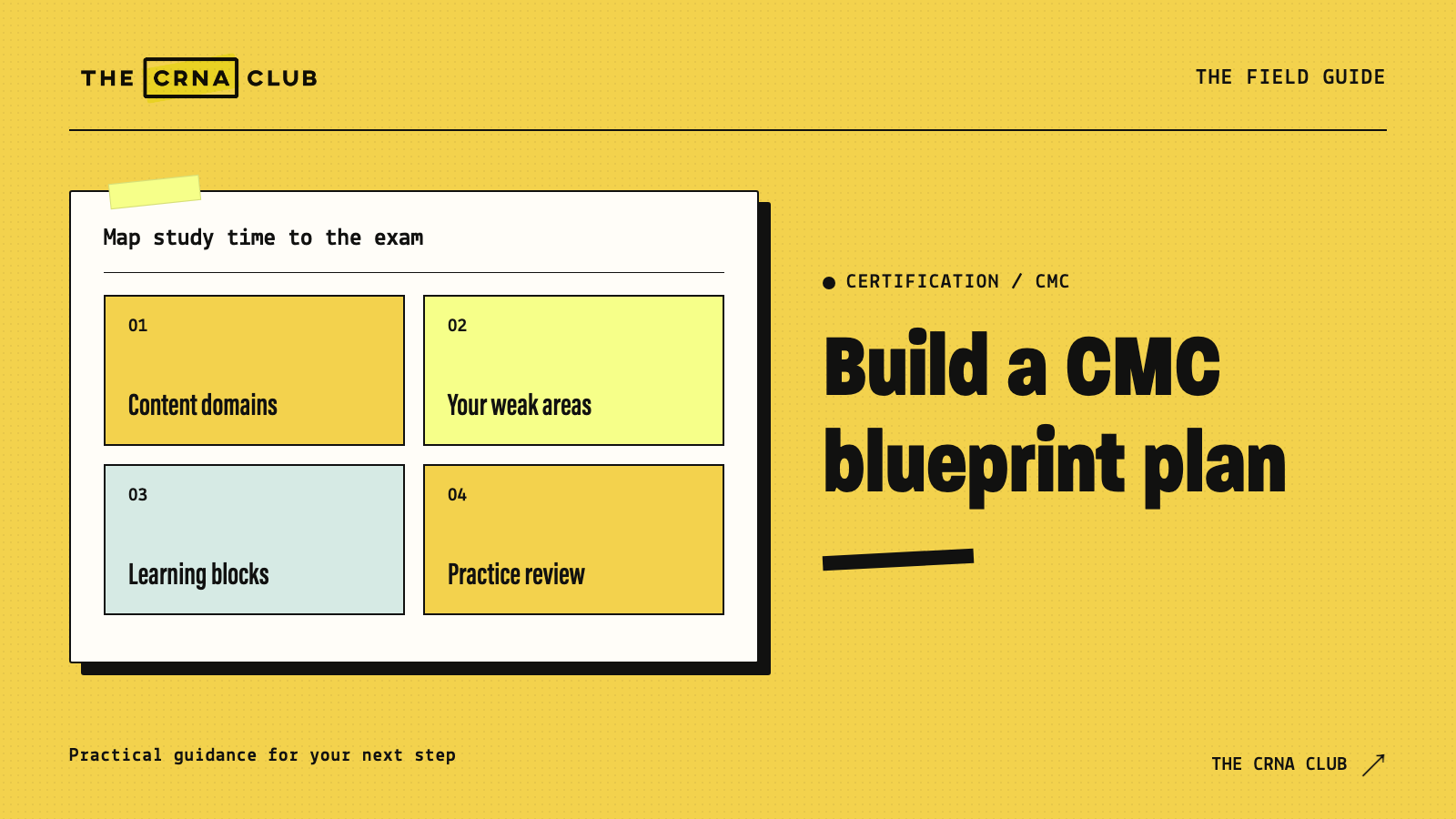
They help you check whether the calendar neglects a major part of examination scope. For the revised plan, therapeutic interventions accounts for forty-four percent, cardiovascular and noncardiovascular conditions twenty-one percent each, and monitoring and diagnostics fourteen percent. Your study allocation also needs to reflect baseline understanding.
Consider an original arithmetic exercise using a twenty-hour planning block:
| Revised domain | Weight | Proportional share of this hypothetical block |
|---|---|---|
| Cardiovascular conditions | 21 percent | 4.2 hours |
| Noncardiovascular conditions | 21 percent | 4.2 hours |
| Therapeutic interventions | 44 percent | 8.8 hours |
| Monitoring and diagnostics | 14 percent | 2.8 hours |
Twenty hours is an example budget, not a claim that CMC preparation takes twenty hours. The calculation simply multiplies the block by each percentage.
Use the table as a first check of emphasis. It doesn’t prove everyone should divide every week that way, and it doesn’t tell you whether the topics fit the total time available.
How should you adjust that first sketch for your needs?
Move time toward unresolved learning while keeping the full outline visible. Use specific gaps to explain the adjustment rather than spending more on whatever feels interesting or comfortable. Reassess after observing how long the teaching and application actually take.
Say familiar cardiovascular topics need less review, while noncardiovascular topics need more teaching. You change the twenty-hour example to three hours of cardiovascular review, six of noncardiovascular learning, eight of interventions and three of monitoring. Add them: 3 + 6 + 8 + 3 = 20 hours.
The adjusted hours still total twenty. They reflect your adjusted example plan, not a change in official examination weighting or a validated optimal schedule.
Another learner needs more foundational monitoring teaching. That person’s calendar should differ. A common blueprint doesn’t require identical appointments when starting knowledge differs.
If the needs plainly exceed the block, expand the timeline or reconsider other commitments. Reallocating twenty hours can’t turn a much larger workload into twenty hours of learning.
How do you place the tasks around shifts?
Mark workdays, recovery and fixed responsibilities first, then assign specific learning to usable blocks. Keep lighter review where attention is limited and protect fuller sessions for unfamiliar teaching and explanation repair. Don’t make essential study depend on downtime during patient care.
A hypothetical off-day block might cover one difficult concept, retrieval without notes and a short application task. A workday might contain optional review of an earlier learning point, if practical.
If a block disappears because the shift schedule changes, move the specific task into a realistic opening. Don’t automatically double tomorrow’s work without checking tomorrow’s capacity.
Our CCRN overview gives broader certification preparation context. Keep the CMC outline beside the new calendar rather than copying a base-exam schedule unchanged.
What does a complete learning task look like?
It names the concept, the source you will use and the check you will perform afterward. Include teaching, independent explanation and later application where needed. A calendar label is complete when you know what doing the assignment means, not merely when it contains a domain name.
Try an appointment like this: use the CMC monitoring lesson for the relationship you don’t understand, explain the variables without notes, then check a different example later. Save the lesson location beside the task. When the session starts, you already know where to go.
If the explanation remains unclear, the next task becomes smaller: identify the step that broke down and locate a clearer explanation. If it is accurate, move toward unfamiliar application.
Our CMC teaching follows the information through to interpretation and response. Use that sequence in your plan. What do the findings mean? Why does the next step fit? How would you assess the response? Watching the lesson is one part of answering those questions yourself.
How much practice should you schedule?
Schedule enough practice to investigate application, with enough review time to learn from uncertainty. The appropriate amount changes with the gaps. Large unfamiliar content needs more teaching, while stronger explanations sometimes leave more room for mixed practice or timing checks.
Don’t fill every available block with answering questions. A set gives you learning needs, and those needs require somewhere to go.
Keep familiar and unfamiliar results distinguishable. Repeating a set helps with retrieval, while a changed example offers another check of whether the concept transfers.
At the end of each practice block, record one clear next assignment. “Do more CMC” leaves tomorrow undefined. A named relationship or comparison gives the next session a starting point you are able to evaluate.
When should you revise the calendar?
Review it after an initial learning block and whenever the actual work, schedule or examination date changes. Compare planned and completed appointments, current explanations and unresolved gaps. A useful calendar responds to those observations instead of requiring the original estimate to remain correct.
A short checkpoint asks what you now explain, which topics remain broad and which blocks repeatedly failed to happen. Change the next week accordingly.
Also compare the result with the applicable official outline. Don’t assume a planning product has already implemented a future revision’s weights. Use tools for organization and current official documents for the scope check.
Try our CMC planner, review and questions through the seven-day membership trial. Enter your actual dates and workdays, then use one scheduled block for a real gap. After the lesson and practice, update the next task with what still needs work.
How does the plan fit a CRNA application timeline?
Check each target program’s credential requirements and evidence deadlines separately. CMC preparation sometimes supports a clear development goal, but it doesn’t automatically replace another required credential, course or document. Keep the school policy beside the study calendar before deciding what must happen first.
Our certifications-beyond-CCRN guide provides broader context. Use actual eligibility, learning needs and the application tasks still unfinished to choose the order.
A deadline is useful when it organizes feasible work. It doesn’t make missing clinical experience or a large learning gap disappear.
After the first block, compare estimated and observed time for one difficult topic. Use that difference in the next calendar rather than assuming every remaining topic will fit the original estimate.
Our Final Thoughts
Use the blueprint to check emphasis and your own gaps to choose the work. Mark real constraints, write specific tasks and revisit the calendar after seeing what happened. A plan earns its place by helping you begin and complete the next useful study session.
Take the Next Step
Start the seven-day membership trial to plan and study with the CMC tools together. If you want a first calendar, the free certification planner includes one lifetime free plan. Check coverage against the AACN outline applying to your appointment.