How should you study cardiac medications for the CMC without memorizing disconnected drug lists?
Sachi, CRNA
CRNA
In This Article (8 sections)
- What belongs on a CMC medication study card?
- How do you connect a mechanism to monitoring?
- How should you organize medications across the test plan?
- How do you compare two medications without oversimplifying?
- What should you do with a missed pharmacology question?
- How do you turn this into a weekly study routine?
- Our Final Thoughts
- Take the Next Step
Study CMC medications by following what each drug does, what that changes in your patient, and what you need to watch next. We recommend the Vasoactive Agents & Inotropes teaching in our CMC Review, followed by CMC practice questions. You can try the lessons, questions and planner with a seven-day membership trial, then use the drug comparison below to check your understanding.
You already give medications with very different jobs. A diuretic removes sodium and water. An inotrope increases contractility. An anticoagulant affects clot formation. Organize your notes around those jobs, then add the mechanism and monitoring specific to the drug you’re studying.
If the receptor effects are the part you keep mixing up, start with our vasopressor pharmacology guide. Then take one medication and follow it all the way from its mechanism to your patient’s response. That gives the details somewhere to go.
What belongs on a CMC medication study card?
A medication study card should connect the clinical problem, mechanism, expected response and meaningful monitoring. Include a reason the drug would be a poor fit for a particular patient. Keep dosing and administration details in a current reference so a simplified card doesn’t become an incomplete treatment instruction.
Use one page for a medication you understand reasonably well. Write the generic name, then the familiar brand name if it helps you recognize it. Next, answer these questions in connected sentences:
- What problem is this medication intended to address?
- What does it act on, and how does the action produce the effect?
- What change would support an effective response?
- Which adverse effect or patient factor needs particular attention?
- What related medication would you compare it with?
Try to finish the explanation without using the drug’s name as the explanation. “Milrinone is an inodilator” gives you a class. You still need to explain increased contractility alongside vasodilation and why both affect your assessment.
Keep the card readable (you should want to revisit it). If it becomes a copied package insert, divide the material. One page handles the mechanism and clinical reasoning. Another reference holds detailed administration information you need to verify.
How do you connect a mechanism to monitoring?
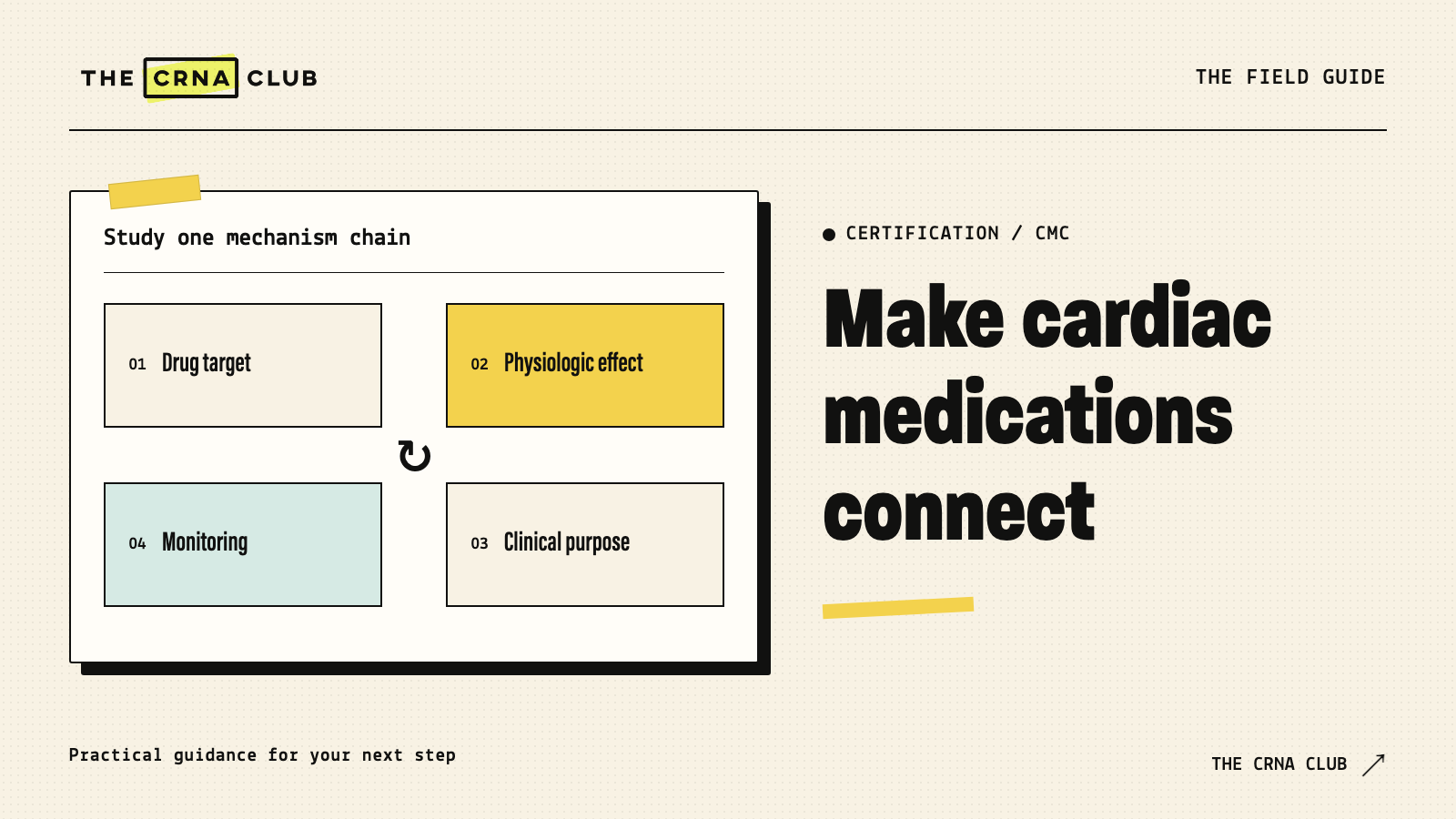
Ask what you expect the drug to change. More vascular resistance? Follow pressure and perfusion. A stronger squeeze with vasodilation? Look at flow and pressure together. Then add the drug’s risks. A better cardiac index doesn’t tell you everything went well if the pressure is falling or a new arrhythmia appears.
Milrinone offers a useful example. It inhibits phosphodiesterase-3, which reduces cAMP breakdown. Its effects include increased myocardial contractility and vascular relaxation. The current prescribing information also describes hypotension, arrhythmia risk and prolonged elimination with renal impairment.
Turn this into a study explanation: improving forward flow is one desired effect, but blood pressure still needs attention because vasodilation lowers resistance. Rhythm assessment and renal function belong beside the mechanism. “The cardiac index increased” is therefore only part of your evaluation.
Try changing one detail in a practice case. Renal function was normal. Now it’s worsening. What changes in your milrinone explanation? Elimination takes longer with renal impairment, so you need to bring that into the assessment. If your card only says “helps cardiac output,” add the missing connection.
You don’t need a longer list. You need the missing connection. Our milrinone mechanism article goes further into the cellular pathway if this is your weak area.
How should you organize medications across the test plan?
Use the applicable CMC outline as your coverage checklist, then organize learning sessions around related clinical problems. Keep a separate entry for each listed medication group so familiar vasoactive infusions don’t crowd out anticoagulants, chronic heart-failure medications or other therapies. A checklist shows what you’ve covered without pretending every topic deserves equal time.
AACN’s revised CMC test plan, effective for exams on or after November 19, 2026, lists pharmacology within therapeutic interventions. The list includes more than vasopressors and inotropes. Check the full current outline against your exam date before building your schedule.
A personal worksheet might look like this:
-
Inotropes and vasoactive agents: Which hemodynamic problem does the drug address? Compare two patient profiles.
-
Diuretics: What fluid and electrolyte changes need follow-up? Explain a laboratory trend.
-
Anticoagulants and platelet inhibitors: Which part of clotting does the drug affect? Separate mechanism from bleeding assessment.
-
Antidysrhythmics: Which rhythm problem is being treated? Link the rhythm to the medication’s effects.
-
Chronic cardiac therapies: What is the treatment purpose and relevant patient context? Review the listed class in a current reference.
Use these questions to organize your notes, with the actual AACN topics underneath. Leave a blank where you haven’t studied something. Now you know what to open next instead of reviewing the same drips again.
How do you compare two medications without oversimplifying?
Compare medications using the same patient question, then name the difference that changes your reasoning. Start with mechanism, intended effect and patient context. Avoid ranking one drug as universally better. A drug useful in one hemodynamic situation has a different risk-benefit balance when resistance, ventricular function or rhythm changes.
Take norepinephrine and milrinone. Norepinephrine has strong vasoconstrictor effects with beta-adrenergic cardiac activity. Milrinone increases contractility and dilates vessels through a different mechanism. Calling both “cardiac medications” doesn’t explain their different effects on resistance and pressure.
For this comparison, describe what problem remains unresolved. Is pressure inadequate because vascular resistance is low? Is forward flow poor? Is there congestion? What information supports those conclusions? A question stem needs enough context before you choose among treatment categories.
The norepinephrine prescribing information warns about inadequate perfusion when pressure is supported without addressing blood-volume deficits. Don’t convert “the blood pressure rose” into “the entire problem resolved.”
Make your comparison table small enough to explain aloud. Two drugs and one patient problem usually expose more gaps than a table of fifteen agents copied from different resources. Add another drug when you understand the first comparison.
What should you do with a missed pharmacology question?
Ask why you missed the question. Did you forget the name, misunderstand the mechanism, or skip a patient detail? Each needs a different fix. We suggest opening the relevant CMC lesson when the mechanism is unclear, then using a different question to see whether you can apply it.
Suppose you chose a medication because it increases contractility but missed a warning sign in the stem. Your correction needs the patient factor you overlooked and its relevance to the drug. Copying “wrong answer: B” gives you very little to review later.
Try this error-log entry:
| Field | Hypothetical entry |
|---|---|
| What I thought | More contractility alone explained the choice |
| What I missed | The patient’s falling pressure changed the assessment |
| What I reviewed | The drug’s vascular effect and monitoring |
| How I’ll check it | Explain a new case with a different pressure trend |
Keep uncertain correct answers in the same log. A correct guess still deserves follow-up. And if the explanation in a question bank seems inconsistent with a current prescribing reference, investigate the discrepancy instead of memorizing whichever sentence is shorter.
Don’t record recalled live exam items. Practice from authorized materials and your own hypothetical cases. You want transferable reasoning, not somebody else’s memory of a question.
Our CMC Review includes Vasoactive Agents & Inotropes teaching to help connect a drug mechanism with its hemodynamic effects. Explore the lesson through the seven-day membership trial, then test the explanation with a changed case rather than another isolated drug list.
How do you turn this into a weekly study routine?
Alternate short explanation sessions with mixed questions and targeted reference reading. One session builds the medication map. A later session tests it without the map in front of you. Revisit the errors after some time has passed, then use a different question to check whether your understanding carries over.
For example, spend one study block comparing a vasopressor and an inodilator. In the next block, review a medication area you see less often. Finish the week with mixed questions so the answer isn’t obvious from the chapter title. This is a suggested method, not a fixed number of hours required to pass.
Protect time for the unfamiliar groups. If every shift gives you experience with infusions but little exposure to another listed medication class, your study calendar should reflect the difference. Experience helps explain familiar material, but the outline still determines the breadth of your preparation.
Before the next week, pick the two explanations you still can’t give clearly. Review those specific mechanisms and patient factors. Leave accurate notes alone. Rewriting every page in a different color takes time you need for questions and feedback (and the new color doesn’t prove retention).
Our Final Thoughts
You don’t have to hold every cardiac medication in your head as a separate fact. Connect the drug to the problem it addresses, explain how it works, and follow the expected response alongside the risks.
When a medication keeps confusing you, narrow the question. Is it the receptor? The effect on resistance? The patient factor in the stem? Fixing one clear gap gives the next practice question a purpose.
Take the Next Step
Try our seven-day membership trial and use CMC Review to work through a medication you still can’t explain. Follow it with CMC questions, then add the missing mechanism or patient factor to your notes. The CMC planner helps you reserve time for that review around shifts, instead of setting another question target without time to learn from it.