How should you study fluids, vasopressors and inotropes for the CSC?
Sachi, CRNA
CRNA
In This Article (9 sections)
- What question should you ask before choosing fluids or a vasoactive drug?
- How should you study fluid management after cardiac surgery?
- How do vasopressors and inotropes differ in your study map?
- How do you build a mechanism-to-response explanation?
- Why should you check perfusion when pressure improves?
- How do you practice mixed postoperative mechanisms?
- What should your error log capture?
- Our Final Thoughts
- Take the Next Step
For CSC fluids and vasoactive medications, start with what’s wrong in the circulation, then connect the intervention with the response you expect. We recommend our Vasoactive Agents & Inotropes lessons for the drug mechanisms, CSC questions to practice, and the planner to schedule review. You can explore them through the seven-day membership trial, then use the postoperative comparisons below to check your reasoning.
A medication list is easier to remember when each drug has a clear job in your explanation. But “raises blood pressure” is still incomplete. You also need to understand how the drug affects circulation and what would show the patient is responding.
The revised AACN CSC outline, effective November 19, 2026, includes fluid management, vasoactive agents and inotropes within therapeutic interventions. Use the version for your actual exam date and keep the teaching connected to postoperative context.
What question should you ask before choosing fluids or a vasoactive drug?
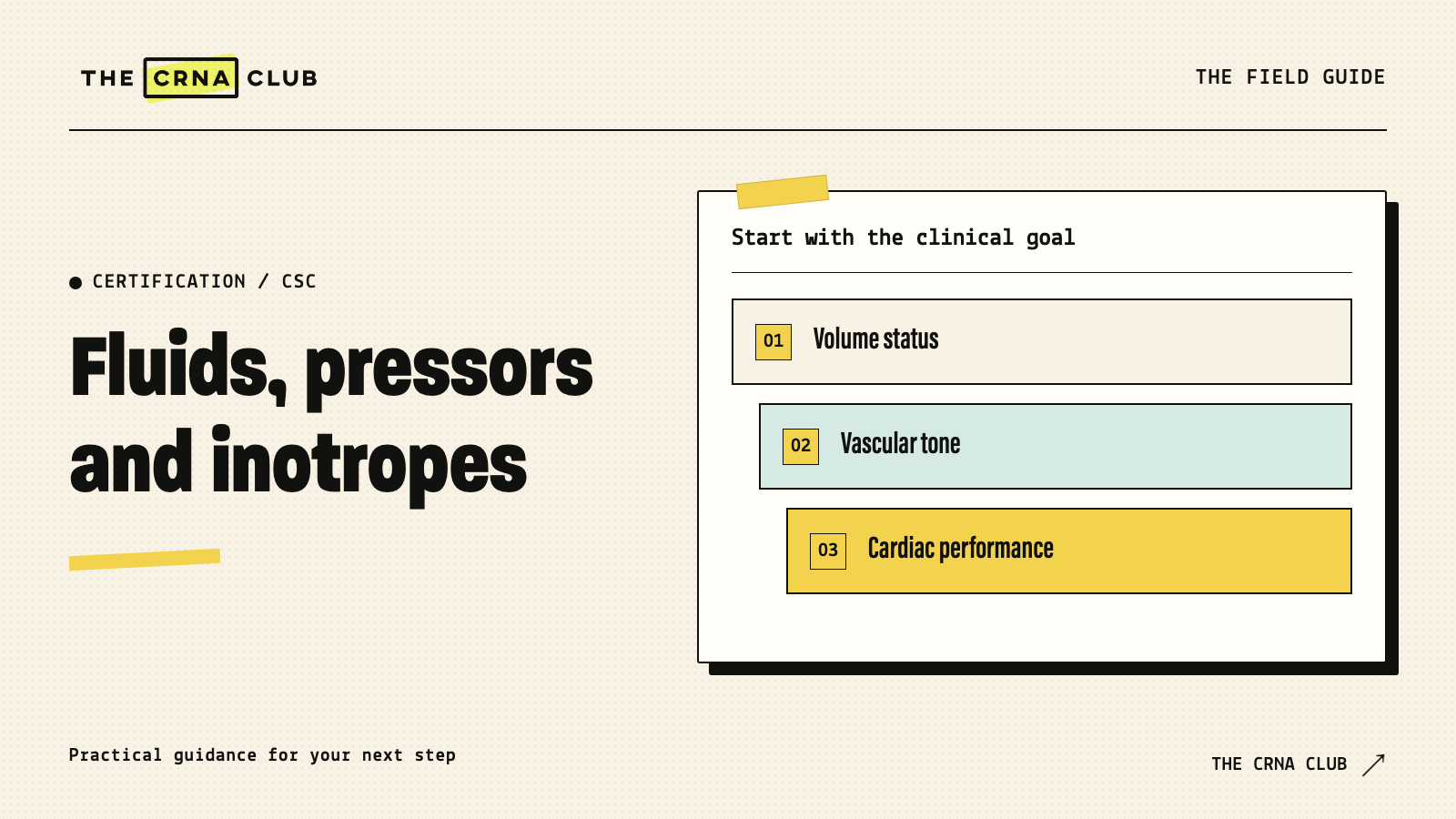
Ask what the patient findings suggest. Is forward flow poor? Is vascular tone low? Is filling a problem? Check the measurements and the rest of the case before choosing a treatment category. More than one problem can be present, so explain what each finding adds instead of deciding from the pressure alone.
Before choosing a treatment category in a practice case:
- Identify the change in the patient’s exam.
- Read the rhythm and trends. What do they add?
- Check the pressure measurement. Is it reliable?
- Review ventricular function and forward flow using the information the case provides.
A low blood pressure alone doesn’t tell you whether filling is inadequate, contractility is impaired or vascular tone is reduced. The same pressure might appear in different cases requiring different reasoning. Your study note should preserve that context.
Our preload, afterload and perfusion article explains these foundations. Review the measurement you find confusing, then use a complete case to connect it with the postoperative patient.
Don’t treat a filling pressure as a direct measurement of circulating blood volume. The value needs physiologic context and a reliable setup. That distinction changes how you interpret an apparently simple “give fluid” question.
How should you study fluid management after cardiac surgery?
Study why fluid is being considered, what evidence supports the need and how the response would be assessed. Include the potential consequences of unnecessary volume and the context of blood loss, ventricular function and postoperative shifts. A fluid decision is more than choosing a product from a list or reacting to one number.
Cardiac surgery and cardiopulmonary bypass affect fluid distribution after the operation. So a postoperative balance record doesn’t automatically describe the intravascular situation at a specific moment. Connect the balance with what you find when you assess the patient.
For a hypothetical study case, list the evidence suggesting inadequate filling and what additional findings would challenge that explanation. Then change the case to include congestion or ventricular dysfunction. Explain why the same fluid choice shouldn’t remain automatic after the new information appears.
Keep blood loss distinct from a generic volume question. The case may require you to think about oxygen-carrying capacity, coagulation and the cause of bleeding as well as circulating volume. Don’t reduce every postoperative hypotension problem to the same crystalloid response.
This is a reasoning exercise, not a dosing or transfusion algorithm. Use current clinical sources for specific thresholds and management recommendations. Older study material may provide helpful physiology while still needing updates to numerical advice.
How do vasopressors and inotropes differ in your study map?
A vasopressor primarily supports vascular tone and pressure, while an inotrope increases myocardial contractility. Some agents have more than one effect, and an inodilator combines increased contractility with vasodilation. Learn the actual drug mechanism and patient context rather than assuming every vasoactive infusion performs the same function.
Use a comparison worksheet:
| Category | Main study question | Response to examine |
|---|---|---|
| Fluid intervention | Does the case support a need for additional filling or replacement? | The relevant perfusion and circulation changes |
| Vasopressor | Is inadequate vascular tone part of the problem? | Pressure alongside tissue perfusion and other findings |
| Inotrope | Is impaired contractility contributing to poor forward flow? | Flow, clinical response, rhythm and other drug-specific effects |
| Inodilator | How will increased contractility and reduced resistance interact? | Flow and pressure together, with drug-specific risks |
Now ask what else the drug does. Milrinone increases contractility and dilates vessels, so you need to think about both effects. Putting it only in the “stronger squeeze” column would leave out part of what you need to watch.
For individual explanations, review our vasopressor pharmacology article. Then compare the effect with the patient problem in your CSC practice rather than memorizing a receptor beside a name alone.
How do you build a mechanism-to-response explanation?
Name the drug’s action, connect it to the expected physiologic effect, and choose observations that would support benefit or reveal harm. Keep relevant patient factors beside the mechanism. A rising pressure or output number is useful information, but it doesn’t erase adverse effects or establish that the underlying problem has resolved.
Milrinone is a useful study example. It inhibits phosphodiesterase-3 and has positive inotropic and vasodilator effects. The prescribing information describes hypotension, arrhythmia concerns and prolonged elimination in renal impairment.
Follow the effects together. A stronger contraction can help forward flow, while vasodilation can lower pressure. What happened to both? Then look at rhythm and renal function. We suggest explaining that whole chain before answering another medication question, because “improves output” leaves too much out.
Now add worsening renal function to the stem. Your study answer should identify prolonged milrinone elimination as a relevant concern, then connect it with monitoring for drug effects and adverse effects. If your card still says only “increases output,” add the missing renal and pressure considerations from the label.
Our Learning Library and CMC Review include Vasoactive Agents & Inotropes teaching for these foundations. Explore the lessons through the seven-day membership trial, then return to surgical cases for the context the CSC outline requires.
Why should you check perfusion when pressure improves?
Pressure and tissue perfusion are related but distinct, so assess the response beyond the blood pressure number. A vasoactive intervention may change resistance and pressure while another contributor remains unresolved. During study, explain which clinical and measured findings would support improved circulation and which would make you reconsider the initial explanation.
The norepinephrine prescribing information warns that pressure can improve while perfusion remains poor if a blood-volume deficit hasn’t been addressed. So keep checking the underlying problem. That doesn’t mean vasopressors are never used during urgent resuscitation. It means the pressure response alone isn’t enough.
For a hypothetical case, the pressure improves while other perfusion observations remain concerning. What information do you reassess? Is the measurement sound? Does the original mechanism explain the entire situation? What additional cause needs attention?
The useful study answer recognizes the remaining problem rather than declaring success from one number. This also prevents memorizing a medication as the final step in every case. Treatment requires evaluation afterward.
Keep response measures appropriate to the case. No single laboratory value, saturation or urine-output observation describes every patient’s circulation alone. Use trends and the full supplied context.
How do you practice mixed postoperative mechanisms?
Practice cases containing enough information to consider more than one contributor, then explain why a single intervention may leave another problem unresolved. Use the applicable outline and a suitable surgical reference to check the reasoning. Don’t assume simplified shock patterns remain complete descriptions of every postoperative situation.
A hypothetical case might include reduced flow and a concerning resistance pattern. Another might include fluid loss and altered ventricular performance. Your task is to identify what the information supports, what remains uncertain and how the response would be evaluated.
We wouldn’t study this as one fixed drug order. Change the cause or severity and the reasoning changes too. Learn what each intervention does, then use the actual findings to explain the choice and what you need to reassess.
Use our shock-pattern article for basic comparisons, then return to mixed cases. A clear foundational pattern is helpful when you also understand the limits of applying it.
If a reference and question rationale disagree, identify the exact statement and check current primary guidance or labeling. Don’t choose the shorter sentence merely because it is easier to memorize.
What should your error log capture?
Record whether you misidentified the problem, misunderstood the drug’s mechanism, missed a patient factor or failed to evaluate the response. Give each error a targeted next task and test it in a different case later. Keep uncertain correct answers too, because a correct selection may still rest on incomplete reasoning.
For example, “I chose an inotrope because output was low” should become a more specific review: what supported impaired contractility, what other contributors were present and which findings changed the choice? The log should help you answer those questions.
If you struggle with a drug’s mechanism, review that lesson. If you know the mechanism but ignore postoperative context, work a different surgical case. Match the review to the actual gap instead of repeating every question in the same order.
Our Final Thoughts
Start with the circulation, connect the intervention to the problem and follow the response. Your explanation should stay accurate when the patient details change.
You don’t need a universal fluid-first or drug-first shortcut. You need a clear understanding of what each intervention changes and which part of the patient’s problem still needs attention.
Take the Next Step
Try our seven-day membership trial and work through Vasoactive Agents & Inotropes in the learning library or CMC Review. Use CSC questions to apply the mechanisms to postoperative cases, then put recurring misses in the CSC planner. Keep the patient response beside the drug name so your next review strengthens the explanation, not just the list.