How should you study hemodynamics for the CMC if you don't work in CVICU?
Sachi, CRNA
CRNA
In This Article (8 sections)
- Where should you start if invasive monitoring feels unfamiliar?
- What should your hemodynamics skill ladder include?
- How do you practice a case without a CVICU background?
- How do you avoid treating a bad measurement?
- What if you don’t see the device at work?
- How should you organize the first week?
- Our Final Thoughts
- Take the Next Step
To study CMC hemodynamics outside CVICU, start with pressure, flow and the patient findings you already know. We recommend our CMC Review’s hemodynamic-monitoring lessons to help you connect those pieces, then practice with the CMC questions. Both are available through the seven-day membership trial. Work through the examples below with your own notes beside you.
If you work in telemetry or stepdown, you’re already watching rhythms, breathing, mentation, urine output and response to treatment. Start there. A pulmonary artery catheter adds measurements to the same patient assessment. Learning those measurements is much easier when you keep asking what your patient is doing.
You don’t have to work in CVICU to build this knowledge. AACN includes other settings, including telemetry and progressive care, when your actual care and hours meet its CMC requirements. Once you’ve checked eligibility, focus on the measurements you see less often.
Where should you start if invasive monitoring feels unfamiliar?
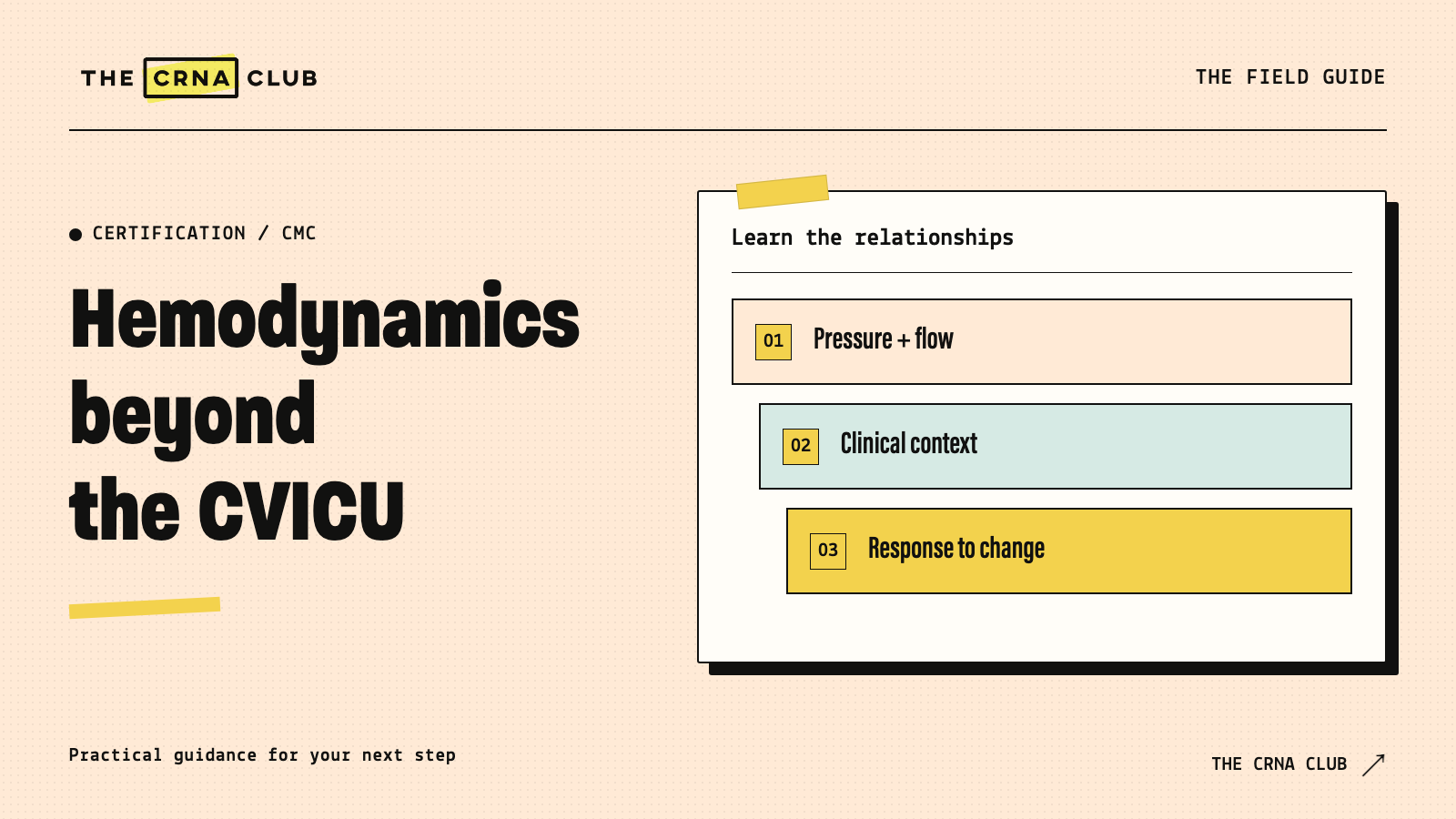
Start with a patient assessment and identify the question you need a measurement to answer. Cardiac output describes blood flow per minute. Filling pressures describe pressure in particular locations. Vascular resistance describes opposition to flow. Keep these measurements connected, because a satisfactory blood pressure alone doesn’t establish adequate tissue perfusion.
Draw the right atrium, right ventricle, pulmonary artery, lungs and left heart. Label where blood travels. Then put each measurement beside its anatomical location. CVP belongs on the right side. Pulmonary artery occlusion pressure, also called wedge pressure, estimates left atrial pressure under appropriate measurement conditions. Neither is a direct container reading of circulating volume.
Use your existing observations beside the diagram. What happens to breathing when pulmonary congestion develops? What does reduced forward flow do to urine output or mentation? What other explanations might produce those findings? This keeps the diagram clinically useful.
Don’t begin by memorizing a long list of normal values. First explain what each variable represents. Then add reference ranges from your current study source and practice describing why an abnormal number matters. If the definition remains fuzzy, adding more numbers usually makes the page harder to use.
Our existing hemodynamics articles provide a narrower starting point for individual measurements. Keep a separate notebook page for the larger patient pattern.
What should your hemodynamics skill ladder include?
Start by explaining what the number measures. Then calculate it, check whether you trust it, and connect it with the patient. Can you explain a new case before reading the answer choices? Name what you see, another possible cause, and what you would check next. That’s a useful way to find the part you still need to learn.
We suggest working through these skills in order. If you get stuck, go back to that lesson and explain the missing step before adding more questions.
-
Explain flow: Describe cardiac output and cardiac index in ordinary language. If you get stuck: Review stroke volume, heart rate and body surface area.
-
Locate a pressure: Place CVP and wedge pressure on your drawing. If you get stuck: Review anatomy and the pressure waveform.
-
Read a pattern: Compare output, filling pressures and resistance together. If you get stuck: Work through one complete case slowly.
-
Question the measurement: Identify a setup or physiologic limitation. If you get stuck: Review leveling, zeroing and waveform quality.
-
Follow the response: Predict which observations should change. If you get stuck: Return to the mechanism of the intervention.
Write a short explanation at each level before adding flashcards. For example, cardiac index is cardiac output divided by body surface area. If a hypothetical patient has a cardiac output of 4 liters per minute and body surface area of 2 square meters, the cardiac index is 2 liters per minute per square meter.
So you’ve adjusted flow for body size. Why is the flow low? The calculation can’t answer that. Look at the rhythm, how the ventricles are working, filling, resistance and the patient’s condition. Keep those questions beside the math so you practice both parts.
How do you practice a case without a CVICU background?
Practice with a short case containing enough information to compare explanations. Start with the patient’s findings, then interpret the measurements, and only afterward consider treatment categories. Change one feature and explain whether your reasoning changes. This builds more flexible knowledge than memorizing one set of numbers beside one shock label.
Consider this hypothetical study case: an adult with known left ventricular dysfunction has worsening dyspnea, cool extremities, reduced urine output, low cardiac index and elevated left-sided filling pressure. Those findings raise concern for poor forward flow with congestion.
Now pause before choosing a fluid bolus. Which finding suggests congestion? What evidence supports impaired ventricular performance? Is there a new rhythm problem or ischemic event? Is the measured pressure reliable? The study goal is explaining why more filling isn’t automatically the answer to every low-output state.
Change the case. The patient now has recent gastrointestinal losses, lower filling pressures and a different exam. Your explanation should change too. You still assess the full situation, including bleeding or other causes, but the original congestion explanation no longer fits as neatly.
Which findings support your explanation, and which would make you change it? Ask that in both cases. A patient can have congestion, poor ventricular function and another problem at the same time. Your explanation needs to leave room for that combination.
How do you avoid treating a bad measurement?
Check measurement quality before drawing a strong conclusion from an unexpected number. Transducer position, zeroing, waveform quality and the patient’s breathing or ventilation affect interpretation. When the number conflicts with the exam, investigate the discrepancy rather than choosing whichever observation makes the practice answer easier.
Make measurement quality part of every case, including cases with apparently sensible values. A transducer below the reference level produces an artificially higher pressure reading. A transducer above it produces an artificially lower reading. Explain the direction of the error aloud (this is a useful place to slow down).
Then study the waveform. An arterial pressure number has a different meaning when the tracing is distorted. A pulmonary artery catheter measurement also requires knowing where the catheter is and which waveform you’re viewing. You don’t gain this understanding by copying a reference range alone.
Keep a short error log with two columns: the conclusion you initially made and the measurement issue you missed. An entry might read, “I interpreted the pressure as a true rise before checking the transducer level.” Your next practice set should include a fresh setup problem rather than another identical screenshot.
The CMC test plan includes invasive and noninvasive monitoring. Use it to check the breadth of your study, rather than assuming every monitoring question involves a Swan-Ganz catheter.
What if you don’t see the device at work?
Use diagrams, waveform examples and case explanations to learn the device’s purpose and limitations. Ask an experienced educator to explain an unfamiliar setup when an appropriate teaching opportunity exists. Studying a device expands knowledge, but it doesn’t create clinical hours or establish independent hands-on competence with equipment you’ve never used.
Choose one device and answer a few specific questions. What physiologic problem does it assess or support? What information does it provide? What information does it fail to provide? Which findings suggest the measurement or device function needs attention?
For an arterial line, concentrate on the pressure waveform and setup. For a pulmonary artery catheter, follow the catheter location and understand what its measurements represent. For mechanical circulatory support, begin with the circulation it supports and the monitoring questions surrounding perfusion.
You don’t have to learn all of these in the same sitting. A 40-minute block on one tool, followed by a few unfamiliar questions, gives you a clear result to evaluate. Reading four device chapters without checking understanding gives you much less information about your next study need.
If a question explanation refers to a concept you haven’t learned, read that section before repeating the question. Recognizing the wording on a second attempt isn’t the same as being able to explain the device.
If filling pressures and flow still feel disconnected, our CMC Review includes hemodynamic-monitoring teaching that works through those foundations. Explore the lessons with the seven-day membership trial, then use the same pressure-location worksheet to check what became clearer.
How should you organize the first week?
For your first week, we suggest anatomy and definitions, then calculations, measurement quality and mixed cases. Use the CMC planner to put those sessions around your workdays. Give yourself more time for the parts that are new to you, and leave a later session to check what you remember.
One possible week includes two 40-minute sessions for anatomy and flow, one for pressure measurement, and a longer case-review session on a day off. After each session, close the source and explain one example from memory. Mark the exact sentence you couldn’t explain.
At the end of the week, compare your notes with the exam version you will take. AACN’s revised CMC plan applies to exams taken on or after November 19, 2026. Its monitoring and diagnostics domain is 14%, and hemodynamic reasoning also connects to other domains. Avoid assigning all your time to this single gap.
Your next week should follow the error log. If the calculations are accurate but measurement limitations remain unclear, work on limitations. If your hemodynamics explanations are improving while renal or respiratory topics remain untouched, widen the review. Familiarity with cardiac numbers shouldn’t crowd out the rest of the plan.
Our Final Thoughts
A telemetry or stepdown background gives you real patient observations to build from. Use those observations while you learn the measurements you see less often. A clear explanation of one complete case is a better checkpoint than a page of numbers you haven’t connected yet.
Keep your questions specific. “I don’t understand hemodynamics” is overwhelming. “I confuse filling pressure with circulating volume” gives you something to work on today.
Take the Next Step
Start a seven-day membership trial and work through the hemodynamic-monitoring teaching in CMC Review. Use a few CMC questions to find the explanation you still need, then put that topic in your study calendar. If you want to begin with the calendar, try the free certification planner, which includes one lifetime free plan.