I failed the CCRN: how do I build a different retake plan?
Sachi, CRNA
CRNA
In This Article (11 sections)
- What should you do before scheduling another attempt?
- How should you use the score report?
- What should you examine about your previous study method?
- What would a different first week look like?
- Do you need new resources after failing?
- How do you choose a new date without rushing or drifting?
- What if test anxiety or timing contributed?
- How should you handle the CRNA application timeline now?
- How do you check whether the reset is working?
- Our Final Thoughts
- Take the Next Step
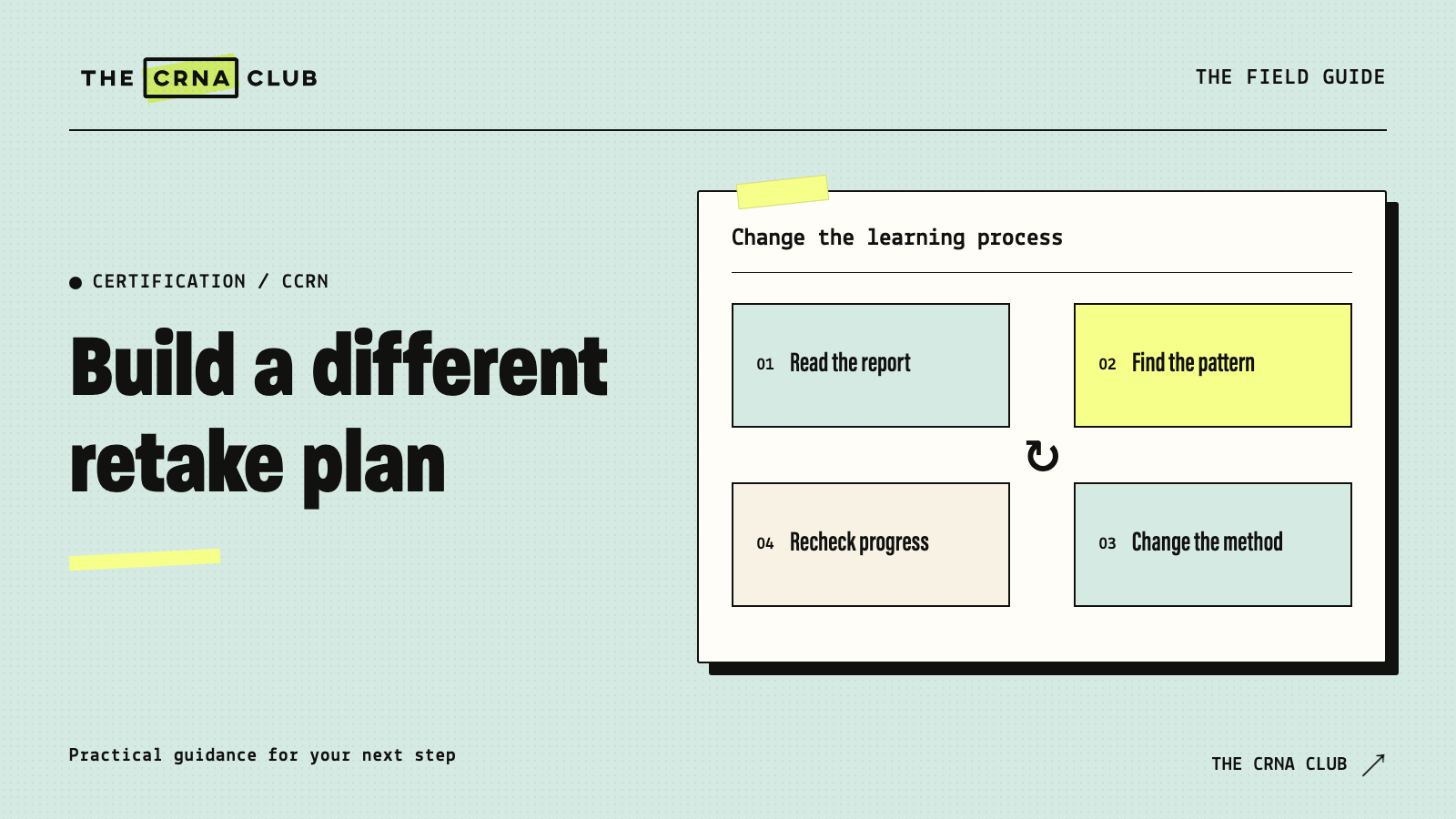
After a failed CCRN attempt, use the score report to build a different plan. Look at what you missed and how you studied, then change the work you do between questions. Repeating the same bank faster won’t explain a concept you still don’t understand.
We suggest our CCRN Toolkit when your retake plan needs video teaching beside practice and a calendar. Use the report to choose a topic, work through its lesson and schedule a fresh check later.
A failed result hurts, especially when you’ve been working toward CRNA school. Give yourself room for that. Then make the next study session specific enough to help.
What should you do before scheduling another attempt?
Save the score report, review current policies and identify the broad areas needing attention. Then compare the required learning with realistic available time. An immediate booking sometimes creates a useful deadline, but it shouldn’t replace understanding what will change between attempts.
AACN’s CCRN FAQ directs unsuccessful candidates to the score report and describes up to four attempts in a twelve-month period. Check the current requirements and instructions for your situation before acting.
Don’t reconstruct or share actual examination items. You have enough appropriate information to plan from the official report, the current outline and your own general observations about preparation and pacing.
Also avoid treating a near miss as proof you need only another day of questions. A small difference from the cut score doesn’t explain which learning or testing issues remain unresolved.
How should you use the score report?
Use the report to locate areas with room for improvement, then connect those broad areas with specific learning tasks. It describes performance on that examination. Your practice notes add detail about the concepts and habits you need to investigate. Neither record should become a list you look at without changing the next study session.
AACN’s preparation guidance recommends using the report alongside the plan and its weighting. It also warns against overlooking other areas simply because you are focusing on the weakest ones.
Use the exact labels on your report. Don’t force them into a table from an older lesson with different domain wording or percentages.
For each area needing attention, write a question about your understanding. “Which concepts do I still guess about?” or “Where do I recognize the answer but fail to explain it?” gives practice review a useful purpose.
What should you examine about your previous study method?
Look at what you did with the materials. Did you pause the videos and explain anything back? Review unfamiliar questions, or repeat the same set? Leave time for rationales? Write the habit you want to change. Owning a different course won’t automatically change what happens in your next session.
A review of your previous plan might look like this:
| Previous habit | What it left uncertain | Change to test |
|---|---|---|
| Watched lessons without checking recall | Whether the explanation stayed accessible | Close the material and explain a short case |
| Repeated one bank immediately | How much improvement reflected answer memory | Use a later unfamiliar check |
| Answered large sets, rushed rationales | Which concepts remained unclear | Reduce volume and reserve review time |
| Avoided an unfamiliar domain | Whether the outline was covered | Give that area a protected teaching block |
| Studied in unreliable leftover time | Whether the calendar was usable | Build around protected appointments and workdays |
Those are personal review categories. They don’t diagnose the result or claim one habit explains every failed attempt. Use the ones supported by your actual preparation record.
What would a different first week look like?
Start by addressing a specific gap and checking whether the new activity changes your explanation. Don’t spend the first week purchasing a completely new stack before using the report. A practical reset gives you an early opportunity to test the change you intend to keep.
Say you mostly repeated familiar questions before the first attempt. Try this sequence:
- Start with one weaker area from the report. Use the relevant CCRN lesson and stop at the explanation you couldn’t give before. Work through it, then close the material and say it in your own words.
- Next session, explain it again without notes.
- Later, try unfamiliar related questions and review what remains unclear.
- In your weekly check, write what the new approach helped you understand.
That gives you something concrete to keep or change.
Keep some mixed review too so other areas stay visible. Your retake week should give learning and later recall actual time. You don’t need to prove your effort with a larger count in the same familiar bank.
Our CCRN overview supplies general scope and preparation context while you rebuild the calendar.
Do you need new resources after failing?
Keep a resource when it still gives accurate, useful teaching or practice. Add something when you identify a gap it doesn’t address. A failed result doesn’t automatically prove every material was wrong, and a new purchase doesn’t automatically change how you use the material.
Start with a concept your current material didn’t explain well. Try the matching video lesson or ask an educator to work through that step. If the explanation helps, use it. If it doesn’t, name what’s still missing before adding another full resource.
A new question bank sometimes provides unfamiliar application after you exhausted familiar material. It still needs review and teaching around gaps. More fresh questions alone won’t explain a concept you haven’t learned.
Write the reason for each addition. “I need a clearer explanation of this mechanism” is specific. “I failed, so I need everything different” makes it harder to see what is helping.
How do you choose a new date without rushing or drifting?
Estimate the learning still needed and compare it with available blocks, then choose a timeline you will review as preparation progresses. Keep current policy and appointment requirements in view. A date should organize the work rather than force you to ignore gaps or postpone indefinitely without a plan.
A hypothetical nurse has several focused blocks each week and one defined unresolved area. Another has broad unfamiliar content and a major academic deadline ahead. Their calendars need different timelines, even if both missed the examination by the same number of points.
Build in a check after the initial reset period. Are explanations clearer? Does unfamiliar practice identify narrower gaps? Are scheduled blocks happening? Use the answers to refine the plan.
If you consider changing an appointment, verify current rules and fees. Historical podcast comments and old study discussions aren’t reliable instructions for today’s process.
What if test anxiety or timing contributed?
Examine those factors separately from content. Record the general pattern you noticed, then choose a focused response. Difficulty with pace needs a look at where time went. Persistent anxiety deserves support appropriate to its impact. Neither issue means you should abandon content review or assume knowledge wasn’t involved.
For timing, identify whether you stalled on unfamiliar concepts, reread without understanding the task or repeatedly changed choices without a new reason. Those patterns suggest different practice activities.
For anxiety, distinguish a feeling from a conclusion about future ability. A disappointing result doesn’t establish how every future attempt or application will go. Keep the next decision connected to the evidence you have.
Try our CCRN lessons and study tools through the seven-day membership trial. Bring a topic from your report and use the teaching-to-practice process above. It’s a way to try a different approach with the material you actually need, rather than buying everything again after a disappointing result.
How should you handle the CRNA application timeline now?
Check each target program’s exact credential requirement and when evidence is due. Then compare the updated certification plan with those policies. A failed attempt doesn’t create one universal application decision, and another credential doesn’t automatically substitute for an explicit requirement.
Our CCRN application strategy guide helps frame the questions. Keep a record of where you verified the policy, and ask the program directly if the wording leaves your situation unclear.
Don’t turn one result into a sweeping judgment about every part of your application. Review the specific tasks still needed and the deadlines governing them. That gives you choices you are able to act on.
How do you check whether the reset is working?
Look for better independent explanations, application to unfamiliar examples and fewer repeated unresolved gaps. Record what changed in the study task as well as the result. A completed schedule is useful when the learning improves, not merely because you followed a more demanding routine.
If a gap persists, make it more specific and change the repair. You might need a different explanation, a discussion or a smaller foundational step. Give the new activity a chance to produce an observable change before adding more volume.
Write the first changed assignment before closing the report. A useful reset starts with a task you will actually do differently in the next protected study block.
Our Final Thoughts
Use the result to build a different plan. Keep the review specific, preserve useful resources and give the missing connections actual time. The next week should look different for a reason you explain clearly, not because you promised to work harder at everything.
Take the Next Step
Use the CCRN Toolkit for video review, questions and a retake calendar. Already have useful teaching? Start with the free certification planner for one lifetime free plan and schedule what will change this time.