Failed the CMC? How should you change your preparation before a retake?
Sachi, CRNA
CRNA
In This Article (8 sections)
- What should you do with the CMC score report?
- How do you check whether your materials match the next exam?
- What should change in your daily study method?
- How do you build a retake calendar around real weaknesses?
- When should you consider another study resource?
- What should you check before booking another attempt?
- Our Final Thoughts
- Take the Next Step
After failing the CMC, start with your score report and change how you study the gaps it shows. We recommend using our CMC Review for explanations you still need, CMC questions to practice, and the planner to build a different retake schedule. You can try them with the seven-day membership trial. Use the report to choose a different task for the gaps your first plan left.
It’s frustrating to put in the hours and still see an unsuccessful result. Give yourself a little space before buying another resource or booking the nearest opening. Your next plan needs a clearer explanation of what happened than “I need to study harder.”
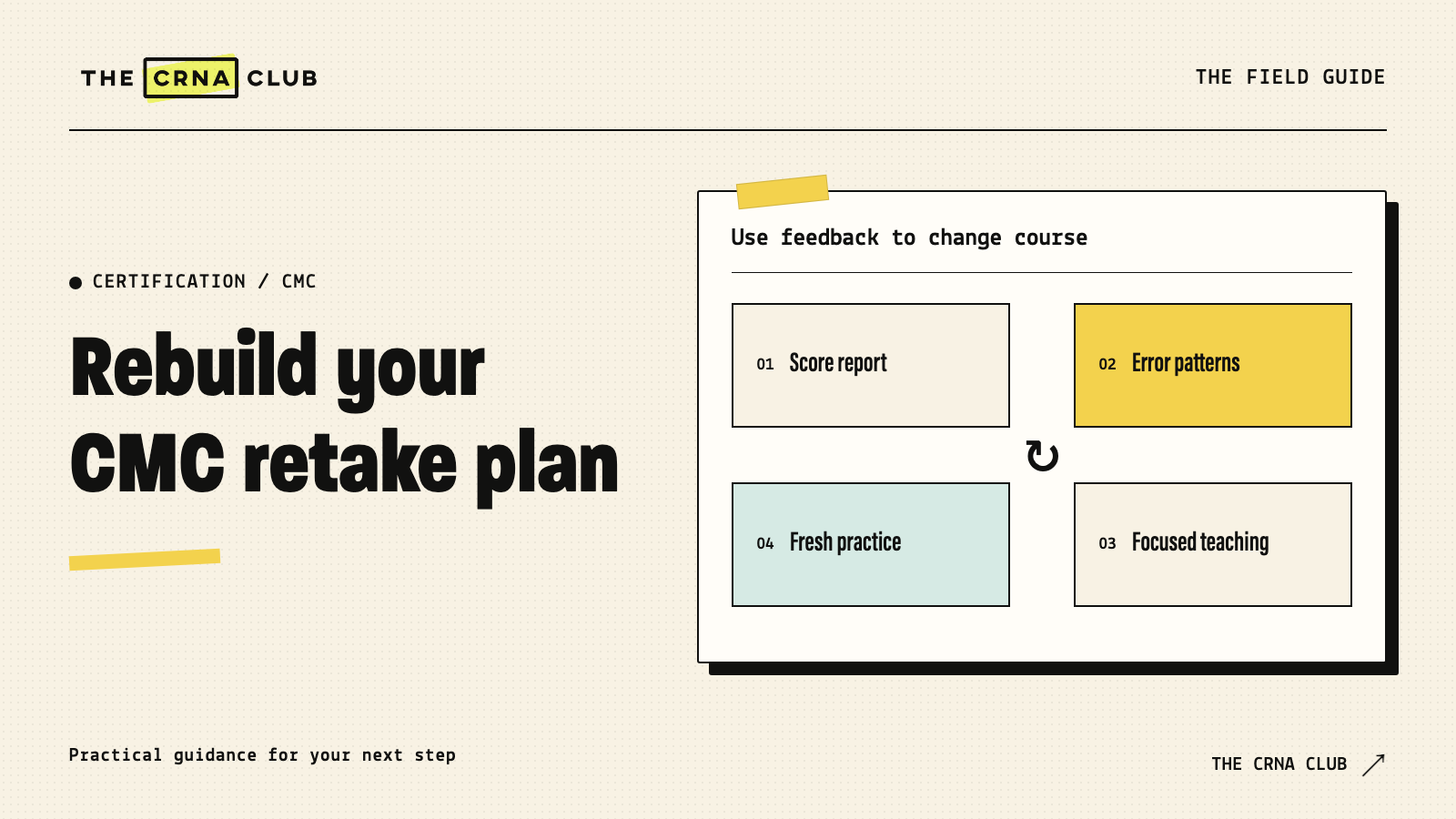
AACN recommends reviewing your score report alongside the exam test plan. Use those two documents to begin. Your recollection of the hardest questions is useful for personal reflection, but it isn’t a reliable map of everything you need to review.
What should you do with the CMC score report?
Your report shows broad areas to revisit. It won’t tell you exactly why you missed each question. Choose one weaker area and try a few new practice questions. Can you explain why the right answer fits? If you can’t, you now have a more specific lesson to review than “study cardiac again.”
Create a worksheet with the report’s actual domain labels. Beside each one, record whether you studied it, which resources you used and how you checked your understanding. Be specific. “Watched videos” tells you less than “watched the lesson and explained two unfamiliar cases without notes.”
If an area looks weaker despite considerable study time, inspect how you spent the time. Did you mostly reread familiar explanations? Did you postpone topics you don’t see at work? Did you remember the wording in your main question bank before you finished reading the stem?
You don’t need to solve every uncertainty on the first day. Start with one domain and identify a clear next task. A report showing a broad weakness in therapeutic interventions might lead you to audit medication mechanisms, procedures and organ support separately.
Avoid reconstructing or sharing live exam content. Your plan should use the official outline, authorized study questions and your own learning gaps. Those sources give you enough to build a useful review without relying on recalled test items.
How do you check whether your materials match the next exam?
Match the test plan to the date of your retake before deciding which resources to keep. AACN’s revised CMC exam begins November 19, 2026. If your first attempt occurred before the revision and your next attempt is afterward, compare your existing checklist with the new outline and revise the gaps explicitly.
The AACN revision announcement says existing study materials remain relevant and useful. You don’t need to discard every accurate explanation because the test plan changes. You do need to check coverage and version-sensitive facts.
Label the top of your worksheet with the retake date and applicable outline. Then copy the current domain names beside your earlier notes. Mark material requiring an update, topics you skipped and explanations you still don’t understand.
A resource might explain cardiac physiology well while using an older exam percentage in its introduction. Keep the accurate physiology and correct the planning information. Buying an entirely new set of resources before making this distinction often adds more reading without solving your original problem.
If you change the appointment across the transition date, revisit this step. Your plan should follow the exam you will take, rather than the version you first intended to book.
What should change in your daily study method?
Change the study task according to the error. Missing a drug name calls for targeted reference review. Misreading a hemodynamic profile calls for slower case interpretation. Forgetting an accurate explanation after a delay calls for retrieval practice. Treating every mistake as a reason to reread the whole chapter wastes useful feedback.
Use a small error log:
- You didn’t recognize the topic: Read the relevant outline section and explanation, then explain a new example.
- You knew the topic but missed a patient clue: Underline the clue and explain how it changes the options. Try a different case with a similar decision.
- You selected a remembered answer: Stop repeating that item immediately. Try unfamiliar mixed questions later.
- You guessed correctly: Write the missing reasoning, including why the alternatives fit less well.
- You ran short of time: Practice a manageable timed set and review pacing, then repeat under realistic conditions after content review.
Keep entries short enough to revisit. One sentence describing the reasoning gap is more useful than a page copied from the rationale. Add a source reference so you know where to return when the explanation remains uncertain.
For medication-specific gaps, use our vasopressor pharmacology article as a focused starting point. For pressure and flow interpretation, review hemodynamics and perfusion. Neither replaces the full CMC outline.
How do you build a retake calendar around real weaknesses?
Give the weakest or least-covered topics protected time, while preserving mixed review across the full outline. Build the calendar from hours you will realistically use after accounting for shifts, sleep and other deadlines. Choose the retake date after you understand the work remaining, rather than forcing the work into an appealing early opening.
Consider a hypothetical nurse whose report and fresh practice both suggest medication and diagnostic gaps. Her first week might include two focused medication sessions and a separate diagnostic session. Another session uses mixed questions so the familiar areas remain active.
After each focused session, she writes a short explanation without looking at her notes. The explanation exposes whether she learned the mechanism or only recognized the slides. Later in the week, she attempts different questions and reviews uncertain correct responses too.
For example, a 45-minute review could use 15 minutes for one unclear medication explanation, 10 to explain it without notes, 15 for a small set with rationale review, and five to schedule the next check. These times are a sample, not a required workload. Her next week depends on the result. If the same mechanism remains unclear, she changes the explanation source or asks for focused teaching. If the gap improves but an untouched topic appears on the checklist, she widens the schedule.
The number of weeks is individual. A published testimonial about passing quickly tells you someone else’s outcome. It doesn’t describe your starting knowledge, your shifts or the work your report identifies. Leave enough space to learn what your own feedback shows.
When should you consider another study resource?
If you keep missing the same mechanism, we suggest going back to the matching lesson in CMC Review before answering another long set. Work through the explanation, close the lesson, and say it in your own words. Then use a different question. If you need more detail, add a focused reference section for that question.
Be specific about what you need help with. “I don’t understand why the filling pressure is high” gives you a lesson to open and a question to answer. “I’m bad at CMC” doesn’t. Keep narrowing the problem until you can choose the next study session.
Check whether the resource includes explanations you understand, covers the applicable test plan and offers practice beyond questions you’ve memorized. Avoid promises tied to a universal practice-bank percentage or a fixed number of study days.
Also inspect what you already own. A reference section you skipped might answer the current question. An educator might help clarify one concept without requiring a new course. Use your study budget on the actual gap (especially if another exam fee is coming).
You don’t need to finish every available lesson again. Use your report and practice notes to choose where to spend more time, then keep mixed questions in the week so stronger areas stay familiar.
If your score review points to a mechanism you never fully understood, our CMC Review offers lessons to work through cardiac foundations alongside question practice. Explore the teaching with the seven-day membership trial, then return to the explanation your first preparation left unfinished.
What should you check before booking another attempt?
Before you book, check AACN’s retake rules and your remaining study work. Are you explaining the weak topics more clearly on questions you haven’t memorized? Does your calendar leave time for unfinished areas? An open appointment tells you when you can test. Your review tells you what still needs to happen first.
AACN’s FAQ currently describes up to four attempts in a 12-month period. Check the current handbook before booking so you use the rules applicable to your situation. Don’t interpret the maximum number of attempts as a recommended schedule.
Look for concrete changes: previously untouched outline items reviewed, a smaller list of unresolved mechanisms, and better reasoning in unfamiliar mixed cases. Use those changes to choose what still needs time before booking.
If a CRNA application deadline is creating pressure, read the program’s instructions before rushing. Determine what the school actually requires and when. A certificate you haven’t earned should never appear as an earned credential on your application. Your admissions plan and your retake plan need honest dates.
Our Final Thoughts
An unsuccessful CMC attempt gives you a reason to make the next plan more specific. Use the report, inspect the study method and check improvement with work you haven’t memorized.
You don’t need to punish yourself with longer sessions. You need a clearer task and enough time to complete it. Start with the explanation you couldn’t give, then build from there.
Take the Next Step
Start a seven-day membership trial and choose one weak area from your CMC report. Review the matching lesson, try different CMC questions, and put a later check in the planner. You can also begin with the free certification planner, which includes one lifetime free plan, to give the changed preparation a real place on your calendar.