Failed the CSC by a few points? What should you do before retaking it?
Sachi, CRNA
CRNA
In This Article (9 sections)
- Why doesn’t a small score gap tell you how much review you need?
- How do you turn the report into a surgical gap map?
- What should change in your case practice?
- How do you decide whether the problem was content or test approach?
- When should you add a new resource?
- How should you plan the retake date?
- What evidence suggests your preparation has changed?
- Our Final Thoughts
- Take the Next Step
If you missed CSC by a few points, use the report to decide what needs to change before your retake. We suggest our CSC questions for new practice, shared cardiac lessons for mechanisms you need to revisit, and the CSC planner to give that review enough time. You can try them with the seven-day membership trial. Being close doesn’t tell you whether you need a short refresher or more surgical review.
It’s understandable to look at the missing points and want the next appointment immediately. But the score doesn’t explain whether the difficulty involved procedures, complication recognition, treatment reasoning or interpreting the question. You need that information before deciding what a short review would accomplish.
AACN’s CMC and CSC FAQ recommends using the score report with the test plan to identify improvement areas. Begin there, then make the review specific to the surgical context you struggled to explain.
Why doesn’t a small score gap tell you how much review you need?
A small raw-score gap describes the result of one exam attempt. It doesn’t identify every knowledge gap, show which correct answers were guesses or predict performance on another form. Use it as a reason to investigate, rather than converting the missing points into a fixed number of study sessions.
As checked November 3, 2026, AACN lists the CSC cut score as 55 correct among 75 scored items. Revised exams launch November 19, so recheck the official information for a later appointment. Don’t assume a pre-launch figure remains unchanged.
Imagine a hypothetical candidate who finished just below the listed cutoff. She remembers uncertainty in several topics, including questions she answered correctly. A plan focused only on the numerical distance would ignore those unresolved explanations.
Write a three-line retake note: “The area I need to investigate is ___. My old approach was ___. This time I will ___ and check it with a new case on ___.” For example: “I kept repeating questions about a procedure I couldn’t explain. This time I will read its surgical section, explain the postoperative implications, then try a different case.”
Keep the result in perspective without minimizing the work. You completed an attempt and now have feedback. You still need to identify what will change before the next one.
How do you turn the report into a surgical gap map?
Choose a weaker area from the report and make it smaller. Which procedure can’t you explain? Which postoperative findings do you keep mixing up? We suggest writing that question beside the CSC topic, then choosing a lesson or reference section to answer it. Now the next session has a clear starting point.
Use these questions to find the gap:
- Procedure context: What changed anatomically or physiologically? Check your explanation against a relevant reference.
- Complication assessment: Which findings support or challenge the explanation? Try an unfamiliar postoperative case.
- Treatment reasoning: What problem does the intervention address? Explain the mechanism, expected response and risks.
- Monitoring: Is the measurement reliable and relevant? Review setup, waveform or test limitations.
- Question interpretation: What exactly was the task? Read a fresh stem without rushing.
Use your own practice work to answer those questions. Don’t reconstruct or share live exam questions. The official outline and authorized questions provide enough material to investigate the gaps.
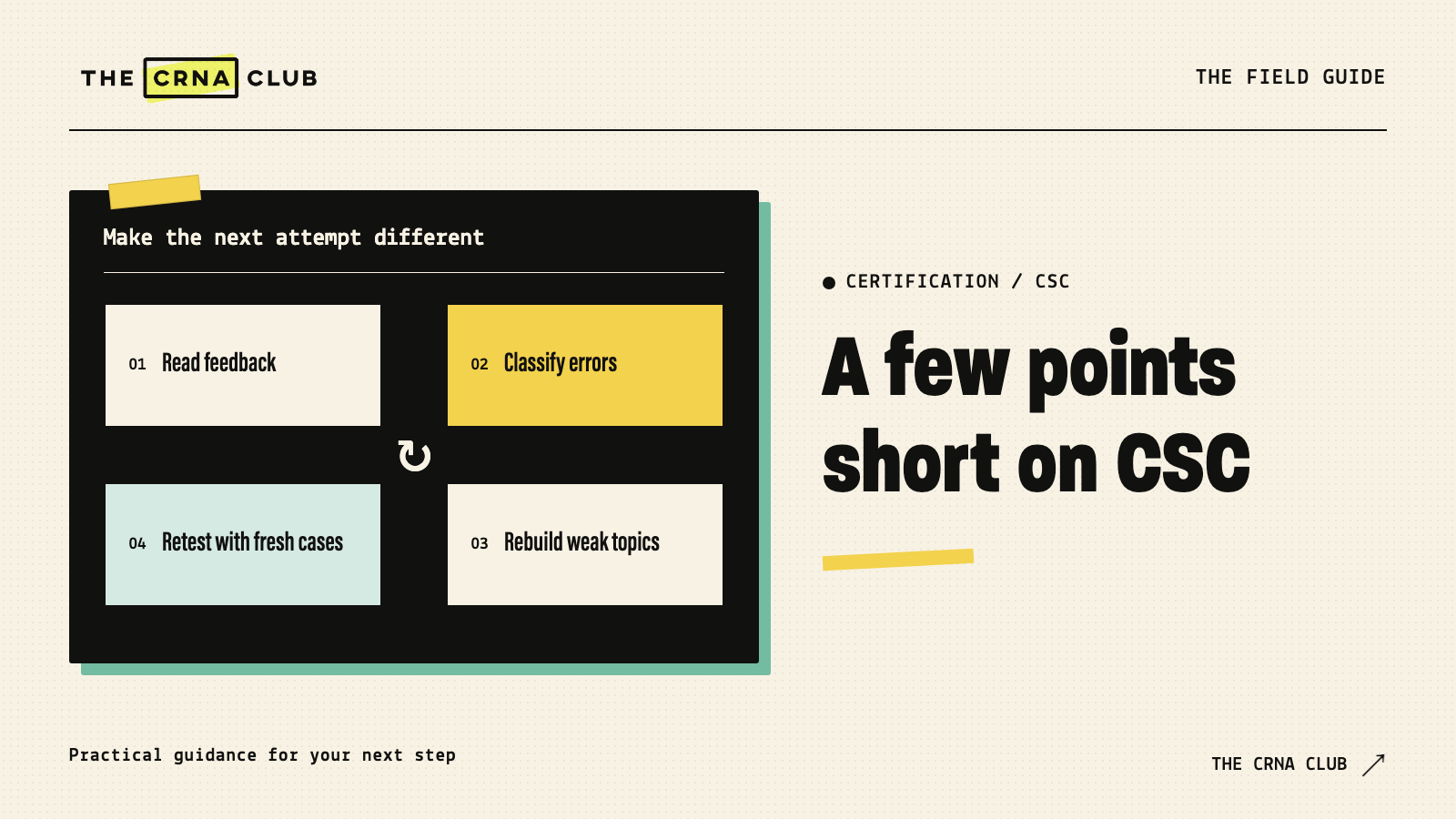
For each gap, name one next task. “Review complications” becomes “compare two causes of postoperative hypotension using the case findings.” That gives the next session a clear purpose.
Keep strong topics in mixed review, but don’t let them occupy every block because they feel better. The gap map needs to guide the difficult work too.
What should change in your case practice?
Try explaining the case before you read the choices. What happened during surgery, what changed afterward, and what findings support your explanation? Then change one detail. If the rhythm changes or the pressure trend reverses, does your explanation change too? That’s how you check whether you’re using the patient information.
For example, a hypothetical patient develops reduced perfusion after cardiac surgery. Instead of immediately attaching a diagnosis to one number, list what you know about the procedure, timing, rhythm, pressure, flow and clinical exam. Identify what information remains missing.
Now change the case by adding a different rhythm, a new pressure trend or a relevant procedure detail. Explain how the new information changes your reasoning. If the answer stays exactly the same despite a major change, inspect whether you’re using the patient information at all.
Our postoperative chest-drainage article offers focused teaching for a particular assessment problem. Use it when relevant, then review the other complications in the applicable outline. Don’t turn one memorable drainage example into your entire postoperative assessment method.
Write one sentence after each case describing the decisive clue and one uncertainty. This makes the review useful when you revisit it later, especially if you guessed correctly at first.
How do you decide whether the problem was content or test approach?
Separate a missing explanation from a problem using information you already understand. A content gap needs teaching or reference reading. A reading or pacing problem needs changed practice conditions. Both might be present, so use a small unfamiliar set and review the reasoning rather than assuming every error has the same cause.
If you don’t understand the procedure in the stem, timed repetitions alone are unlikely to help. Read the relevant section and explain the postoperative implications. Then return to a new case.
If you understand the topic but repeatedly answer a different question from the one asked, slow down and identify the task before selecting an option. Is the question asking what caused a finding, what assessment is needed or which intervention fits the described situation?
If you run short of time, inspect whether uncertainty in content is driving long pauses. A pacing exercise might help, but you may also need to repair the unfamiliar topic. Don’t add a timer to a concept you haven’t learned and expect speed alone to solve it.
Keep the distinction in your error log. The next task should describe what will change: a reference section, a worked comparison, an unfamiliar timed set or a review after a delay.
When should you add a new resource?
If you’re remembering the answers in your old bank, use the CSC questions for different practice. If a shared cardiac mechanism is the problem, open the matching lesson. If you don’t understand a surgical procedure, use a cardiac-surgery reference. We suggest choosing from the actual miss instead of replacing everything because the first attempt hurt.
Use the AACN CSC bibliography to identify relevant reference options. Check access through your employer or library before purchasing another book.
Write the purpose before buying: “I need a clearer explanation of ___.” If you can’t finish the sentence, return to the report and gap map. A general feeling of needing more material isn’t the same as an identified teaching need.
Keep an existing resource when its explanations are accurate and useful. You don’t need a completely different preparation system to make a meaningful change. Sometimes the change is how you use the resource: reading the omitted section, explaining the mechanism and testing it in a fresh case.
Our seven-day membership trial includes CSC quiz questions and certification planning, with broader lessons for relevant foundations. Use those lessons to rebuild the foundation behind a missed explanation, then choose surgical reading according to the remaining gap.
How should you plan the retake date?
Before booking, put the changed study work in your planner. Leave time for surgical reading, questions and reviewing mistakes. Does it fit the weeks you have? Check AACN’s current retake rules too. We wouldn’t choose the nearest opening simply because you were close last time.
AACN’s FAQ currently describes up to four attempts in a 12-month period. Verify the current handbook and your situation before booking. The maximum is an administrative rule, not a recommendation to use attempts quickly.
If the next exam is on or after November 19, 2026, use the revised CSC plan. AACN states existing materials remain useful, but you still need to compare coverage and recheck date-sensitive facts.
For admissions timing, read the program instructions. Don’t list CSC as earned while a retake remains pending. If a school asks about certification status, describe the actual status accurately and follow its requested format.
What evidence suggests your preparation has changed?
Look at the questions you couldn’t explain when you started. Can you explain them now and apply the idea to a different case? Have you covered the topics you skipped? Use those changes alongside your practice results when deciding what still needs time. A higher percentage on remembered questions tells you less.
Review the original gap map before booking. Can you explain the procedure that used to confuse you? Do you distinguish plausible postoperative causes using the patient findings? Is the monitoring explanation accurate? Which questions remain unresolved?
If the answers are still vague, choose another specific task. If the explanations are clearer and the outline is covered, avoid restarting every chapter because the previous result felt discouraging. Use what the current work shows.
Our Final Thoughts
A near miss deserves a thoughtful review, not an automatic repeat of the same plan. Find the explanations that remained unclear and change how you learn and test them.
You don’t have to turn the result into a judgment about your future. Give the next attempt a plan you can explain, with different work behind it.
Take the Next Step
Start a seven-day membership trial and choose one surgical topic from your score-report review. Use CSC questions to practice, cardiac lessons for a foundation that needs work, and surgical reading for the remaining detail. Put a later check in the CSC planner so the next attempt has a different preparation plan behind it.