Is Retaking the GRE Worth It for Your CRNA Application?
Sachi, CRNA
CRNA
In This Article (9 sections)
- Check how your schools use the GRE
- Name the problem a retake would solve
- A strong GRE doesn’t replace missing academic requirements
- Look for a reason your next attempt could improve
- Put the whole reporting process on the calendar
- Compare the retake with your strongest alternative
- Use a retake decision worksheet
- Our Final Thoughts
- Take the Next Step
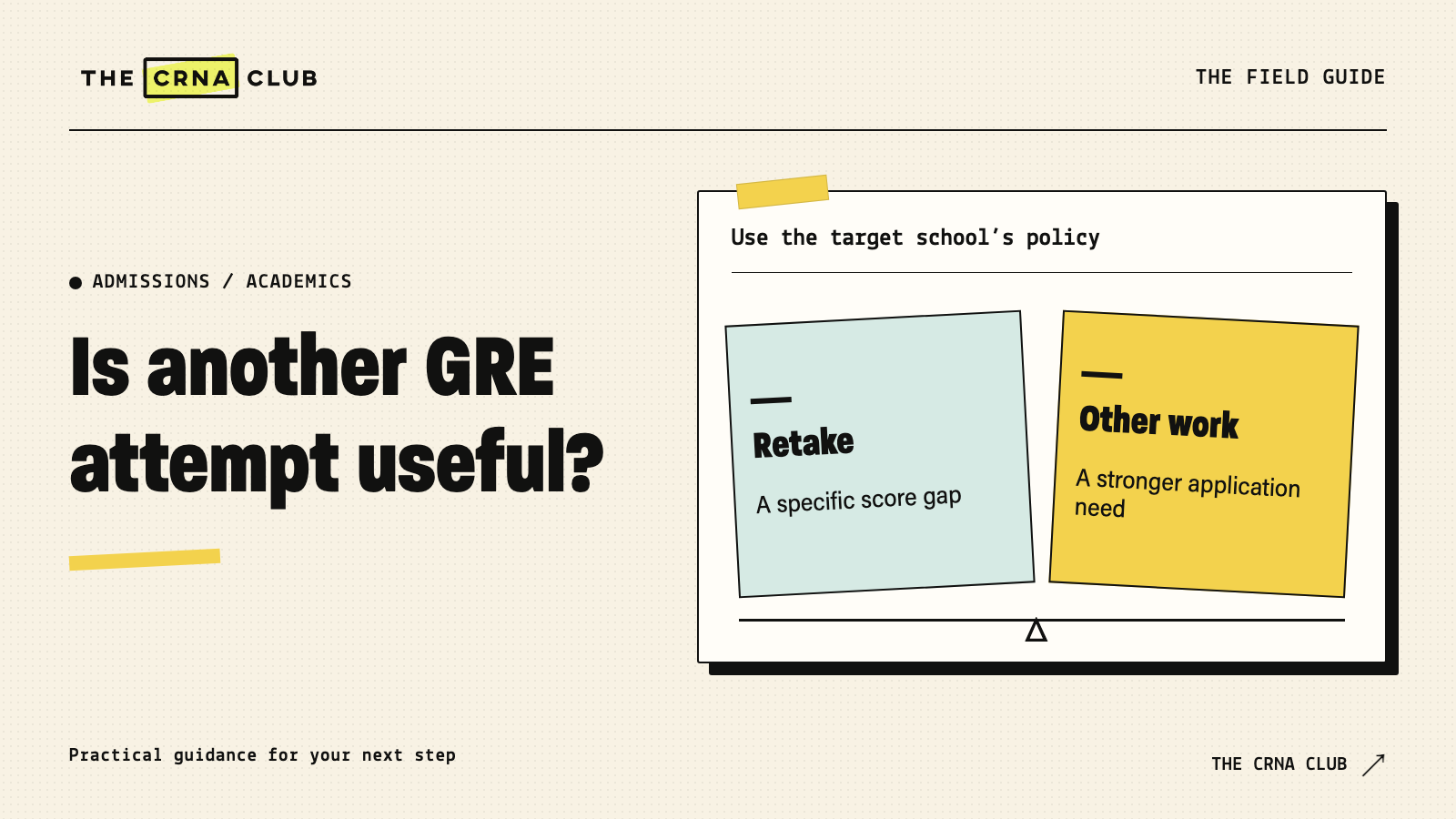
Retake the GRE when a better score would solve a specific problem at a school you plan to apply to. We suggest starting with our School Database preview to build the list, then confirming how those programs use the GRE. Our seven-day trial includes GRE and application lessons to help you compare another attempt with the other work you still need.
Your school list gives the score a purpose. Someone else’s acceptance story doesn’t tell you whether another attempt would help your application.
You have limited time between ICU shifts. Before spending another month preparing, identify what a new result would change.
Check how your schools use the GRE
Write down the policy for each target program. Use the current admissions page for your intended application cycle, and ask admissions about anything the page leaves unclear.
Place each school in one of these groups:
- GRE required with published minimums: Do you meet every section minimum and the score-age rule?
- GRE required without a stated minimum: How does the program describe its score review?
- GRE optional and considered: Would the result add useful evidence to your application?
- GRE waived under specified conditions: Do you meet those actual conditions?
- GRE not required, with score use unclear: Will admissions review an optional submission?
- GRE scores not considered: What other evidence does the program evaluate?
If the school says “not required,” ask whether it reviews optional scores. If it doesn’t consider them, a retake won’t add that evidence to its review. We suggest getting this answer before spending more study time on the exam.
For a current example, TCU’s nurse anesthesia FAQ lists minimums of 150 Quantitative Reasoning, 150 Verbal Reasoning, and 3.5 Analytical Writing. It also states that all applicants need scores from the last five years. Marian’s nurse anesthesia FAQ says the GRE is not required. These are individual program policies checked November 3, 2026. Recheck before applying.
A combined score alone may hide a section problem. In a hypothetical program requiring 150 in each reasoning section, a 149 quantitative score and 157 verbal score would still leave the quantitative minimum unmet. A higher total doesn’t remove a separate requirement.
Name the problem a retake would solve
Finish this sentence: “I am retaking the GRE because _____.”
Useful answers describe an application requirement or a defined weakness:
- “My quantitative score is below School A’s published minimum.”
- “My score will be too old under School B’s rule.”
- “School C considers optional scores, and my current result doesn’t represent the skills I can demonstrate now.”
- “Adding School D to my list requires a GRE score I don’t currently have.”
An answer such as “I want to look more competitive” needs more work. Competitive for which school, and compared with what other use of your time?
Now you know what the retake needs to accomplish. If you meet that section minimum or replace the old score, reassess the rest of the application before booking again. We wouldn’t keep chasing points without knowing what the next attempt would change.
A strong GRE doesn’t replace missing academic requirements
If your science GPA falls below a published minimum, don’t assume a strong GRE will create an exception. Ask the program whether an exception process exists and what evidence it considers. An exam score doesn’t change the grades on your transcript.
This is especially relevant when you’re deciding between a GRE retake and a graduate course. They demonstrate different things.
The GRE shows how you performed on that exam. A graded class shows work across a term in that subject, and an accepted prerequisite may also finish a requirement. Which do you need? Check the school and your record before treating the two as interchangeable ways to look stronger.
For example, a nurse who still needs an approved chemistry prerequisite has a different next step from a nurse whose only unmet requirement is a GRE section score. Studying harder for the GRE won’t complete chemistry. Taking another science course won’t submit a required GRE result.
Our guide to when to take the GRE for CRNA school covers scheduling the first attempt. For a retake, add this extra question: what changed after the first result that makes another attempt useful?
Look for a reason your next attempt could improve
Start with your previous preparation and a realistic practice assessment. Identify whether the main issue was subject knowledge, pacing, reading precision, writing organization, or unfamiliarity with the test.
“I’ll study more” doesn’t tell you how the next attempt will differ.
“I repeatedly missed algebra questions because I couldn’t translate the wording into an equation” gives you something to work on. You can practice that skill, review why the original approach failed, and see whether you solve unfamiliar examples more consistently.
Keep a short error log with four columns:
| Missed question or task | Why you missed it | Change in your approach | Result on a new example |
|---|---|---|---|
| A timed quantitative item | Misread the comparison being requested | Restate the requested quantity before calculating | Record whether the method transferred |
| A reading passage | Chose an answer broader than the passage supported | Separate the author’s statement from your inference | Check a different passage |
| A writing practice task | Main claim remained vague | State the claim and outline supporting reasons first | Review the next response against official criteria |
Try the changed approach on a new question. Can you translate a different word problem into an equation now? That’s a better check than recognizing the answer you reviewed yesterday. Use the result to choose the next practice task.
No fixed number of study hours guarantees a score increase. Use practice work to guide preparation, while recognizing that practice conditions and the official exam differ.
Put the whole reporting process on the calendar
Don’t plan around the test appointment alone. Your application needs an acceptable score delivered through the required process by the program’s deadline.
ETS’s current registration guidance allows the GRE General Test once every 21 days, up to five times in a continuous rolling 12-month period. Official scores are typically available in your ETS account eight to ten days after testing. Leave time for the program to receive and match the official score to your application.
Build your schedule backward from the school’s materials deadline. Include time for testing, official score availability, the required reporting route, and confirmation that the application is complete. Check whether the program requires an institutional code, a department code, or a specific application-service procedure.
If a retake would occur close to the deadline, ask admissions what it can accept before registering. A plan that depends on an unconfirmed late update is fragile.
Also check the school’s score-age rule. Record the date the program uses to assess age, rather than assuming every school measures it from the day you submit your application.
Compare the retake with your strongest alternative
Make the comparison concrete. Give each option a cost, a realistic time commitment, and an application purpose.
| Option | What would it address? | What needs verification? |
|---|---|---|
| GRE retake | Required score or a score the school evaluates | Section minimums, reporting rules, deadline |
| Science prerequisite | Missing or outdated required course | Course approval, grade, lab, completion timing |
| Graduate science course | Recent academic performance in a relevant subject | Whether the school values it and whether the workload is manageable |
| Application completion | Missing essays, references, records, or other required materials | The program’s definition of a complete application |
Consider two hypothetical nurses. One already meets every course requirement, but a required GRE section score is below the school’s minimum. A focused retake has a clear job. The other meets the GRE requirement but hasn’t completed an approved prerequisite. The course addresses a problem the retake can’t fix.
Neither nurse needs a universal “best GRE score for CRNA school.” Each needs a next action that fits the target program.
If comparing policies is where you’re getting stuck, our learning library covers GRE and application preparation. You can explore those lessons and the planning tools with a seven-day membership trial, then build a plan around your own school list.
Use a retake decision worksheet
Before booking another attempt, complete these seven lines:
- Target program and cycle: Which application would use the result?
- Current policy: Is the GRE required, optional, waived, or not considered?
- Current score issue: Which section, age rule, or missing score matters?
- Retake purpose: What specific change would make the attempt useful?
- Preparation change: What will you do differently from the first attempt?
- Receipt deadline: Can the official result reach the correct destination in time?
- Alternative: What would you do with the same time and money if you didn’t retake?
Then choose a decision date. If your practice work isn’t improving or a required course becomes the more urgent issue, revisit the plan before paying for another attempt.
Choose when you’ll reassess before you book. That might be after meeting the required scores, finishing one well-prepared retake, or getting the school’s answer about optional scores. We suggest looking at the whole application again at that point, so another test doesn’t automatically become the next step.
Our Final Thoughts
A GRE retake makes sense when the score has a verified role in your application and you have a workable plan to address it. It makes less sense when you’re chasing a number your schools don’t request while a more meaningful requirement remains unfinished.
Take the Next Step
Start with the free School Database preview to build a shortlist and save up to three schools. Confirm their GRE policies directly, then decide what another attempt would change. For GRE and application lessons, school research and planning tools, try our seven-day membership trial and build the next step around that list.