Local Anesthetic Systemic Toxicity: Recognition and the First Response
Local anesthetic systemic toxicity, or LAST, happens when a local anesthetic reaches a systemic exposure high enough to disrupt brain or cardiovascular function. It can follow an accidental injection into a vessel, rapid absorption or accumulation. A seizure, an arrhythmia or cardiovascular collapse may be the first obvious sign. The symptoms don’t always arrive in a predictable order.
Sachi, CRNA
CRNA
In This Article (7 sections)
For your review, connect the warning signs with where the drug can act. Then practice the dose arithmetic separately, so a correct total doesn’t become your only check.
The local-anesthetic lessons in the CRNA Club learning library through the seven-day platform trial help you connect sodium-channel blockade with both anesthesia and toxicity.
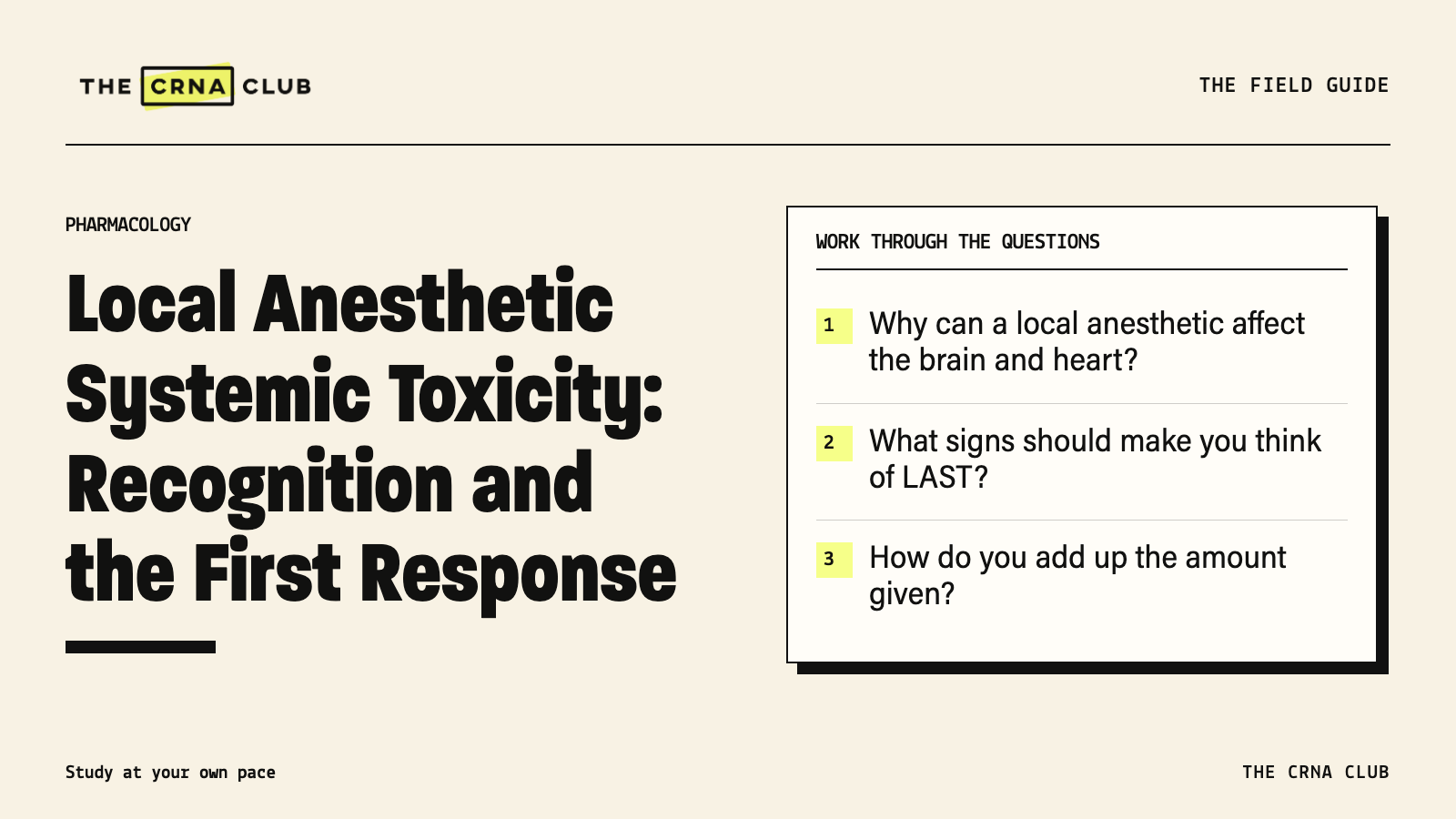
Why can a local anesthetic affect the brain and heart?
Local anesthetics block voltage-gated sodium channels. Near the intended nerve, that stops the electrical impulse from traveling and produces anesthesia.
But the drug can reach sodium channels elsewhere too. If systemic exposure becomes excessive, signaling in the brain and conduction in the heart are disrupted. Other cellular effects also contribute to severe cardiac toxicity.
The amount matters, and so does how it reaches the circulation. Drug absorbed gradually from the intended tissue doesn’t produce the same blood concentration over time as drug delivered rapidly into a vessel.
That is why you look at the drug, injection site, total exposure and patient factors together. A familiar dose or ultrasound guidance doesn’t rule out LAST.
What signs should make you think of LAST?
A patient may describe ringing in the ears, an unusual taste or symptoms around the mouth. You might notice agitation or altered mental status. Seizures and cardiovascular changes can follow.
Now consider a sedated patient. They may not be able to report those warning symptoms. Cardiovascular toxicity can also appear without an obvious neurological warning first.
Look at when the change happened. A new unexplained seizure or arrhythmia during or after local-anesthetic administration should bring LAST into the differential while you check other causes.
Keep the ASRA LAST checklist and rescue resources accessible wherever these drugs are given. You need the emergency response even if the patient hasn’t followed the symptom sequence you memorized.
How do you add up the amount given?
Check the actual product, concentration and volume. Include the route and time, and ask what everyone involved has already administered. Your own syringe may be only part of the exposure.
This original arithmetic example uses the same drug, lidocaine, twice:
| Exposure | Work out the amount | Lidocaine given |
|---|---|---|
| First infiltration | 1% = 10 mg/mL; 10 mL × 10 mg/mL | 100 mg |
| Additional infiltration | 0.5% = 5 mg/mL; 20 mL × 5 mg/mL | 100 mg |
| Total | 100 + 100 | 200 mg |
The calculation tells you how many milligrams were given. It doesn’t establish that 200 mg is appropriate for this patient. Check planned doses against the actual product instructions, patient factors and procedural protocol.
Practice the conversion in the local-anesthetic review. If different local anesthetics are used together, don’t treat each as having an independent safety allowance. Their combined toxicity needs assessment too.
What do you do when LAST is suspected?
Stop further local-anesthetic administration, call for help and activate the LAST response. Support oxygenation, ventilation and circulation. Use the current ASRA checklist for seizure treatment, lipid emulsion and the changes to resuscitation that LAST requires.
Lipid emulsion is part of serious-LAST treatment. The patient still needs airway support, seizure management and high-quality resuscitation when indicated. The checklist gives the rescue doses and observation guidance for the clinical team.
Don’t automatically apply a routine cardiac-arrest drug sequence without recognizing the toxicological problem. LAST changes the resuscitation approach.
What if the recorded dose was below a listed maximum?
In this fictional case, a patient develops an unexplained seizure shortly after additional local-anesthetic infiltration. The recorded amount is below a listed maximum.
Does that exclude toxicity? No. An unintended intravascular exposure, absorption and patient factors can change the risk. The timing still needs attention.
Stop administration and activate the response while the team assesses LAST and other causes. You don’t have to prove exactly how the exposure happened before responding to the emergency.
Our Final Thoughts
During your study review, try the concentration calculation until you can explain the units at each step. Then return to the case and ask why an amount below a listed maximum doesn’t exclude LAST. Keep the recognition and emergency response alongside the arithmetic.
Work through local-anesthetic review
Use the CRNA Club platform trial to continue your local-anesthetic review. Convert the two concentrations to milligrams, add the amounts and explain what the total still can’t tell you.


