Octreotide Mechanism of Action: Variceal Bleeding Interview Practice
Suspected acute variceal bleeding is an emergency requiring combined treatment. Octreotide is a guideline-supported off-label treatment in the United States and one part of that care. A change in cellular cyclic AMP or measured portal flow doesn't establish a proportional change in portal pressure or show that bleeding stopped.Source
Why do we use octreotide for variceal bleeding?
How does a hormone drug help a patient with bleeding varices? For CRNA interview practice, connect octreotide's somatostatin-receptor activity to reduced splanchnic inflow, the blood reaching the abdominal organs and then the portal system. That helps explain its place in acute care. It doesn't repair the ruptured vein or the scarred liver. Suspected acute variceal bleeding requires emergency combined care, including vasoactive treatment, endoscopy, antibiotics and resuscitation.
Key takeaways
- Octreotide is a somatostatin analog and receptor agonist. Variceal bleeding is a guideline-supported off-label use in the United States.
- One receptor pathway inhibits adenylyl cyclase and lowers cyclic AMP, but a cell signal doesn't quantify a patient's portal pressure.
- Reduced portal flow, reduced portal pressure and control of bleeding are different outcomes.
- Octreotide affects insulin as well as glucagon, so glucose sometimes rises and sometimes falls.
In this video
How does octreotide signal inside a cell?
Octreotide acts like some of the body's somatostatin signals and lasts longer than the natural hormone. It activates somatostatin receptors, with a preference for SST2. Agonist means it activates the receptor. It doesn't block somatostatin from binding as its main action.
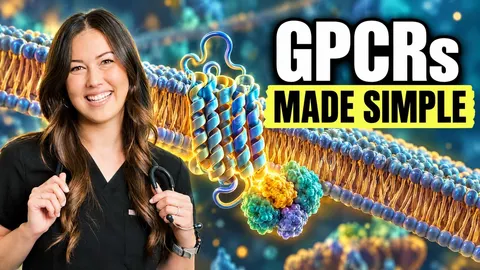
These are G-protein-coupled receptors. One important pathway uses an inhibitory G protein to slow adenylyl cyclase, the enzyme making cyclic AMP. Less cyclic AMP helps reduce secretion in the relevant cell. But inhibitory doesn't mean every activity in every tissue falls. Experimental calcium responses vary with the cell and agonist, and some work used a related compound rather than octreotide itself.
What connects the gut circulation to bleeding varices?
Blood leaving much of the gut enters the portal vein and travels toward the liver. In cirrhosis, resistance through the liver rises. Enlarged collateral veins provide other paths, including esophageal varices. A varix bleeds when it ruptures.
Octreotide reduces splanchnic blood flow. Reduced glucagon release appears to contribute, alongside other vascular and disease-related effects. Lowering inflow addresses one part of portal hypertension while the liver's resistance remains. You still need to find out whether bleeding is controlled.
Baveno VII recommends starting a vasoactive drug promptly when variceal bleeding is suspected, with antibiotics and endoscopic care as part of the acute treatment. Nonselective beta-blockers have a prevention role. Balloon tamponade is a temporary bridge for uncontrolled bleeding, and TIPS is considered in selected situations. Those treatments do different jobs rather than forming one automatic sequence.
Does a fall in portal flow prove portal pressure fell?
No. Flow is an amount moving per unit of time. Pressure describes the force driving blood through a circulation, and resistance affects the relationship. A Doppler flow result doesn't supply the missing pressure measurement.
Illustrative calculation: portal flow falls from 900 to 810 mL/min. The reduction is 90 divided by 900, or 10%. You have calculated a flow change. You have not shown a 10% portal-pressure reduction or established control of hemorrhage. A change in cyclic AMP from a separate cell experiment would not predict that percentage either.
The small human studies in the source list measured different things under different conditions. One found a larger portal and mesenteric flow effect after a meal than during fasting. Another did not find a significant change in hepatic venous pressure gradient over its short observation window. These findings don't predict every patient's response or replace evidence supporting combined acute care.
Why might glucose rise while octreotide is running?
Octreotide suppresses insulin and glucagon, and it also affects growth hormone. Reducing glucagon alone would suggest less glucose release, but insulin is changing too. The balance sometimes produces hyperglycemia and sometimes hypoglycemia, which is why glucose needs reassessment.
Also watch the heart rate and conduction. The prescribing information describes bradycardia and reports of higher-degree AV block with IV use. Gallbladder and biliary problems are another concern, especially with longer exposure. Event rates from long-term acromegaly treatment don't become the risk estimate for a short ICU course.
How would you answer the octreotide interview question?
Illustrative answer: 'Octreotide is a somatostatin analog and agonist. One receptor pathway inhibits adenylyl cyclase and lowers cyclic AMP, reducing secretion. Hormonal effects, including reduced glucagon, contribute to reduced splanchnic inflow. It's one part of treatment for a suspected variceal bleed alongside endoscopy, antibiotics and resuscitation. I'd reassess bleeding and perfusion, and watch glucose and cardiac conduction.'
Then practice the follow-up: 'If the portal flow falls but the patient is still bleeding, did treatment work?' The flow measurement changed, but bleeding remains uncontrolled. We continue urgent assessment and the combined treatment rather than using the flow percentage as reassurance. The prompt is illustrative interview practice, not a report of a school's questions.
Our Final Thoughts
Practice explaining the drug through three separate observations: secretion inside a cell, blood entering the portal circulation and bleeding at the bedside. If you start using one percentage for all of them, pause and name what was actually measured.
Try the answer once without notes, then have a practice partner ask why glucose might rise. The Interviewing Toolkit linked below pairs clinical teaching with AI mock interviews and a prep plan, so your next session has a specific question to work on.