Should I do CCRN practice questions by body system or in mixed sets?
Sachi, CRNA
CRNA
In This Article (10 sections)
- When should you do CCRN questions by system?
- What does mixed practice add?
- Which type should you start with?
- What would a balanced week look like?
- How do you know when to leave a system set?
- What if your mixed score drops after strong system scores?
- Should timed practice always be mixed?
- How do you keep favorite topics from taking over?
- Our Final Thoughts
- Take the Next Step
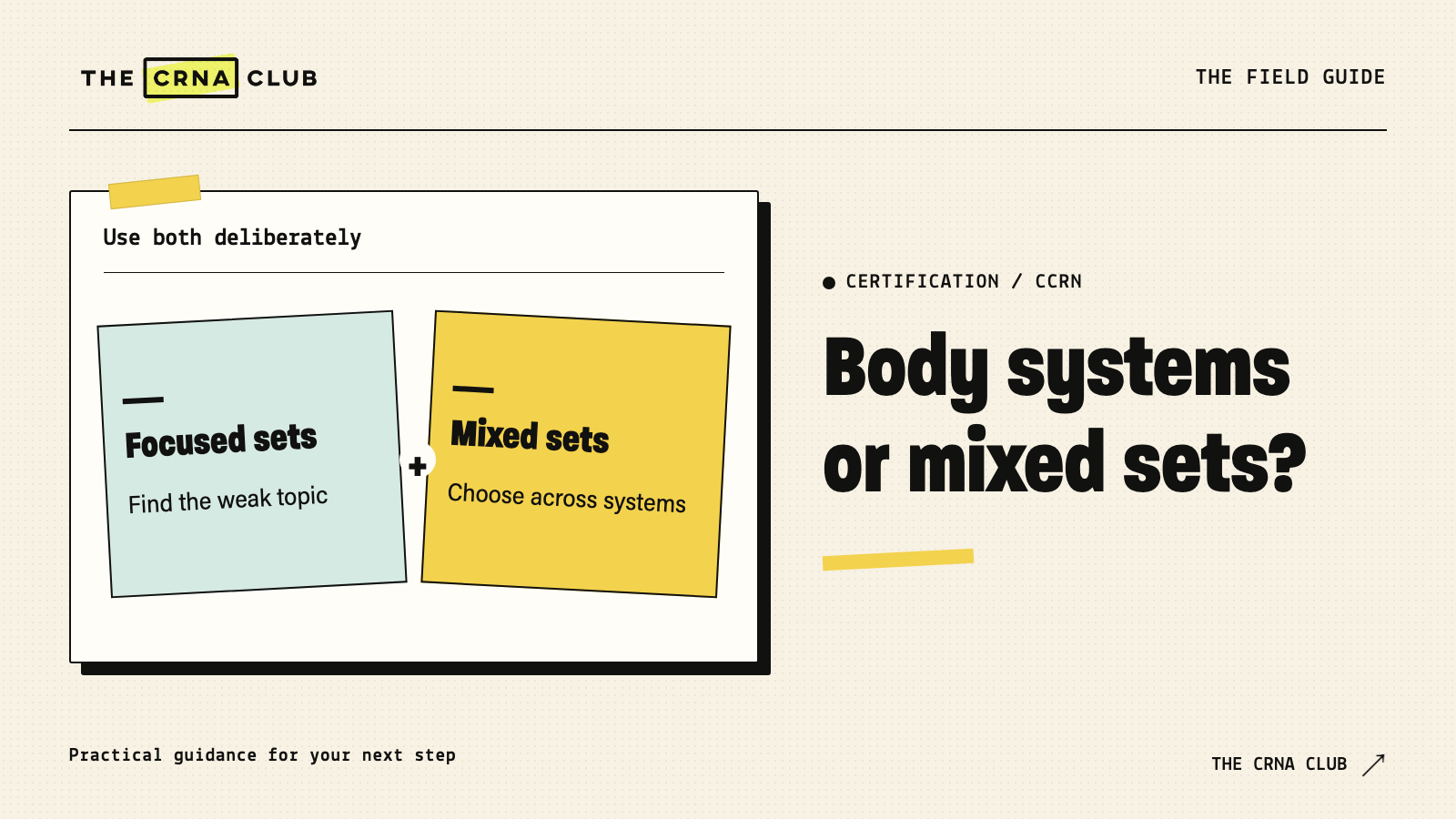
Use both. Body-system questions help you work on a topic you’re learning. Mixed questions check whether you recognize the problem when nobody tells you which system to think about. Start with the gap you’re finding, then come back to mixed practice.
We suggest using our CCRN Toolkit to connect that practice with video teaching and a study plan. If renal questions keep giving you trouble, schedule the relevant lessons before asking another mixed set to do the teaching for you.
You don’t have to finish every system before mixing questions. You also don’t have to keep guessing through a subject you haven’t learned yet.
When should you do CCRN questions by system?
Use a system set to investigate a defined topic and check whether focused teaching helped. The set gives you repeated opportunities to examine related concepts. Review beyond the correct answer, because knowing the system in advance supplies a cue you won’t always receive in mixed practice.
AACN’s preparation guidance recommends self-assessment against the test plan and attention to unfamiliar patient problems. System practice helps you investigate one of those problems in manageable detail.
Say renal questions keep exposing the same missing explanation. Spend a session on the relevant CCRN lesson, then work through related practice. Explain why the answer fits before opening the rationale. You’re checking whether the lesson helped you understand the subject, rather than trying to finish every renal question in one sitting.
System work also helps when you are new to a topic. Switching between several unfamiliar domains after every question sometimes leaves you with a scattered list of gaps and no time to address any one of them.
What does mixed practice add?
Mixed practice asks you to identify the problem and retrieve the relevant knowledge without being told the topic first. It also helps reveal whether your recent focus crowded out other areas. Use unfamiliar mixed questions periodically so the result reflects more than memory of the last topic you studied.
The official examination covers a broad outline. AACN’s certification FAQ directs candidates to the applicable test plan in the handbook. Your preparation should eventually ask you to work across that outline too.
A mixed set doesn’t automatically provide equal representation of every domain. Check what it actually sampled before making a broad conclusion. Ten questions are a small window, and one difficult topic might occupy several of them.
The useful outcome is a more specific next task. You might notice you understand recent renal review but remain uncertain about professional-practice situations. That is a reason to adjust the next session, not a reason to repeat renal indefinitely because it now feels better.
Which type should you start with?
Choose your starting point from what you know:
- If you have enough background to attempt it meaningfully, start with a brief mixed diagnostic.
- Use the result and the current outline to choose focused review.
- If an entire area is unfamiliar, begin with an explanation and a smaller system set rather than using a long mixed session to confirm the same missing knowledge repeatedly.
You don’t need a perfect baseline score. You need enough information to make the next session useful.
A nurse with broad exposure might move quickly from diagnostic questions to targeted repair. A nurse from a highly specialized unit might spend more time building knowledge outside the usual patient population. Both still return to mixed practice to check application across topics.
Our CCRN overview covers general preparation context. Use it alongside the official outline when choosing where your diagnostic and system work should begin.
What would a balanced week look like?
We suggest giving focused teaching and mixed practice their own place in your planner. Use a mixed set to find a gap, learn the topic, then try related practice. Return to mixed questions later so you check whether you recognize the idea when the topic isn’t announced. Adjust the time for whichever step you need most.
Consider a hypothetical nurse with four study sessions this week:
| Session | Task | What decides the next step |
|---|---|---|
| Monday | Brief unfamiliar mixed practice and review | Which topics remain unclear after reading the explanations? |
| Tuesday | Focused teaching on one selected gap | Does she explain the concept without looking? |
| Thursday | Related system questions plus rationale review | Does the explanation hold when details change? |
| Saturday | Mixed practice including other areas | Has the repaired concept transferred, and what now needs attention? |
These are example appointments. They don’t prescribe a universal number of sessions. If your week offers two protected blocks, combine tasks thoughtfully and keep the second check realistic.
Also include small retrieval moments between longer sessions. You might explain Thursday’s learning point without notes before opening Saturday’s set. If it disappeared, briefly repair it before deciding the whole topic needs another large review.
How do you know when to leave a system set?
Move toward broader application when you explain the main concepts, identify why alternatives don’t fit and handle related unfamiliar questions with clearer reasoning. You don’t need every possible question correct before returning to mixed practice. You do need to know which uncertainty remains and when you will revisit it.
Staying with a system until the score feels perfect creates two problems. The questions become familiar, and other areas lose time. A beautiful percentage on one domain doesn’t establish broad coverage.
Before moving on, write yourself a short note: “I understand these ideas now. This one still needs review. I’ll check it again Saturday.” You don’t have to get a perfect system score before studying something else. Keep the unresolved part on your calendar.
If a new mixed set reveals the same unresolved issue, reopen the topic. Changing formats doesn’t remove a gap. It gives you another way to see it.
What if your mixed score drops after strong system scores?
Check the conditions before interpreting the drop. Mixed practice removes the topic cue and might sample unfamiliar material. Review whether errors came from missing content, choosing the wrong frame for the problem or timing. Comparing percentages alone won’t show which of those needs work.
Say you do well on cardiac questions after a week of cardiac lessons. Then your mixed score drops because you missed several renal questions you haven’t reviewed. That doesn’t undo the cardiac learning. It tells you where the next teaching session belongs.
Another learner misses familiar concepts because he assumes a new question belongs to the topic he studied yesterday. He needs to practice identifying the actual request and findings before searching for an answer.
Give each problem its own repair. More system questions help the first learner build missing content. More careful problem identification and fresh mixed practice address the second learner’s pattern.
Should timed practice always be mixed?
Choose the format according to what you are checking. A timed system set shows how you work within a topic. A timed mixed set adds the task of moving between topics. Neither should replace slower learning sessions where you examine uncertainty and rebuild an explanation.
If you haven’t learned the content, timing a long set mainly measures how quickly you encounter unfamiliar information. Start with teaching and meaningful attempts, then add timing when you want to examine pace.
When you review timing, look for where minutes went. Did you reread because the task was unclear? Spend too long between two choices without naming the difference? Open explanations during the attempt? Those details guide a useful adjustment.
Don’t copy someone else’s pace target without checking the official format and your session design. The practice task should have a clear purpose before you attach a clock to it.
How do you keep favorite topics from taking over?
Review your week against the current outline, including topics you didn’t touch. A question bank’s default settings won’t necessarily allocate time according to your needs. Make your next selection deliberately and give unfamiliar areas protected teaching time rather than saving them for the end of a tired session.
A simple coverage note helps: date last studied, current uncertainty and next appointment. You don’t need a color-coded dashboard for every condition. You need to see whether a topic has been postponed three weeks in a row.
And keep application questions outside the practice percentage. If exam timing is driven by admissions, check CCRN requirements versus strategy and confirm each program’s actual policy. Then build a study calendar you have a chance of following.
At the next weekly check, look at what each session taught you. Keep the sessions with clear follow-up work and change the ones you repeat mainly because their scores feel reassuring.
If the switch from questions to teaching is where your plan falls apart, try our CCRN review and planning tools through the seven-day membership trial. Choose one weak topic, work through its lesson and schedule a later mixed check. Use that first week to practice the whole sequence.
Our Final Thoughts
System sets give you room to work on a gap. Mixed sets help you check whether you recognize and apply the concept without a label. Let each format answer its own question, and use the review to decide what comes next. The balance should change as your needs change.
Take the Next Step
Use our CCRN Toolkit for video teaching, CCRN questions and planning together. Already have your study materials? The free certification planner includes one lifetime free plan so you have somewhere to schedule focused work and later mixed practice.