Should you take CMC or CSC first if you are eligible for both?
Sachi, CRNA
CRNA
In This Article (9 sections)
- What’s the difference between CMC and CSC?
- How do you compare the outlines with your experience?
- Would CMC first make sense for a cardiac stepdown nurse?
- Would CSC first make sense for a CVICU nurse?
- How much should admissions influence the order?
- How should the November 2026 revision affect your sequence?
- What does a final decision worksheet look like?
- Our Final Thoughts
- Take the Next Step
If you’re eligible for both, we suggest taking the exam that best fits your current patients and leaves you a manageable amount to learn. You don’t have to take CMC before CSC. Our membership includes CMC Review, CMC/CSC questions and both planners to help you compare the work. Try the seven-day trial while you build the side-by-side plan below.
You don’t have to earn every available credential before submitting an application. Another exam uses time you might also need for a prerequisite, recommendations or interview preparation. Give the next certification a specific purpose rather than choosing the longest set of letters.
If you’re still deciding whether another certification belongs in your application plan, read our guide to certifications beyond CCRN. If you already want both, let’s compare what each one would take.
What’s the difference between CMC and CSC?
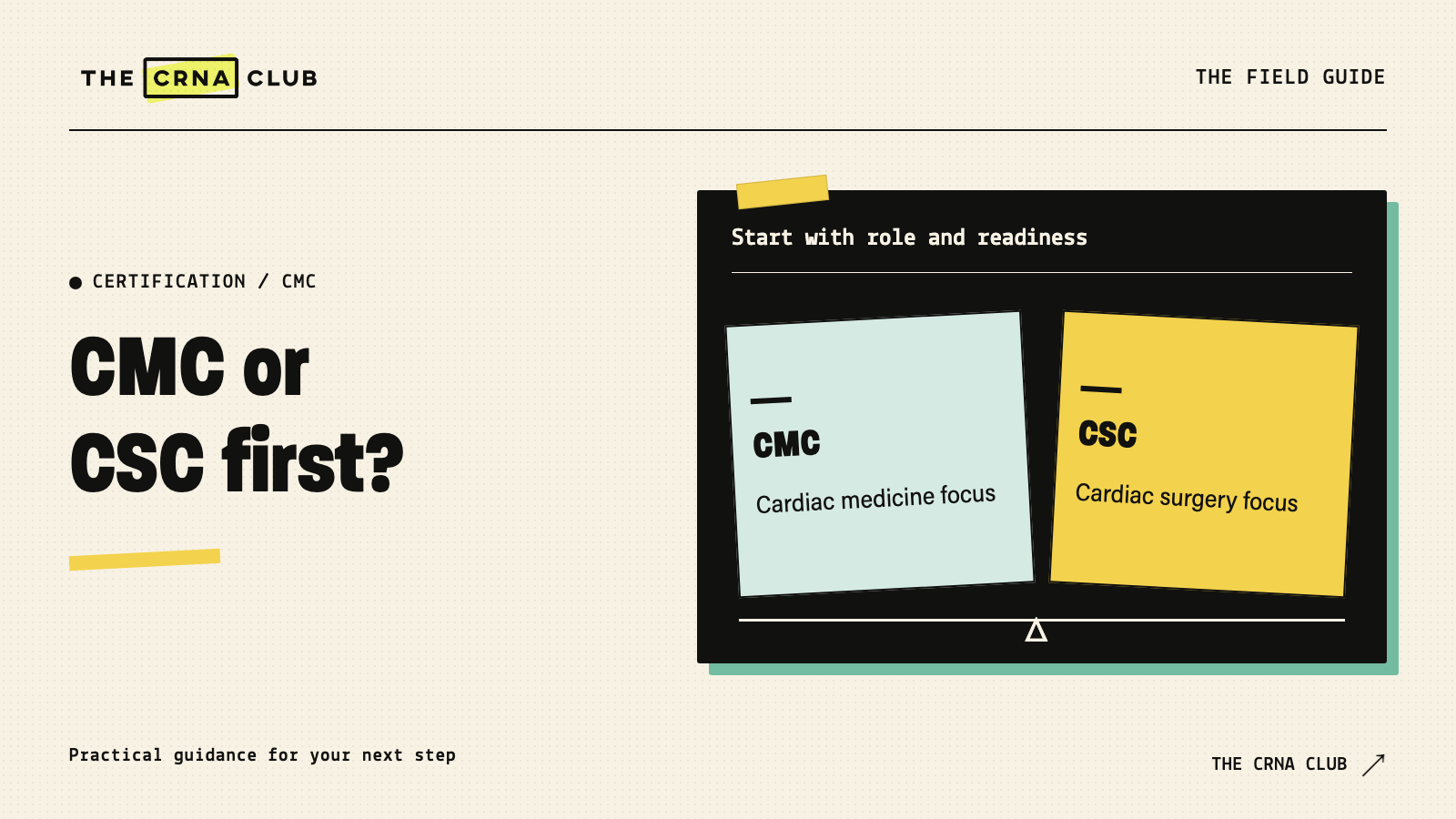
CMC focuses on adult cardiac medicine, while CSC focuses on qualifying adult cardiac-surgery care during the first 48 hours after surgery. Both are subspecialty credentials attached to an eligible clinical specialty certification. Similar cardiac knowledge appears in both, but their practice focus and exam content are not interchangeable.
Check the AACN CMC page and AACN CSC page before comparing study schedules. Being comfortable with postoperative patients doesn’t automatically establish the hours for both applications. Verify each route with your actual practice record.
Use a simple side-by-side sheet:
| Decision | CMC | CSC |
|---|---|---|
| Clinical focus | Acutely or critically ill adult cardiac patients | Qualifying adult cardiac-surgery patients in the first 48 postoperative hours |
| Your evidence | Adult cardiac direct-care record | Qualifying early postoperative cardiac-surgery direct-care record |
| Study comparison | Applicable cardiac medicine outline | Applicable cardiac surgery outline |
| Scheduling question | What remains unfamiliar for you? | What remains unfamiliar for you? |
Don’t make the choice from the credential names alone. Look at the actual listed topics and the work you perform. Then decide which exam you’re in a position to prepare for thoughtfully.
How do you compare the outlines with your experience?
Look at each outline and ask two questions: have you cared for these patients, and can you explain the care? Those aren’t always the same. Mark what you know, what needs a refresher, and what you need to learn. Now you can compare the actual work instead of asking which exam other nurses found easier.
Take one topic you see often at work. Explain the patient problem, relevant assessment and treatment reasoning without opening your notes. If the explanation becomes unclear halfway through, mark it for review even if you’ve cared for similar patients for years.
Now choose an unfamiliar topic from each outline. Estimate what learning it involves. Do you need a brief reference review, a full lesson or several worked cases? A topic you’ve never managed should not receive the same study estimate as a concept you understand well.
For each outline item, make these four notes:
- Name the topic using the applicable outline.
- Record your relevant experience. What care have you actually provided?
- Check your explanation. “I can explain the mechanism and monitoring” tells you more than “pretty good.”
- Choose the next task from the gap you found.
You aren’t rating your worth as a nurse. You’re looking at where your normal assignments gave you exposure and where the exam asks for more breadth. That makes the audit easier to use honestly.
Would CMC first make sense for a cardiac stepdown nurse?
CMC may be the more relevant first choice for a nurse whose qualifying experience centers on adult cardiac medicine rather than early postoperative cardiac surgery. The reason is the match between practice and scope. The nurse still needs to verify eligibility and review unfamiliar topics across the entire applicable outline.
Consider a hypothetical nurse with extensive acute adult cardiac care who recently moved into a mixed unit. She meets CMC requirements but is still confirming whether she has enough qualifying CSC hours. Her next step is resolving the hour question before treating both exams as immediately available.
If she confirms she is eligible for both, she compares the actual learning gaps. Perhaps the medicine outline aligns with her recent patients while surgical procedures and complications require a larger review. CMC first might fit her current schedule and learning goals.
For her, CMC first matches the patients she knows and the time she has. That doesn’t tell us what a school prefers. She still needs to check its actual certification and experience requirements before building the application around that choice.
Don’t transfer this example to yourself based on the unit label alone. Another stepdown nurse might have different assignments, recent experience or professional goals. Use your own record and outline audit.
Would CSC first make sense for a CVICU nurse?
CSC may be a practical first choice for an eligible nurse whose recent work centers on early postoperative adult cardiac-surgery care. Familiarity with that setting helps connect the study to real observations. It still leaves topics outside the usual case mix to review, so CVICU experience alone doesn’t establish full exam coverage.
Imagine a hypothetical CVICU nurse who routinely recovers qualifying cardiac-surgery patients. She has a current base certification, verified practice hours and a school application several months away. Her outline audit shows strong familiarity with routine postoperative assessment but weaker coverage of procedures she rarely sees.
Her plan could focus on those less familiar surgical topics while maintaining mixed review. Choosing CSC first would give that plan a clear purpose. It would not mean the exam is easy or that a few shifts replace studying.
Now change the example. Her application is due soon, her prerequisite remains incomplete and a reference request hasn’t gone out. Another certification might reasonably move later on the calendar. The clinical fit stays the same, but the timing changes.
This is why a useful decision includes both the outline and the rest of your application. Your next task should address an actual need rather than becoming a way to postpone work that feels less comfortable.
How much should admissions influence the order?
Use published program requirements and direct clarification to identify what admissions actually needs. Don’t assume CMC or CSC is preferred everywhere, replaces a required base credential or compensates for an unmet academic requirement. If both are optional for your target programs, choose the sequence using your practice, learning goals and available time.
Create one row per target school. Record the exact certification wording, the date you checked it and any question requiring clarification. Keep required, recommended and optional language distinct. A school accepting a credential isn’t necessarily assigning it a particular weight.
Our CCRN and CRNA school article helps frame the base-certification question. Then read the actual programs you’re considering. A broad article can’t settle every school’s current policy.
If your school instructions don’t address the subspecialty question, avoid inventing a committee preference. Ask a concise question if the answer would change your plan. Otherwise, use your time to complete the published requirements and prepare an honest application.
You should be able to explain why you chose the credential in terms of your practice and learning. “Someone online said this one looks better” leaves you without much reasoning if your timeline or school list changes.
If the comparison reveals a cardiac physiology or medication gap, our learning library and CMC Review offer teaching for those foundations. Explore the lessons, CMC/CSC quiz questions, and planning tools through the seven-day membership trial while building the first exam plan.
How should the November 2026 revision affect your sequence?
Use the outline matching each booked exam date. Revised CMC and CSC exams begin November 19, 2026. If one appointment is before that date and the other after it, maintain the correct plan for each. The revision date shouldn’t become a reason to rush into an exam before you’re prepared.
AACN’s announcement states existing study materials remain useful. Compare coverage rather than assuming you need to replace every book or finish both exams before the change.
On your worksheet, record the appointment, applicable outline and remaining gaps for each exam. If the second date remains tentative, label it tentative. A clear first plan is more useful than two firm bookings supported by wishful estimates.
You may choose to prepare for one exam, reassess after the result and then plan the second. This gives you better information about the time you actually used and the learning that carries over. There is no need to promise yourself a compressed double-exam schedule before you have that information.
What does a final decision worksheet look like?
Write why you’re choosing one first and what would change your mind. Maybe your work schedule changes. Maybe a required class needs more time. We suggest revisiting the decision when those things happen, rather than treating two exam bookings as a commitment you have to keep regardless of the workload.
Write: “I will prepare for ___ first because ___. My largest gaps are ___. I have these study blocks available ___. Before booking, I still need to confirm ___.” Use your own specifics.
Then add the deferred task. If you are postponing CSC, write when you’ll revisit it and what information you need. If you are postponing both, identify the application requirement you are completing first. A deliberate later date is a legitimate plan.
Our Final Thoughts
Choose the next certification from your actual practice and the work still ahead. Both cardiac subspecialties require preparation, and neither needs to become a contest over whose credential list is longer.
A clear first step leaves room to learn well. Check the hours, compare the gaps, and put the plan beside the rest of your application.
Take the Next Step
Try our seven-day membership trial to explore CMC Review, CMC/CSC questions and the certification planners. Start with the exam you choose first and the topics you need most. If you want a calendar before exploring membership, the free certification planner includes one lifetime free plan.