Should I work on CMC or CSC after CCRN, or strengthen another part of my CRNA application?
Sachi, CRNA
CRNA
In This Article (11 sections)
- What should you check before choosing another certification?
- How do CMC and CSC eligibility affect the decision?
- When should an academic task come first?
- When is additional certification a sensible next goal?
- What if the next weak area is interview preparation?
- How do you compare the time costs honestly?
- What if an application deadline is close?
- How should you use application-planning tools in this decision?
- What should you write as the final decision?
- Our Final Thoughts
- Take the Next Step
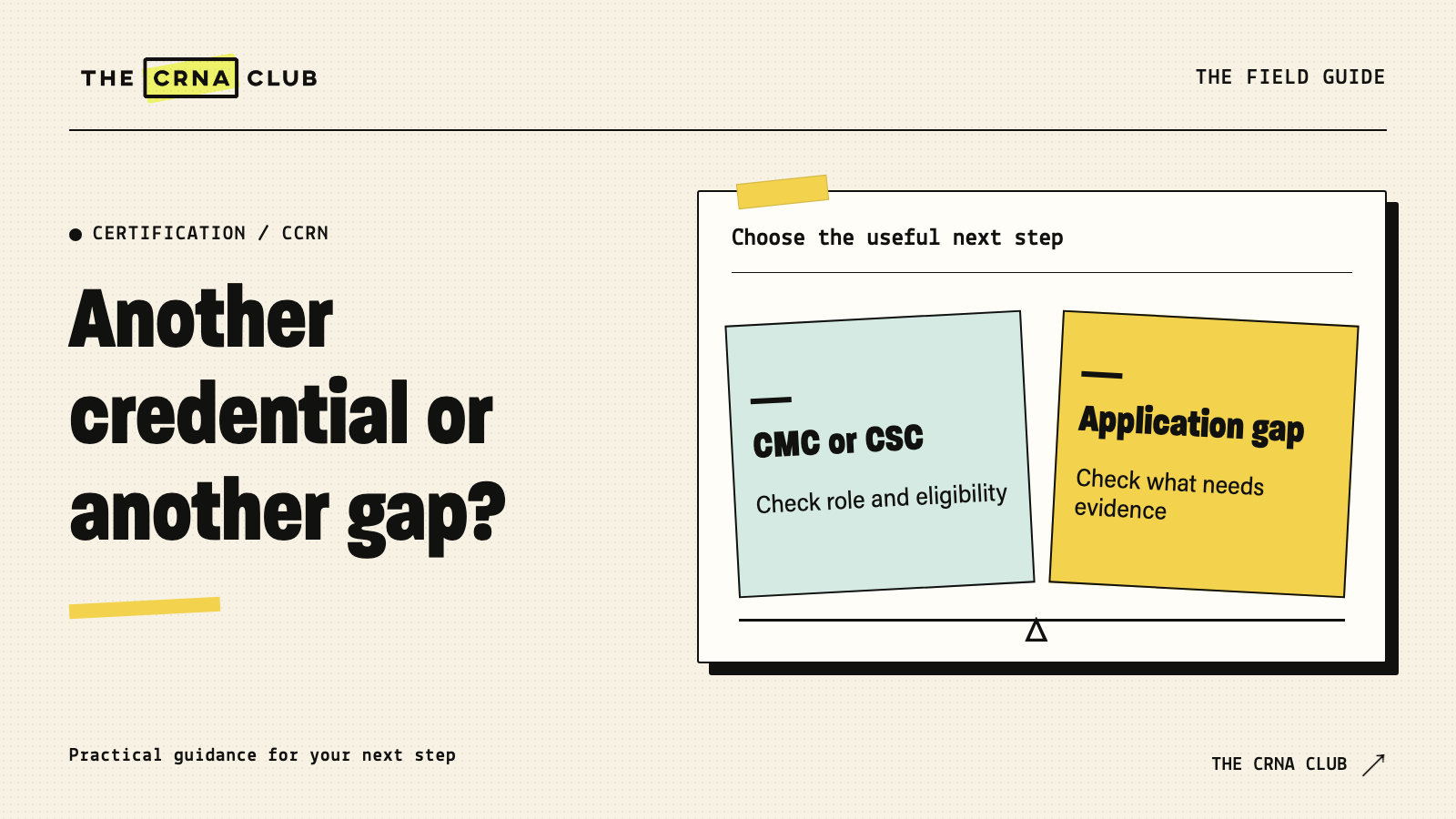
After CCRN, choose the task addressing your next real gap. CMC or CSC makes sense when you’re eligible and the learning fits your work. If you’re missing a required course, document or interview preparation, give that task time first.
We suggest reviewing your targets in our School Database and your academic record in the Transcript Analyzer before adding another exam. The seven-day membership trial brings those planning tools together with CMC review, certification questions and planners when another credential is the right next step.
Another exam has a clear endpoint. Improving an essay or choosing a science course sometimes feels less obvious. Don’t let the easier task to measure choose the whole application plan for you.
What should you check before choosing another certification?
Review your target programs’ actual requirements, your current application gaps and your clinical eligibility. Keep those three questions separate. A credential sometimes supports a useful development goal while still being lower priority than an unfinished required course or document due sooner.
Use a personal review sheet:
-
Is something required still incomplete? Check current program criteria and your checklist to see whether another task needs priority.
-
Am I eligible for this certification? Compare your record with current official credential requirements before treating it as an available option.
-
What would studying help me understand? Use your actual clinical gaps and practice exposure to decide whether the learning goal fits.
-
Does the calendar support it? Compare the work with your shifts, academic work and deadlines to judge whether the timeline is realistic.
-
What would I postpone? Name the next-best use of that same time. That’s the opportunity cost of choosing certification now.
Our broader certifications-beyond-CCRN article explains how additional credentials fit the application picture. Use this workflow to decide what deserves your next available block of time.
How do CMC and CSC eligibility affect the decision?
Choose from the credentials your actual practice qualifies you to pursue. CMC and CSC have different clinical scopes and require an eligible base specialty credential plus qualifying experience. Studying well doesn’t replace the clinical-hour conditions. Check the current application details before building your timeline.
AACN’s CMC eligibility page describes qualifying adult cardiac practice and its requirements. AACN’s CSC page focuses on qualifying adult cardiac-surgery care in the first forty-eight postoperative hours.
That distinction matters. An applicant working with cardiac patients doesn’t automatically have CSC-qualifying hours. A nurse outside a unit labeled CVICU shouldn’t assume the unit name alone decides CMC eligibility either.
Review the actual duties, patient population, dates and verification requirements. Ask AACN about unclear experience before applying. A credential should accurately represent the qualifying practice behind it.
When should an academic task come first?
Prioritize an academic task when it completes a target program’s explicit requirement or addresses a clearly identified academic learning need. An extra certification doesn’t add academic grade points or automatically waive a course condition. Confirm the relevant calculation and course acceptance before paying for either path.
Consider a hypothetical nurse who already has CCRN and lacks a required course meeting a program’s stated criteria. The immediate issue is the course. Passing another certification doesn’t complete it.
Another nurse meets the stated academic conditions but has weak recent performance in a relevant subject. The next question is what academic evidence or learning would address that pattern, using current program guidance. A credential alone doesn’t explain the transcript.
Use the Transcript Analyzer to review the actual grade pattern, then compare it with target-school requirements. A weak cumulative GPA from an older degree and recent weak science grades need different review. Choose a relevant course only after checking what the program accepts. Another credential doesn’t answer that academic question.
When is additional certification a sensible next goal?
It deserves consideration when eligibility is clear, required tasks are on track and the learning fits your clinical practice or development goals. You should explain what you intend to learn and how the calendar supports it. A longer list of letters isn’t a complete reason by itself.
Say your required work is on track, you meet CMC eligibility and you want to understand your cardiac-medicine patients better. Use our CMC review to work through the topics you find difficult, then practice and plan around your shifts. You have a clear reason to study beyond adding letters to the application.
Another nurse regularly provides qualifying early postoperative cardiac-surgery care and identifies gaps in explaining that population’s care. CSC preparation fits a different scope, provided the current eligibility conditions are met.
Neither example establishes an acceptance advantage or guarantees an outcome. They show a clear relationship between experience, learning and the chosen goal.
Check the current examination plan too. CMC and CSC revisions start November 19, 2026, so your appointment date affects which official blueprint applies. Resource selection should account for that date without assuming every current product has already changed its weighting.
What if the next weak area is interview preparation?
Give spoken explanation and authentic experience practice their own time. Another examination sometimes deepens content, but it doesn’t automatically teach you to answer an interview prompt clearly. Identify whether your current problem is missing knowledge, communication or an application task before choosing the remedy.
If you know the content but ramble when asked to explain it, start with spoken practice. Use the Mock Interview feedback to hear where the answer loses focus. A second certification might deepen knowledge while leaving that communication habit untouched.
A different nurse cannot explain the relevant physiology even during quiet review. That person needs teaching as well as spoken practice.
Use the distinction to plan. You aren’t deciding whether knowledge or communication matters more in every application. You are identifying what you personally still need to work on.
How do you compare the time costs honestly?
Estimate the full work each option requires, including teaching, practice, review and administrative steps. Compare it with actual available blocks, then name what would be delayed. A plan claiming you will complete everything without moving anything hasn’t examined the constraint.
Compare the options using your actual workload:
| Option | Work beyond the visible endpoint | What I would delay |
|---|---|---|
| Additional certification | Eligibility check, gap review, practice and examination process | Another planned study or application block |
| Academic course | Approval, enrollment, assignments and assessment | Time across a defined academic period |
| Interview preparation | Clinical explanation, authentic examples and feedback | Other nonurgent work |
| Application completion | Program research, documents and revisions | Optional development tasks |
Use your actual dates and obligations in the final column. You don’t need precise estimates on the first pass. You need to see whether two major commitments are competing for the same evenings.
If you keep underestimating, use observed weekly capacity from the tasks already underway. A realistic smaller plan gives you more useful information than assigning extra hours because the goal feels important.
What if an application deadline is close?
Check the requirement and required evidence before rushing an optional credential. Separate what the program must receive from what you hope would add depth. A new certification doesn’t compensate for missing required documents, and a scheduled exam doesn’t automatically count as a completed credential.
Our CCRN application strategy guide helps frame those policy questions. Keep a current source or written clarification beside each deadline.
Say the deadline is close and your essay still needs revision while recommendations remain unfinished. Put those required tasks into the available blocks before adding an optional exam. Our application-planning tools help keep the tasks visible, but you still need to choose a realistic order.
If the credential is explicitly required, the problem changes. Verify the due milestone and assess whether the timeline is feasible rather than relabeling the requirement optional.
How should you use application-planning tools in this decision?
Use the tools to see your record, targets and unfinished tasks together. Then confirm the requirement with the school or certifying body responsible for it. A planning score helps organize your work. It doesn’t reveal a school’s admissions formula or your chance of acceptance.
Keep the task simple: what is missing, what source defines it and what action addresses it? That structure helps you avoid choosing the most measurable task merely because it has a clear dashboard.
Use the seven-day membership trial for the next task you identify. Review target schools, look at the transcript or practice an interview answer. If CMC preparation is next, use the CMC lessons, planner and questions. You don’t need to choose the product before naming the help you want.
Membership includes CMC review teaching, CMC and CSC questions, and certification planning. For CSC, use those tools with appropriate surgical references and shared clinical foundations. Don’t expect a standalone CSC review course. Choose the support matching the credential’s scope.
What should you write as the final decision?
State the next task, why it fits and when you will reassess. A decision such as “confirm this course and complete it before adding another credential” is specific. So is “verify CMC eligibility, audit the applicable plan and start a realistic review schedule.”
Leave the other tasks visible without pretending they are all immediate priorities. You are choosing an order, and new information sometimes changes it.
Our Final Thoughts
Choose the next task around the gap it addresses. Check eligibility, protect required work and give clinical development a clear purpose. An additional credential belongs in a thoughtful plan, alongside the academic, communication and application tasks it doesn’t replace.
Take the Next Step
Start with the free School Database to save up to three target programs and organize the requirements to confirm. Then use the seven-day membership trial for the academic, interview or certification task you decide to work on next.