Succinylcholine vs. Rocuronium: What Is the Difference?
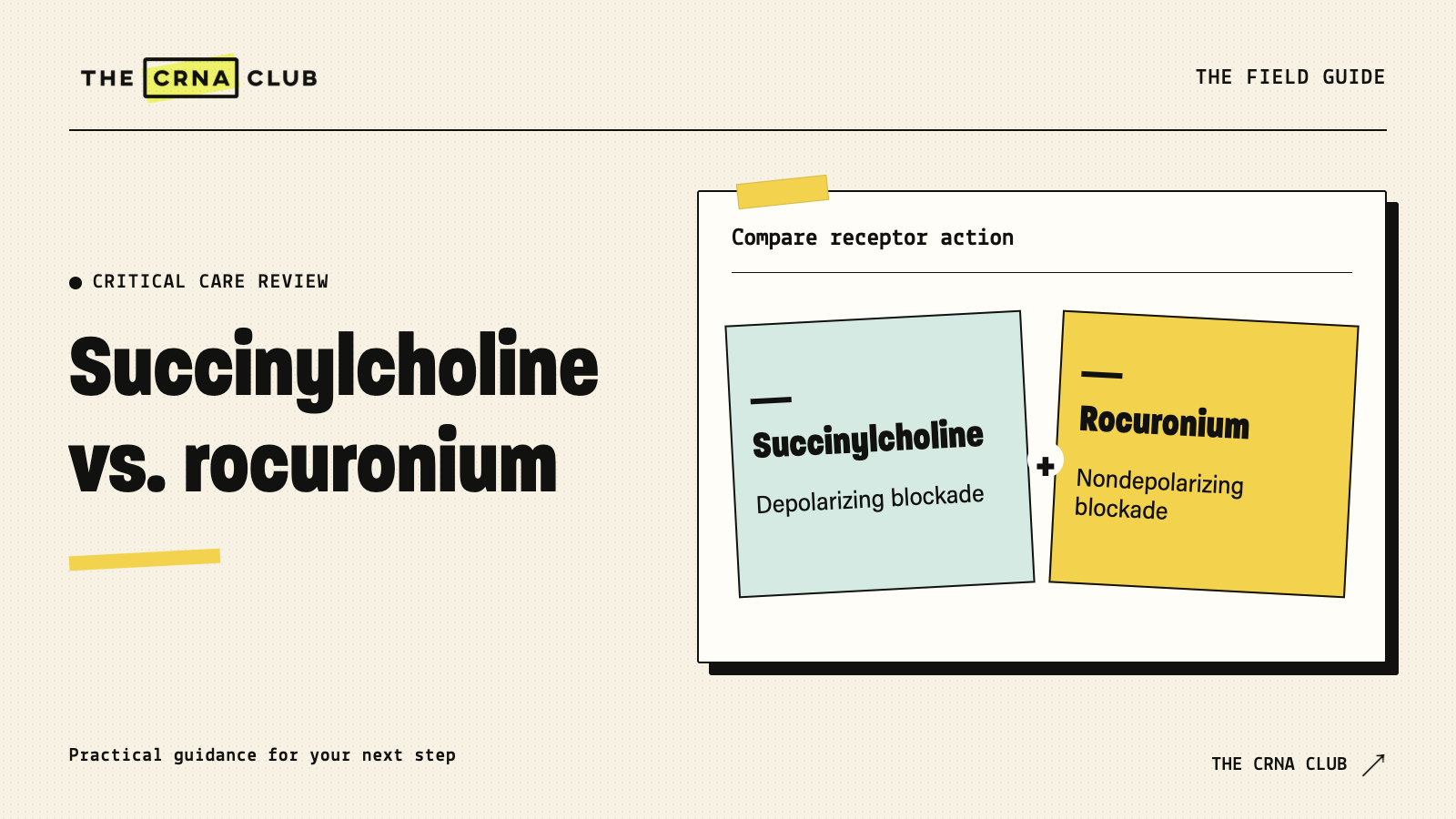
Succinylcholine activates muscle nicotinic receptors and causes a depolarizing block. Rocuronium competes with acetylcholine at those receptors without activating them. That difference matters for how the block works and how it can be reversed.
Sachi, CRNA
CRNA
In This Article (9 sections)
- What normally happens at the neuromuscular junction?
- How does succinylcholine work?
- How does rocuronium work?
- Which differences should you be able to explain?
- Why does succinylcholine raise concern in burns or denervation?
- How do reversal and recovery differ?
- What would a useful interview answer sound like?
- Our Final Thoughts
- Study the drugs you need to explain
For CRNA interview preparation, we suggest the Pharmacology lessons in The CRNA Club learning library. Work through the receptor explanation, then practice saying what it changes for your patient. Try the full platform free for seven days, including the learning library and interview tools.
What normally happens at the neuromuscular junction?
A motor nerve releases acetylcholine. Acetylcholine binds nicotinic receptors on the muscle end plate, opening channels and depolarizing the membrane. That electrical signal leads to muscle contraction. Acetylcholinesterase breaks down acetylcholine in the synaptic space.
Now compare the two drugs at the same location. With succinylcholine, the receptor activates, but repeated normal transmission is interrupted while the drug remains effective. With rocuronium, acetylcholine loses access to enough receptors to produce normal transmission.
Both routes produce paralysis. Neither route supplies hypnosis, amnesia or analgesia. A motionless patient still needs appropriate anesthesia or sedation and pain control, with ventilation supported throughout the block.
For either drug, build the plan around:
- How you will maintain oxygenation and ventilation.
- Adequate anesthesia or sedation and analgesia throughout paralysis.
- The patient history and contraindications affecting the drug choice.
- How you will assess recovery and respond if the airway is not secured.
How does succinylcholine work?
Succinylcholine behaves as a nicotinic receptor agonist. Initial depolarization sometimes appears as fasciculations, followed by flaccid paralysis. Plasma butyrylcholinesterase, also called pseudocholinesterase or plasma cholinesterase, normally breaks the drug down rapidly.
During the initial phase I block, the motor end plate stays depolarized. Nearby voltage-gated sodium channels remain inactivated, preventing another normal muscle action potential from propagating. That’s how activating the receptor leads to paralysis: the muscle membrane doesn’t reset for repeated normal transmission.
The US succinylcholine prescribing information describes rapid onset and a brief effect after a single IV administration. Reduced enzyme activity or certain variants prolong paralysis, so an expected short duration never replaces a rescue oxygenation plan.
We suggest learning the receptor action before memorizing onset times. The learning library’s pharmacology lessons walk through neuromuscular transmission, and the Mock Interview Lab gives you a place to practice explaining the difference aloud.
How does rocuronium work?
Rocuronium is a nondepolarizing aminosteroid neuromuscular blocker. It competes at the motor end plate and prevents acetylcholine from producing normal depolarization. Its onset depends on dose and patient factors, and its clinical effect generally lasts longer than a single dose of succinylcholine.
The FDA rocuronium label includes both routine and rapid-sequence tracheal intubation. Avoid a blanket statement such as “rocuronium is too slow for RSI.” The actual dose and circumstances determine the onset and duration.
For the wider physiological preparation, read our explanation of rapid sequence intubation, oxygen reserve and falling blood pressure.
Which differences should you be able to explain?
| Question | Succinylcholine | Rocuronium |
|---|---|---|
| Does it activate the end-plate receptor? | Yes, producing a depolarizing block | No, it competitively blocks acetylcholine |
| What happens to duration? | Usually brief after a single dose, but prolonged with reduced plasma cholinesterase activity | Usually longer, with dose, patient factors and interacting drugs affecting recovery |
| What major risks need attention? | Hyperkalemia in susceptible patients and malignant hyperthermia, among other risks | Residual paralysis and anaphylaxis, among other risks |
| Does sugammadex reverse it? | No | Yes, when appropriately selected and dosed |
| Does it provide sedation or pain relief? | No | No |
The table should help you compare mechanisms. It isn’t a complete contraindication list or a substitute for evaluating the airway and patient.
Why does succinylcholine raise concern in burns or denervation?
Receptor changes after major injury or denervation increase the risk of a dangerous potassium release. The succinylcholine label contraindicates use after the acute phase of major burns, multiple trauma, extensive skeletal-muscle denervation or upper motor neuron injury. It also lists skeletal-muscle myopathies and known or suspected malignant-hyperthermia susceptibility.
The risk depends on the condition and time course. Don’t turn this into a universal “safe until exactly this hour” rule. Check the actual injury history, metabolic findings and relevant contraindications.
Rocuronium also has important risks. In particular, longer paralysis means continued ventilatory support, adequate anesthesia and a plan to assess recovery. Choosing an alternative to succinylcholine doesn’t remove the need for preparation.
How do reversal and recovery differ?
Sugammadex binds rocuronium and reduces the amount available to act at the neuromuscular junction. Acetylcholinesterase inhibitors such as neostigmine increase acetylcholine, but their usefulness depends on the blocker and depth of recovery. Neither is routine reversal for a succinylcholine phase-I block.
Don’t assume a reversal dose proves recovery. The ASA neuromuscular-blockade guideline recommends quantitative monitoring at the adductor pollicis and a train-of-four ratio of at least 0.9 before extubation after nondepolarizing blockade.
Four visible twitches don’t establish that ratio. And adequate neuromuscular recovery still leaves the other extubation requirements to assess. Our train-of-four guide explains count, fade and ratio with worked examples.
What would a useful interview answer sound like?
Try this original question: “Why would you choose rocuronium instead of succinylcholine?”
A complete answer needs the patient context:
“I’d start with the airway plan and contraindications. Rocuronium is a nondepolarizing blocker and is an option when succinylcholine is unsuitable, such as a patient with a relevant hyperkalemia risk. I’d account for its longer effect, maintain sedation and ventilation, and plan monitoring and reversal. Access to sugammadex doesn’t replace a failed-airway plan.”
Then answer a follow-up: “Which drug sedates the patient?” Neither. Explain where each acts and why stopping muscle movement doesn’t establish unconsciousness.
At The CRNA Club, we suggest practicing the receptor, the patient consequence and the next assessment together. Use the Mock Interview Lab after reviewing the mechanism, rather than memorizing a paragraph word for word.
Our Final Thoughts
Start at the muscle end plate. Follow what each drug does there, then explain duration, risks and recovery. Your answer gets much more useful when you connect those differences to oxygenation, sedation and an actual airway plan.
Study the drugs you need to explain
Use the Pharmacology learning library and seven-day platform trial to review the mechanisms and practice clinical reasoning. Then rehearse your explanation with the Mock Interview Lab.