What changes on the CMC exam starting November 19, 2026?
Sachi, CRNA
CRNA
In This Article (11 sections)
- Which CMC appointments use the revised plan?
- What are the revised CMC domain weights?
- Should you replace your current books and courses?
- How should you audit your materials against the revised plan?
- How do you use the revised bibliography?
- What should change in your study calendar?
- Does a practice bank or planner already use the revised weights?
- Should you use an earlier passing score for the revised exam?
- What if you’re choosing between CMC and CSC?
- Our Final Thoughts
- Take the Next Step
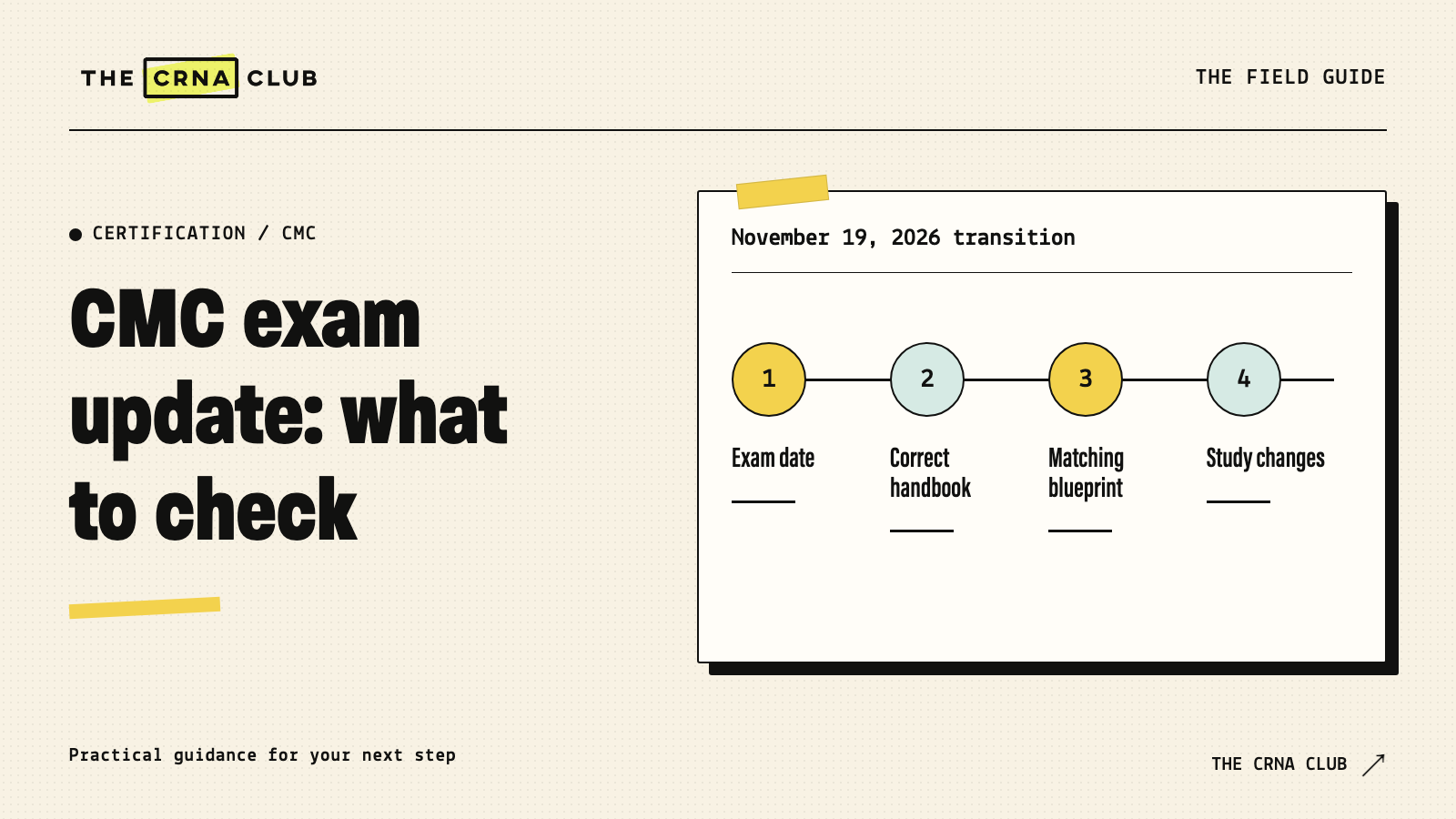
The revised CMC exam starts November 19, 2026. For that date onward, the plan assigns 21% to cardiovascular conditions, 21% to noncardiovascular conditions, 44% to therapeutic interventions and 14% to monitoring and diagnostics. Use the version matching your appointment.
Keep useful explanations you’ve already studied. Then compare coverage with the revised outline. Our CMC Review, questions and planner in CRNA Club membership help you work through the topics you still need. Use the official percentages to check your plan rather than assuming a tool’s settings confirm the new weighting.
A revision gives you a reason to review what is missing. It doesn’t mean you have to throw away every book and start over.
Which CMC appointments use the revised plan?
Appointments on and after November 19, 2026, use the revised examination. Earlier appointments need the official plan applying before that date. The relevant date is when you take the examination, so check it again if you change an appointment across the transition.
AACN announced the revision on August 19, 2026. Its notice links the revised plans and references and explains the update follows the 2025 study of practice.
Consider two hypothetical appointments: November 18 and November 19. They sit one day apart but fall on different sides of the published effective date. A resource audit or study schedule needs to identify which one applies.
Write your appointment and the applicable plan version together. If you are still choosing a date, keep the distinction visible while deciding instead of combining both outlines into an unexplained master list.
What are the revised CMC domain weights?
The revised plan assigns forty-four percent to therapeutic interventions, with the remaining scope divided among cardiovascular conditions, noncardiovascular conditions, and monitoring and diagnostics. Use the percentages to understand coverage emphasis, then adjust personal study time around the gaps you actually have.
The official revised CMC test plan gives the exact outline:
| Domain for appointments on or after November 19, 2026 | Weight |
|---|---|
| Cardiovascular conditions | 21 percent |
| Noncardiovascular conditions | 21 percent |
| Therapeutic interventions | 44 percent |
| Monitoring and diagnostics | 14 percent |
The table describes examination content. It doesn’t validate a rule that every learner should spend exactly those percentages of study time. A large unfamiliar gap sometimes needs more attention than its weight alone suggests.
Read the topic details under each area too. A domain heading is a starting point for your audit, not the entire scope you need to review.
Should you replace your current books and courses?
No automatic replacement follows from the revision. AACN explicitly says current CMC and CSC study materials remain relevant and useful for the revised examinations. Audit what you own, keep accurate explanations and add targeted teaching where coverage or understanding is incomplete.
Say your book has clear physiology explanations and an older exam table. Keep the teaching and use the revised AACN outline for scope. If another section leaves you with only a definition you don’t understand, choose a fuller lesson for that topic.
A different resource leaves several topics unexplained. That creates a teaching gap worth addressing, regardless of the publication year on the cover.
Try the actual explanation before deciding what to replace. If a CMC lesson helps you understand a difficult connection, use it. If your existing source already does, keep it. The date on the cover is useful information, but it won’t tell you what you learned.
Our CCRN overview provides broader foundation context if you are building from that credential. Use CMC’s applicable official scope for the next examination.
How should you audit your materials against the revised plan?
Locate the teaching for each relevant topic, record what remains unclear and assign a source or study task for the gap. Work through the audit while learning so it doesn’t become a large administrative project preventing you from opening the material.
Use an original worksheet:
-
Official topic: Exact topic from the applicable plan.
-
Existing source: Lesson, chapter or credible reference location.
-
Current understanding: What you explain independently now.
-
Missing connection: The specific part still unclear.
-
Supplement: Teaching or reference you will use.
-
Later check: A changed example or unfamiliar practice appointment.
Start with a brief whole-outline review to catch large omissions, then complete the detail in manageable blocks. Search related terminology before declaring a topic absent from an older resource.
When an explanation conflicts with current clinical evidence, investigate the exact discrepancy. Don’t decide by counting how many study posts repeat one version.
How do you use the revised bibliography?
Use it to locate credible follow-up reading for topics you need to understand more deeply. The bibliography identifies references supporting examination development. It doesn’t require you to purchase every title or read the full list before testing.
The CMC bibliography effective November 19, 2026 belongs beside the revised plan when you need a targeted source.
If a short rationale leaves you confused, use the relevant CMC lesson and check the reference section when you need more detail. Then close it and explain the concept yourself. The bibliography is there to help you answer a question, rather than create a shopping list you must finish.
Read the section because it answers your question. If you’re collecting books without using them to understand a topic, stop adding to the list and work through the first explanation you need.
Check legitimate institutional or library access where available before buying another large reference for a narrow question.
What should change in your study calendar?
Replace old planning facts with the applicable version, check whether all domains received attention and give unresolved topics realistic blocks. Keep time for teaching and explanation review alongside practice. A larger intervention weight doesn’t mean every other area should disappear from the calendar.
If you’ve spent recent weeks on familiar acute cardiac cases, look at the noncardiovascular and monitoring topics you’ve left out. Choose the relevant lessons and put them on the calendar. The revised outline helps you spot the gap. The next session needs to teach it.
Another nurse already has broad coverage but needs deeper intervention reasoning. That learner changes the task within the existing calendar rather than starting the entire preparation again.
Start with your real workdays and usable study blocks in the planner. Then assign the particular CMC topics your review identified. Keep enough time for explanations and practice review so checking the new outline leads to actual studying.
Does a practice bank or planner already use the revised weights?
Check the resource’s current information and compare the resulting practice or calendar with the applicable official outline. Don’t assume an upcoming revision has already changed every product’s practice settings. A tool helps with organization and learning, while the official plan defines the version you need.
Use the same standard for free and paid resources. If alignment isn’t clear, ask the resource owner what is supported and use the official document to guide your own coverage check.
Also keep practice performance in context. A percentage on a familiar set doesn’t become a guaranteed examination prediction because the resource mentions a revised plan.
Try our CMC teaching, questions and planning through the seven-day membership trial. Bring one gap from your coverage check. Work through its lesson and practice, with the AACN outline for your date beside the calendar. You’re using the product for learning while checking exam scope against the official source.
Should you use an earlier passing score for the revised exam?
Use the current official score information for the examination version and date relevant to you. Don’t project a previously published CMC cut score beyond the revision without AACN confirmation. A raw examination standard also doesn’t establish a universal readiness percentage for a separate practice product.
Check AACN’s exam statistics and cut-score page before using a number in your plan. As of November 3, the revised examination has not launched, so a post-launch value needs a fresh check.
The practical study task remains understanding the applicable scope and resolving gaps. A guessed future threshold doesn’t improve that work.
What if you’re choosing between CMC and CSC?
Check the actual eligibility and clinical scope for each before comparing study plans. Both have a November 19 revision, but they are different credentials. One revised outline doesn’t replace the other, and a shared date doesn’t mean their questions or preparation needs are interchangeable.
Our certifications-beyond-CCRN guide gives broader context. Keep the decision tied to your actual practice and the current official requirements.
For a concrete transition check, suppose your appointment moves from November 18 to November 20. Update the version at the top of the audit, compare the calendar with the revised outline and identify any additional coverage check needed. You don’t automatically erase completed learning or restart every resource. You also don’t leave an earlier planning table in charge of the new appointment. Record the changed date and the specific adjustments, then return to the learning tasks that remain useful.
Our Final Thoughts
Match the date, update the planning facts and keep useful teaching. The revision deserves a careful coverage check, with specific follow-up learning. It doesn’t require an anxious rebuild of every resource you own or a guess about future cut scores.
Take the Next Step
Use the seven-day membership trial for CMC review, questions and planning together. Or start with the free certification planner for one lifetime free plan. Compare the final calendar with the official plan applying to your appointment.