What changes on the CSC exam starting November 19, 2026?
Sachi, CRNA
CRNA
In This Article (9 sections)
- Which date determines your CSC test plan?
- What are the revised CSC domain weights?
- How do you compare the new outline with resources you already own?
- Should you replace your entire study calendar?
- What happens to the CSC passing score after the revision?
- What should you do if you’re studying for CMC too?
- What should your revision checklist contain?
- Our Final Thoughts
- Take the Next Step
The revised CSC exam starts November 19, 2026, with procedures at 9%, complications at 37%, therapeutic interventions at 43%, and monitoring and diagnostics at 11%. We suggest using our CSC planner and questions to organize the review, with shared cardiac lessons where you need a refresher. You can explore them through the seven-day membership trial, keeping the revised AACN outline beside your schedule.
You don’t need to panic-buy a new resource set because the exam changes. AACN says existing CMC and CSC study materials remain relevant and useful. The useful work is checking coverage, updating date-sensitive facts and giving unfamiliar topics enough time.
If you’ve already been studying, keep the explanations you understand. Compare the new topic list with what you’ve covered, then add the unfinished areas to your planner. You don’t have to restart every lesson because your appointment falls after November 19.
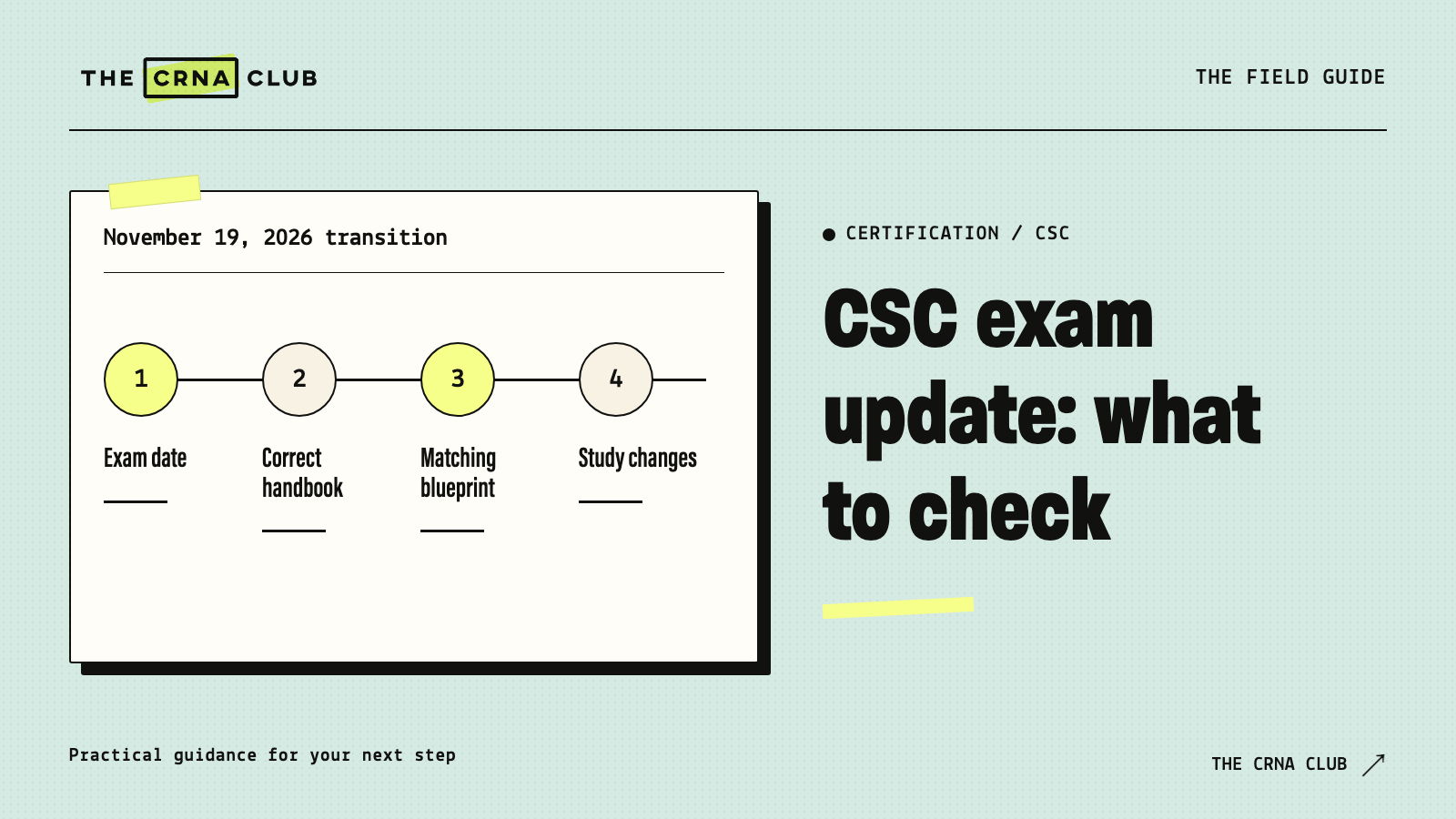
Which date determines your CSC test plan?
Use the date you take the exam. If it’s November 19, 2026 or later, you need the revised plan. It doesn’t matter when you bought your book or started studying. If you move the appointment across that date, update the outline before planning the next sessions.
Write the appointment date at the top of your study checklist. Then label the outline version underneath it. If you haven’t booked, record the intended date as tentative so you remember to confirm the version later.
A hypothetical nurse planning to test November 17 needs the applicable earlier plan. If she moves the exam to November 24, she should compare her checklist with the revised outline. The material she already understands still has value, but the version check needs to change.
Don’t assume a rescheduling email updates your notebook automatically. Treat the outline review as one item in the appointment-change task. Keep the confirmation and current official documents together so you aren’t switching between old screenshots while studying.
If any scheduling detail is unclear, use the current handbook and AACN’s assistance rather than guessing from another candidate’s experience. The change date is specific, and your preparation should use the same date consistently.
What are the revised CSC domain weights?
The revised plan assigns 9% to procedures, 37% to complications, 43% to therapeutic interventions and 11% to monitoring and diagnostics. These percentages describe the exam structure. They help you check study balance, but they don’t require you to assign identical percentages of study time regardless of your starting knowledge.
Use the official CSC test plan for the full item-level outline:
| Revised domain | Weight | Personal review question |
|---|---|---|
| Procedures | 9% | Which listed operations or interventions do I rarely encounter? |
| Complications | 37% | Which postoperative problems can’t I explain confidently? |
| Therapeutic interventions | 43% | Do I understand the purpose, response and risks of listed treatments? |
| Monitoring and diagnostics | 11% | Can I connect results and measurement limits with the patient? |
Don’t turn 9% into permission to skip procedures. Understanding what happened during an operation also supports your interpretation of postoperative care. At the same time, don’t let a familiar procedure chapter absorb every study block while a larger domain remains untouched.
The outline also lists testable nursing actions. Read those pages alongside the content list. A named topic and the way you apply it belong together. Your checklist should include explanation and practice, rather than only the date you watched a video.
How do you compare the new outline with resources you already own?
Compare the actual topics and explanations, rather than deciding from a resource’s publication date alone. Keep accurate material, flag missing coverage and update exam-specific introductions separately. A chapter that teaches a mechanism well might remain useful even if its opening page uses an older exam percentage.
Start with one main resource and the revised outline. For each item, write the chapter, lesson or reference section you would use. Leave a blank when you don’t have a source. Then distinguish a coverage gap from a learning gap.
Is the topic missing from your material, or have you read it and still don’t understand it? Those need different next steps. Find a source for a missing topic. For an explanation you haven’t understood, try the matching lesson or work through a case slowly enough to find the step that’s confusing.
- You already have an accurate explanation: Keep it and practice applying it.
- The topic appears but the explanation is too brief: Add targeted reference reading.
- The topic is absent: Find a suitable source for that item.
- The introduction has old exam facts: Replace them with current official information.
- Several overlapping resources remain unused: Choose a primary source and simplify.
Our postoperative chest-drainage article is an example of focused teaching you might retain for a specific gap. It doesn’t become complete CSC coverage because it addresses one relevant postoperative problem.
If the outline comparison reveals a cardiac foundation you need to revisit, our learning library and CMC Review offer teaching for those concepts. Explore the lessons alongside CSC quiz questions and planning tools with the seven-day membership trial, then keep your surgical reading tied to the revised outline.
Should you replace your entire study calendar?
Revise the calendar where the outline comparison shows unfinished work, while preserving useful sessions you’ve already completed. Start with your actual remaining hours and specific gaps. Weighting helps you notice imbalance, but your weakest unfamiliar topics may need more time than a simple percentage calculation would assign.
Suppose a hypothetical nurse has 16 realistic study hours left before an intended appointment. Multiplying the hours by domain percentages would produce about 1.4 hours for procedures and 6.9 for therapeutic interventions. That arithmetic is a rough planning illustration, not an AACN-recommended schedule.
If the nurse has never studied a listed procedure, the 1.4-hour estimate might be inadequate. If she already understands a particular intervention well, repeating it for hours may be a poor use of time. Review the actual tasks before assigning the blocks.
Name the actual work in your planner: read about a procedure, explain a complication, try mixed CSC questions, then revisit what you missed. The percentage helps you keep the whole outline in view. How long you spend on one topic depends on what you already understand.
If the remaining work doesn’t fit, reconsider the appointment rather than compressing the schedule by removing sleep or skipping untouched topics. Check current rescheduling rules before changing a booking.
What happens to the CSC passing score after the revision?
Use the official published cut score applicable to your exam date and recheck it after the revision. As of November 3, 2026, AACN lists 55 correct answers among 75 scored CSC items within a 90-item exam. This pre-launch figure should not be projected beyond the revision without official confirmation.
AACN’s cut-score page distinguishes the raw passing score from the proportion of candidates who pass. Keep both separate from a practice-bank percentage.
Don’t assume a revised blueprint makes the exam easier or harder for you. The announcement doesn’t give you a personal outcome prediction. Your background and preparation still affect which content feels unfamiliar.
If a study product advertises a readiness percentage, ask what the claim actually supports. An arithmetic comparison with the official raw cutoff doesn’t prove equivalent difficulty. Use question results to identify gaps and test new explanations rather than treating a percentage as a promise.
Keep a note to check the official score source before the exam. Once you have the current information, return to studying. Repeatedly refreshing the page doesn’t improve understanding of postoperative care.
What should you do if you’re studying for CMC too?
Maintain a separate version label and coverage list for each exam, even when the appointments are close together. CMC and CSC both change on November 19, 2026, but their outlines and weights differ. Shared physiology helps with study, while each exam still needs its own gap review.
Put shared foundations in one section of your notebook and keep distinct applications underneath the relevant credential. A mechanism explanation might serve both. A surgery-specific procedure or complication still needs a separate task if it falls outside your experience.
Don’t use the CMC weights to schedule CSC review. Don’t average practice scores from the two banks into one readiness number. The separate lists make it easier to see where combined preparation saves time and where it leaves work unfinished.
Our hemodynamics explanation supports one shared foundation. Use it for the measurement or physiologic question it answers, then return to the applicable exam context. The topic overlap doesn’t erase the difference between medicine and surgical care.
What should your revision checklist contain?
Keep the checklist short: your date, the right outline, what you’ve studied, and what you need to learn next. We suggest choosing the next three unfinished topics and giving them actual sessions in the CSC planner. Then use questions to see where your explanation still needs work.
Finish these tasks in order: confirm the intended date, save the applicable official outline, compare existing coverage, schedule specific gaps and check current administrative and scoring information. Mark only completed work as completed.
If your materials still have useful explanations, keep using them. Add sources where a gap is real. A carefully updated plan is usually easier to follow than an entirely new collection assembled out of worry.
Our Final Thoughts
The date change calls for an outline check and a thoughtful plan. Keep what teaches accurately, correct the facts tied to the old version, and make the unfamiliar topics visible.
You don’t have to start from zero. You do need to know which exam you’re preparing for and what work remains before you take it.
Take the Next Step
Try our seven-day membership trial for CSC questions, planning and shared cardiac lessons. Start with one topic your outline check showed you haven’t covered. Use the planner for the calendar, then compare its topic list with the revised AACN outline and add or reprioritize missing work. Don’t assume generating a calendar updates it to the November blueprint.