What does the current CCRN score report tell me about my weak areas?
Sachi, CRNA
CRNA
In This Article (10 sections)
- What does the report help you identify?
- Why do domain percentages need context?
- How do you connect a report area with the current blueprint?
- What would a worked report-to-study map look like?
- What should you do when the report conflicts with your practice average?
- How should you allocate time after reading the report?
- What should stay separate from domain interpretation?
- How do you know whether the interpretation led to useful study?
- Our Final Thoughts
- Take the Next Step
Use your CCRN score report to choose where to investigate, then turn the broad area into a specific study task. The report won’t tell you every concept you missed. Compare it with the current outline and your own explanations to find the starting point.
We suggest using our CCRN Toolkit for the next step: a video lesson on the concept you need, practice to check it and a planner for the later review. Choose those tasks yourself from the report. You don’t need to restart the whole course because one area was weaker.
Let’s turn “review this domain” into something you know how to begin in your next session.
What does the report help you identify?
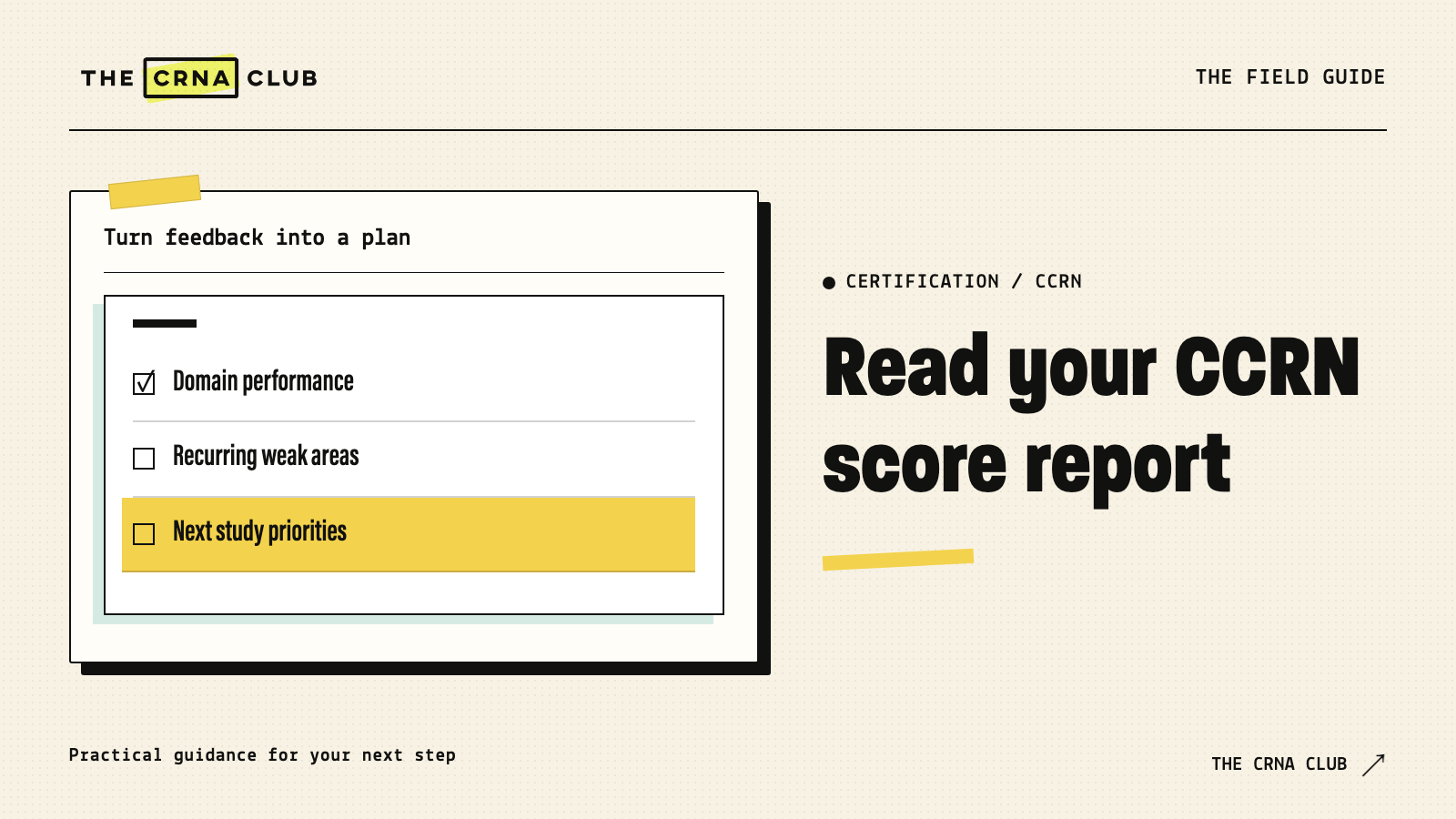
It helps you locate broad performance areas to review. Use the labels and information on your actual report, then check the applicable current test plan. The report describes one examination performance. It doesn’t independently list every missing concept or establish the cause of every error.
AACN’s preparation guidance directs retesting candidates to the report and the outline when choosing study emphasis. It also advises keeping other areas in view rather than focusing so narrowly that lower-performing topics elsewhere disappear.
Start by writing the result exactly as presented. Don’t convert it into a different scale or force it into an older resource’s domain table.
Then add a separate column for your questions about learning. Keeping observed result and interpretation apart helps you see where the report ends and your next investigation begins.
Why do domain percentages need context?
A percentage doesn’t tell you the number of items behind it unless that information is supplied. Small samples change sharply with individual answers, and domains have different roles in the outline. Use the report to guide review without treating every percentage as equally precise or directly additive.
Let’s use simple hypothetical numbers. Four correct out of ten is forty percent. Two correct out of five is also forty percent. The percentages match, but the underlying counts differ. So a percentage alone won’t tell you how many items were involved.
Those are hypothetical numbers, not a representation of your CCRN report or official domain item counts. They show why a percentage alone doesn’t answer how many items changed or how much total performance would move.
Don’t add domain percentages together or average them casually to recreate a total. Use the actual scoring information the report and official documents provide. If the format is unclear, seek official clarification rather than inventing a calculation.
How do you connect a report area with the current blueprint?
Find the corresponding area in the applicable official plan and review its scope. Then identify which topics you explain well and which remain uncertain. A broad weak area often contains several different learning needs, so don’t translate its label into an instruction to reread an entire resource without checking.
The current adult CCRN test plan gives the applicable scope for that population. Use the appropriate official plan if your examination concerns another population.
For each broad area needing attention, select a manageable starting topic. Explain it without notes or answer choices, then compare with a credible source. If the explanation is clear, move to another topic. If it breaks down, record the specific connection.
This process doesn’t identify actual examination items. You are reviewing the published outline, which is the appropriate source for your preparation scope.
What would a worked report-to-study map look like?
Separate the broad observation, the question it raises, the evidence you will examine and the next task. This gives the report a practical role without pretending it contains a detailed diagnosis. The exact categories and values in the example below are hypothetical study labels, not an official report reproduction.
| Broad observation | Question to investigate | What I check | Learning task |
|---|---|---|---|
| Cardiovascular review is needed | Do I confuse cardiac output with cardiac index? | Explain CO/BSA with units and try changed numbers | Review the hemodynamics explanation, then check a new example |
| Respiratory review seems stronger | Can I explain the acid-base problem without choices? | Brief retrieval and unfamiliar practice | Keep a later check instead of spending every block here |
| Professional-practice result surprises me | Did I choose kind-sounding answers without identifying the need? | Current outline, ethics teaching and a new scenario | Explain the patient’s need and why an action addresses it |
| Overall result raises timing concerns | Where did I spend time? | General pace observations | Practice the specific reading or pacing issue |
Say the broad report label worries you. Open that part of the outline and try explaining a few topics. Some make sense. Another is something you’ve avoided. Start with the missing explanation. The report gave you the area, and your self-check gave you the lesson to choose.
What should you do when the report conflicts with your practice average?
Check whether the practice material was familiar, how topics were selected and what conditions shaped the average. A commercial practice result and official examination performance don’t measure identical sets under identical conditions. Treat the discrepancy as an investigation rather than proof one number must be meaningless.
If your practice average came from repeating the same bank, try unfamiliar examples in the reported area. Cover the answers and explain your reasoning. You might discover you’ve been recognizing old choices without understanding why. That’s a useful reason to return to teaching.
Another nurse’s practice record contains varied conditions and several interrupted sessions. The average combines unlike tasks, making a direct comparison difficult.
Keep the session context beside future scores. Topic mix, familiarity, timing and uncertain answers help you interpret results more accurately than a single running average.
Our CCRN overview gives broader preparation context. Keep the official report and personal practice record distinct while using both to guide the next learning task.
How should you allocate time after reading the report?
Consider the applicable outline, the breadth of each gap and the time needed to address it. Give weak areas meaningful attention while preserving periodic broader review. The lowest percentage doesn’t automatically deserve every remaining study block, especially when several areas require different kinds of learning.
Use the month-to-week planning approach from our certification material:
- Mark actual workdays.
- Mark available study days.
- Assign a specific topic or task to each usable block.
Put a focused lesson, a later recall check and unfamiliar practice in this week’s plan. Keep some mixed review too. If the lesson still leaves a step unclear, change the next task to that specific step rather than adding more attempts on the same material.
Don’t schedule only questions. A report-guided plan needs time to investigate the areas the questions reveal. Otherwise the map ends in another list of unfinished learning needs.
For your first appointment, choose one topic in the area and explain it without notes. Find where the explanation stops and use the relevant CCRN lesson. In your second appointment, explain it again and try a different example. If you’re still stuck, ask a focused question about that step. You now have a study task much clearer than the original domain label.
What should stay separate from domain interpretation?
Keep official pass standards, retake policies and school document requirements as separate checks. A domain result doesn’t establish how a CRNA program weighs your report, and a certification cut score doesn’t create a universal practice threshold. Use the responsible official source for each question.
AACN’s exam statistics and cut-score page gives current examination standards. Your actual score report supplies the result for that attempt.
If a program requests the numerical report, follow its current instructions. Don’t infer an unpublished admissions cutoff from a weak domain percentage or assume a certificate substitutes for a report when the application names the report.
Our CCRN application strategy guide helps frame those separate program-policy questions. Keep them outside the learning calculations you are making here.
How do you know whether the interpretation led to useful study?
Look for a specific change in understanding after the assigned task. You should explain a concept you previously couldn’t, apply it to a different example or identify a smaller remaining question. The report has helped when it changes what happens in a study session.
If the next task remains “review everything,” make the starting point more specific. If you repeat a topic without improving, try another explanation or ask an educator to examine the exact missing connection.
Try our CCRN video review, questions and planner through the seven-day membership trial. Bring one topic from your report and use it to choose the first lesson. After practice, schedule the part needing another pass. The tools help you do the follow-up work the report points toward.
Our Final Thoughts
Read the report for what it provides, then add the investigation it still needs. Keep percentages in context, use the current outline and turn broad areas into specific learning. Your next session should have a clearer job than it had before opening the report.
Take the Next Step
Use the free certification planner to schedule the gaps you identified. It includes one lifetime free plan. Bring the actual report areas and specific follow-up topics so the calendar includes both teaching and later application.