What is a passing CMC score, and how should you use practice-test results?
Sachi, CRNA
CRNA
In This Article (8 sections)
- What does the CMC passing score measure?
- Why doesn’t 50 out of 75 create a practice-bank readiness rule?
- What should you record beside each practice score?
- How should you review content coverage alongside accuracy?
- What if your score improves but your reasoning still feels uncertain?
- When should practice results affect your exam date?
- Our Final Thoughts
- Take the Next Step
As of November 3, 2026, AACN lists the CMC passing score as 50 correct answers out of 75 scored questions, within a 90-question exam. That doesn’t make 67% on a practice bank a pass prediction. We suggest using our CMC questions to find what you need to learn, then CMC Review and the planner to work on it. All three are available through the seven-day membership trial.
It is easy to see a practice result and immediately compare it with somebody else’s score. A percentage doesn’t tell you whether the questions were new, whether you guessed, or whether the set covered the whole test plan.
Start with AACN’s official cut-score page. CMC and CSC revised exams launch November 19, 2026. Recheck the published score information for an appointment on or after the transition rather than assuming today’s listed cutoff applies unchanged.
What does the CMC passing score measure?
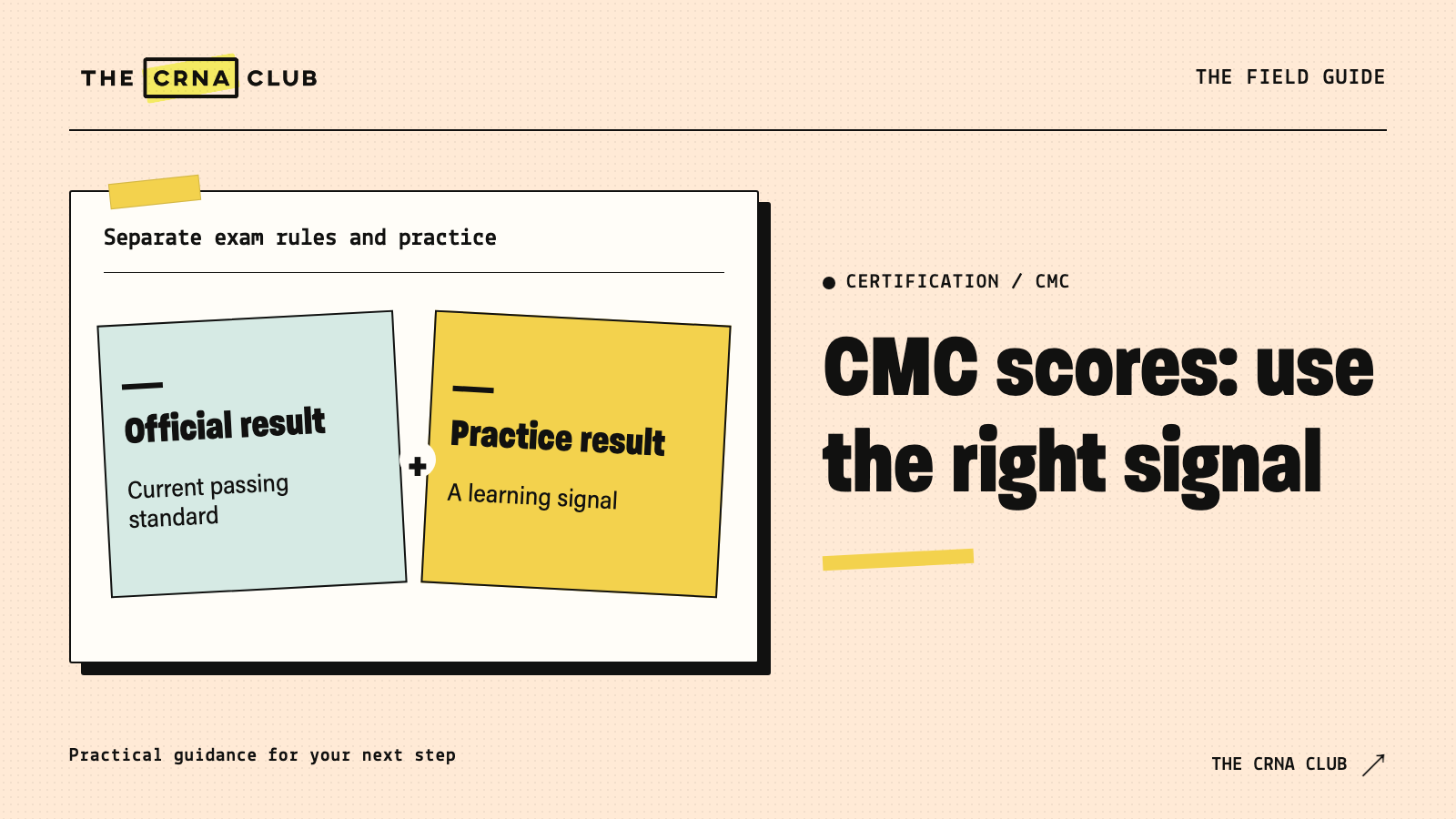
The passing score tells you how many scored questions you need to answer correctly on the exam. A pass rate tells you how a group of candidates did. Your practice percentage tells you how you did on that set. Those are three different numbers, and they answer three different questions.
Use this small reference table:
| Number | What it describes | What it doesn’t tell you |
|---|---|---|
| 90 total items | The currently listed CMC exam item count | How many items a study bank should contain |
| 75 scored items | The items used for the listed raw-score calculation | Which items on your exam are unscored |
| 50 correct scored answers | The cut score listed as of November 3, 2026 | A universal practice-bank target |
| Candidate pass rate | The proportion of a specified candidate group who passed | Your personal probability of passing |
You won’t improve your preparation by trying to identify unscored exam questions. Treat each item as deserving your best answer. Use your study time to improve understanding across the outline.
If a preparation explanation uses a different figure, check its date and the official source. An older screenshot might have been accurate when created. It still needs to match your booked exam before you use it for planning.
Why doesn’t 50 out of 75 create a practice-bank readiness rule?
A raw exam cutoff doesn’t validate the questions in a separate study bank or make their difficulty equivalent. Practice sets differ in content, wording, item selection and how often you’ve seen them. Use practice results to identify learning needs rather than converting a percentage into a promised exam outcome.
Divide 50 by 75 and you get about 66.7%. Does that mean you’re ready if you get 67% in a practice bank? No. The bank uses different questions, and you may have seen some of them already. Use that result to decide what to review next.
Imagine two hypothetical nurses each scoring 75% on a practice set. One completed new mixed questions without notes. The other repeated a familiar set after reading the rationales. Both percentages are accurate descriptions of those attempts. They answer different questions about the preparation.
You don’t need to discount every encouraging result. Record what produced it. A result becomes more useful when you know the set size, topic coverage, whether questions were new and whether the reasoning was clear.
Avoid chasing a universal percentage from online discussions. A threshold someone used for reassurance is their personal rule unless the exam organization has validated it for that specific tool and purpose. Your study plan deserves more useful feedback than a borrowed number.
What should you record beside each practice score?
Write down whether the questions were new, whether you used notes, and what the set covered. Then mark answers you guessed. We suggest reviewing those guesses along with the misses. A correct guess raises your percentage, but you still need to learn why that answer fits.
Use a worksheet with enough detail to guide a decision:
- Date and set: Monday, 30 mixed questions.
- Exposure: First attempt, no notes.
- Result: 21 correct out of 30.
- Uncertain correct answers: Four.
- Main errors: Drug mechanism, test interpretation and one misread stem.
- Next task: Review the two mechanisms and explain a new diagnostic case.
The percentage is 70%, but the four uncertain correct responses deserve attention too. They show explanations you haven’t demonstrated confidently. Don’t subtract them to invent another official score. Use them as a separate review list.
Keep the notes brief. If logging takes longer than reviewing the material, simplify it. You need enough information to understand the result, not a complicated spreadsheet you won’t maintain after a work shift.
After the review, use unfamiliar questions later. A higher score on the exact same items immediately afterward mainly shows you retained the recent explanations. That’s useful for learning, but it is a different checkpoint from transfer to new questions.
How should you review content coverage alongside accuracy?
Compare your practice history with the entire applicable outline. A high average built from familiar topics leaves untested areas unresolved. Keep a separate coverage checklist so you see both what you’ve studied and how well you explain it. Give untouched topics a place on the calendar before repeating your strongest section again.
AACN’s revised CMC test plan provides the content map for exams taken on or after November 19, 2026. Use the correct version for an earlier appointment. The outline, rather than your favorite question category, defines the breadth of the exam.
Put the actual AACN topics beside your CMC lessons and practice notes. After a lesson, close it and explain one example. Could you do it? If not, write the missing step. That’s the part to review before the next question set, even if you’ve already checked off the video.
For instance, strong rhythm scores don’t tell you whether you’ve reviewed noncardiac conditions in the cardiac patient. If your normal work gives you frequent exposure to one topic, your calendar should also protect time for the unfamiliar topics.
Our hemodynamics and perfusion article helps with a focused knowledge gap. Our certification planning guide places exam preparation alongside your broader application work. Neither substitutes for a full coverage check.
What if your score improves but your reasoning still feels uncertain?
Treat the uncertainty as information and identify the explanation you can’t give. A rising score is encouraging, but familiar wording, lucky guesses or a narrow topic mix might contribute. Check understanding with an unfamiliar case, delayed recall and a short explanation of why the other options fit less well.
Suppose you repeatedly choose the correct medication because its name has become familiar. Ask what the drug changes physiologically and which patient finding influenced your choice. If the answer is unclear, revisit that mechanism before adding another large set of questions.
If you understand the mechanism but overlook patient details, practice reading the stem slowly enough to identify the requested task. Is it asking for a likely cause, an assessment or an intervention? A correct fact used for the wrong question still produces a poor answer.
Keep those error types distinct in your notes. The mechanism gap needs teaching. The reading error needs a changed approach to the stem. Repeating a chapter from the beginning doesn’t automatically fix either problem.
And leave room for ordinary variation. One unusually good or bad set shouldn’t decide the entire plan. Look at the pattern of your work and the content you still haven’t checked, then choose the next specific task.
If your error log keeps returning to the same cardiac mechanism, our CMC Review includes lessons to help work through the explanation. Explore those lessons and quiz questions with the seven-day membership trial, then see whether the reasoning transfers to unfamiliar practice.
When should practice results affect your exam date?
Use practice results as one part of a broader scheduling decision. Consider unfinished content, unresolved reasoning gaps, study time available and the administrative rules for changing the appointment. A repeated-bank percentage alone is a weak reason either to rush into an exam or postpone indefinitely.
Write a short appointment review: the outline you are using, the areas still untouched, the explanations you still miss and the realistic sessions remaining. If major content remains uncovered, acknowledge the work. If the outline is covered and fresh practice is becoming more consistent, avoid reopening every accurate note out of anxiety.
The November transition adds one practical check. An appointment change across November 19 changes which outline you need to use. AACN’s revision announcement explains the date and says existing materials remain useful. Compare coverage rather than assuming every resource needs replacement.
Use this review to choose your next study session and reconsider the date when needed. Your starting knowledge and available time matter more than how quickly someone else finished their preparation.
Our Final Thoughts
The official passing score answers a specific scoring question. Your practice work should answer a learning question: what do you understand, and what needs another pass?
Keep the percentage, but give it context. An honest record of new questions, uncertain answers and unfinished topics will help you more than a number you keep checking for reassurance.
Take the Next Step
Try our seven-day membership trial and use a CMC question set to choose your next review topic. Open the matching CMC lesson, explain the concept, and add a later practice session to the planner. For a calendar-first start, the free certification planner includes one lifetime free plan.